Refine search
Actions for selected content:
26076 results in Abstract analysis
On the fundamental group of a Lie semigroup
-
- Journal:
- Glasgow Mathematical Journal / Volume 34 / Issue 3 / September 1992
- Published online by Cambridge University Press:
- 18 May 2009, pp. 379-394
-
- Article
-
- You have access
- Export citation
-
The simplest type of Lie semigroups are closed convex cones in finite dimensional vector spaces. In general one defines a Lie semigroup to be a closed subsemigroup of a Lie group which is generated by one-parameter semigroups. If W is a closed convex cone in a vector space V, then W is convex and therefore simply connected. A similar statement for Lie semigroups is false in general. There exist generating Lie semigroups in simply connected Lie groups which are not simply connected (Example 1.15). To find criteria for cases when this is true, one has to consider the homomorphism

induced by the inclusion mapping i:S→G, where S is a generating Lie semigroup in the Lie group G. Our main results concern the description of the image and the kernel of this mapping. We show that the image is the fundamental group of the largest covering group of G, into which S lifts, and that the kernel is the fundamental group of the inverse image of 5 in the universal covering group G. To get these results we construct a universal covering semigroup S of S. If j: H(S): = S ∩ S-1 →S is the inclusion mapping of the unit group of S into S, then it turns out that the kernel of the induced mapping

may be identfied with the fundamental group of the unit group H(S)of S and that its image corresponds to the intersection H(S)0 ⋂π1(S), where π1(s) is identified with a central subgroup of S.

GMJ volume 3 issue 4 Cover and Back matter
-
- Journal:
- Proceedings of the Glasgow Mathematical Association / Volume 3 / Issue 4 / July 1958
- Published online by Cambridge University Press:
- 18 May 2009, pp. b1-b2
-
- Article
-
- You have access
- Export citation
Free distributive P-algebras: a new approach†
-
- Journal:
- Glasgow Mathematical Journal / Volume 40 / Issue 3 / September 1998
- Published online by Cambridge University Press:
- 18 May 2009, pp. 333-342
-
- Article
-
- You have access
- Export citation
-
It is well known (Lee [13]) that the class of all distributive p-algebras B = Bω is a variety and that the class of all subvarieties of B forms a chain

where B-i is the trivial class, B0 is the class of Boolean algebras, and B1 is the class of Stone algebras.
On the Wielandt subgroup of infinite soluble groups
-
- Journal:
- Glasgow Mathematical Journal / Volume 32 / Issue 2 / May 1990
- Published online by Cambridge University Press:
- 18 May 2009, pp. 121-125
-
- Article
-
- You have access
- Export citation
Naturally ordered bands
-
- Journal:
- Glasgow Mathematical Journal / Volume 8 / Issue 1 / January 1967
- Published online by Cambridge University Press:
- 18 May 2009, pp. 55-58
-
- Article
-
- You have access
- Export citation
-
In the terminology of Clifford and Preston [2], a band B is a semigroup in which every element is idempotent. On such a semigroup there is a natural (partial) order relation defined by the rule

If the order relation ≧ is compatible with the multiplication in B, in the sense that e ≧ f and g ≧ h together imply that eg ≧ fh, we shall say that B is a naturally ordered band. The object of this note is to describe the structure of naturally ordered bands.
On The Closed Graph Theorem
-
- Journal:
- Proceedings of the Glasgow Mathematical Association / Volume 3 / Issue 1 / December 1956
- Published online by Cambridge University Press:
- 18 May 2009, pp. 9-12
-
- Article
-
- You have access
- Export citation
Spaces of holomorphic functions and Hilbert–Schmidt subspaces
-
- Journal:
- Glasgow Mathematical Journal / Volume 13 / Issue 2 / September 1972
- Published online by Cambridge University Press:
- 18 May 2009, pp. 102-106
-
- Article
-
- You have access
- Export citation
Inverse semigroups with certain types of partial automorphism monoids
-
- Journal:
- Glasgow Mathematical Journal / Volume 32 / Issue 2 / May 1990
- Published online by Cambridge University Press:
- 18 May 2009, pp. 189-195
-
- Article
-
- You have access
- Export citation
-
For an inverse semigroup S, the set of all isomorphisms betweeninverse subsemigroups of S is an inverse monoid under composition which is denoted by
 (S) and called the partial automorphism monoid of S. Kirkwood [7] and Libih [8] determined which groups have Clifford partial automorphism monoids. Here we investigate the structure of inverse semigroups whose partial automorphism monoids belong to certain other important classes of inverse semigroups. First of all, we describe (modulo so called “exceptional” groups) all inverse semigroups S such that (S) is completely semisimple. Secondly, for an inverse semigroup S, we find a convenient description of the greatest idempotent-separating congruence on (S), using a well-known general expression for this congruence due to Howie, and describe all those inverse semigroups whose partial automorphism monoids are fundamental.
 (S) and called the partial automorphism monoid of S. Kirkwood [7] and Libih [8] determined which groups have Clifford partial automorphism monoids. Here we investigate the structure of inverse semigroups whose partial automorphism monoids belong to certain other important classes of inverse semigroups. First of all, we describe (modulo so called “exceptional” groups) all inverse semigroups S such that
 On the classification of isotropic tensors
-
- Journal:
- Glasgow Mathematical Journal / Volume 29 / Issue 2 / July 1987
- Published online by Cambridge University Press:
- 18 May 2009, pp. 185-196
-
- Article
-
- You have access
- Export citation
Corrigendum
-
- Journal:
- Glasgow Mathematical Journal / Volume 30 / Issue 3 / September 1988
- Published online by Cambridge University Press:
- 18 May 2009, p. 368
-
- Article
-
- You have access
- Export citation
On the strongly countable-dimensionality of μ-spaces
-
- Journal:
- Glasgow Mathematical Journal / Volume 25 / Issue 1 / January 1984
- Published online by Cambridge University Press:
- 18 May 2009, pp. 13-18
-
- Article
-
- You have access
- Export citation
The KO-cohomology ring of SU (2n)/SO (2 n)
-
- Journal:
- Glasgow Mathematical Journal / Volume 39 / Issue 1 / January 1997
- Published online by Cambridge University Press:
- 18 May 2009, pp. 91-97
-
- Article
-
- You have access
- Export citation
Integral of an E-function expressed as a Sum of two E-functions
-
- Journal:
- Proceedings of the Glasgow Mathematical Association / Volume 1 / Issue 3 / September 1953
- Published online by Cambridge University Press:
- 18 May 2009, p. 118
-
- Article
-
- You have access
- Export citation
-
§ 1. Introductory. The formula to be proved is

where ρq+1 – αp+1 > 0, αr – ρq+1 > 0, r = 1,2, …, p, and p≧q + 1.
A Theorem in Operational Calculus and some Integrals involving Legendre, Bessel and E-Functions
-
- Journal:
- Proceedings of the Glasgow Mathematical Association / Volume 2 / Issue 4 / February 1956
- Published online by Cambridge University Press:
- 18 May 2009, pp. 173-179
-
- Article
-
- You have access
- Export citation
-
In this paper we prove a theorem in Operational Calculus and use it to evaluate a few infinite integrals involving Legendre, Bessel and E-functions. We write

when

and

when

(2) is a generalisation of (1) as given by Meijer [2] and it reduces to (1) when v = ±½ by virtue of the relation


On the group ring of a free product with amalgamation
-
- Journal:
- Glasgow Mathematical Journal / Volume 21 / Issue 2 / July 1980
- Published online by Cambridge University Press:
- 18 May 2009, pp. 135-138
-
- Article
-
- You have access
- Export citation
Integrals involving E-functions
-
- Journal:
- Proceedings of the Glasgow Mathematical Association / Volume 7 / Issue 4 / July 1966
- Published online by Cambridge University Press:
- 18 May 2009, pp. 174-177
-
- Article
-
- You have access
- Export citation
-
In this paper two integrals involving E-functions are evaluated in terms of E-functions. The formulae to be established are:

where n is a positive integer,


and
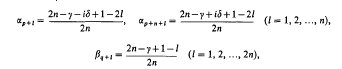
where n is a positive integer,


and
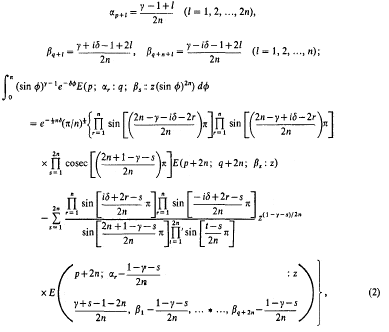
the prime and the asterisk denoting that the factor sin {(s–s)π/2n} and the parameter βq+s–βq+s + 1 are omitted. The definitions and properties of MacRobert's E-function can be found in [1, pp. 348–352] and [3, pp. 203–206].
Interpolation and inequalities for functions of exponential type: the Arens irregularity of an extremal algebra
-
- Journal:
- Glasgow Mathematical Journal / Volume 35 / Issue 3 / September 1993
- Published online by Cambridge University Press:
- 18 May 2009, pp. 325-326
-
- Article
-
- You have access
- Export citation
A note on the associated Legendre polynomials
-
- Journal:
- Proceedings of the Glasgow Mathematical Association / Volume 6 / Issue 3 / January 1964
- Published online by Cambridge University Press:
- 18 May 2009, pp. 156-160
-
- Article
-
- You have access
- Export citation
-
This paper is paper gives what appears to be a new Rodrigues’ formula for the Associated Legendre Polynomials defined by [5, p. 122]

with the restriction that m is an even positive integer, which helps to evaluate some integrals. Putting m = 2k in (1.1) and replacing Pn(x) by the Gegenbauer Polynomial
 and using [3, p. 176]
We obtain

Putting a =v–½ in the relation [4, p. 283]

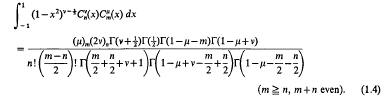
We get
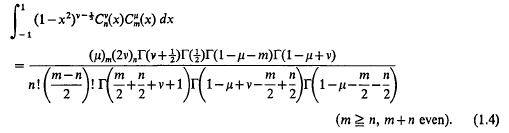
 and using [3, p. 176]
A problem in lie rings
-
- Journal:
- Glasgow Mathematical Journal / Volume 21 / Issue 2 / July 1980
- Published online by Cambridge University Press:
- 18 May 2009, pp. 139-142
-
- Article
-
- You have access
- Export citation
Integration of E-Functions with regard to their parameters
-
- Journal:
- Proceedings of the Glasgow Mathematical Association / Volume 3 / Issue 2 / June 1957
- Published online by Cambridge University Press:
- 18 May 2009, pp. 94-98
-
- Article
-
- You have access
- Export citation
