Refine search
Actions for selected content:
26072 results in Abstract analysis
A note on Noetherian orders in Artinian rings
-
- Journal:
- Glasgow Mathematical Journal / Volume 20 / Issue 2 / July 1979
- Published online by Cambridge University Press:
- 18 May 2009, pp. 125-128
-
- Article
-
- You have access
- Export citation
On the flat overrings of an integral domain
-
- Journal:
- Glasgow Mathematical Journal / Volume 12 / Issue 2 / September 1971
- Published online by Cambridge University Press:
- 18 May 2009, pp. 162-165
-
- Article
-
- You have access
- Export citation
GMJ volume 13 issue 2 Cover and Front matter
-
- Journal:
- Glasgow Mathematical Journal / Volume 13 / Issue 2 / September 1972
- Published online by Cambridge University Press:
- 18 May 2009, pp. f1-f2
-
- Article
-
- You have access
- Export citation
Unique factorisation of normal elements in non-commutative rings
-
- Journal:
- Glasgow Mathematical Journal / Volume 31 / Issue 1 / January 1989
- Published online by Cambridge University Press:
- 18 May 2009, pp. 103-113
-
- Article
-
- You have access
- Export citation
Chain conditions on posets
-
- Journal:
- Glasgow Mathematical Journal / Volume 15 / Issue 1 / March 1974
- Published online by Cambridge University Press:
- 18 May 2009, pp. 79-81
-
- Article
-
- You have access
- Export citation
On well-bounded operators of class Г
-
- Journal:
- Glasgow Mathematical Journal / Volume 24 / Issue 1 / January 1983
- Published online by Cambridge University Press:
- 18 May 2009, pp. 1-5
-
- Article
-
- You have access
- Export citation
-
Let T be a linear operator acting in a Banach space X. It has been shown by Smart [5] and Ringrose [3] that, if X is reflexive, then T is well-bounded if and only if it may be expressed in the form

where {E(λ)} is a suitable family of projections in X and the integral exists as the strong limit of Riemann sums.

Dunford-Pettis and strongly Dunford-Pettis operators on L1(μ)
-
- Journal:
- Glasgow Mathematical Journal / Volume 31 / Issue 1 / January 1989
- Published online by Cambridge University Press:
- 18 May 2009, pp. 49-57
-
- Article
-
- You have access
- Export citation
-
Motivated by a problem in mathematical economics [4] Gretsky and Ostroy have shown [5] that every positive operator T:L1[0, 1] → c0 is a Dunford-Pettis operator (i.e. T maps weakly convergent sequences to norm convergent ones), and hence that the same is true for every regular operator from L1[0, 1] to c0. In a recent paper [6] we showed the converse also holds, thereby characterizing the D–P operators by this condition. In each case the proof depends (as do so many concerning D–P operators on Ll[0, 1]) on the following well-known result (see, e.g., [2]): If μ is a finite measure, an operator T:L1(μ) → E is a D–P operator
 is compact, where i:L∞(μ) → L1(μ) is the canonical injection of L∞(μ) into L1(μ). If μ is not a finite measure this characterization of D–P operators is no longer available, and hence results based on its use (e.g. [5], [6]) do not always have straightforward extensions to the case of operators on more general L1(μ) spaces.
 is compact, where i:L
On Trace Bilinear Forms on Lie-Algebras
-
- Journal:
- Proceedings of the Glasgow Mathematical Association / Volume 4 / Issue 2 / July 1959
- Published online by Cambridge University Press:
- 18 May 2009, pp. 62-72
-
- Article
-
- You have access
- Export citation
-
To what extent is the structure of a Lie-algebra L over a field F determined by the bilinear form

on L that is derived from a matrix representation

of L with finite degree d(Δ) by forming the trace of the matrix products

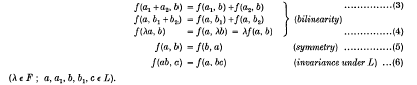
Such a bilinear form is a function with two arguments in L, values in F and the properties:

Some results on coherent rings II
-
- Journal:
- Glasgow Mathematical Journal / Volume 8 / Issue 2 / July 1967
- Published online by Cambridge University Press:
- 18 May 2009, pp. 123-126
-
- Article
-
- You have access
- Export citation
A Relation between Laplace and Hankel Transforms
-
- Journal:
- Proceedings of the Glasgow Mathematical Association / Volume 5 / Issue 3 / January 1962
- Published online by Cambridge University Press:
- 18 May 2009, pp. 114-115
-
- Article
-
- You have access
- Export citation
-
The Laplace transform of a function f(t) ∈ L(0, ∞) is defined by the equation

and its Hankel transform of order v is defined by the equation

The object of this note is to obtain a relation between the Laplace transform of tμf(t) and the Hankel transform of f(t), when ℛ(μ) > − 1. The result is stated in the form of a theorem which is then illustrated by an example.
Ranges of Lyapunov transformations for Hilbert space
-
- Journal:
- Glasgow Mathematical Journal / Volume 19 / Issue 1 / January 1978
- Published online by Cambridge University Press:
- 18 May 2009, pp. 99-101
-
- Article
-
- You have access
- Export citation
Some order properties of coverings of finite-dimensional spaces†
-
- Journal:
- Proceedings of the Glasgow Mathematical Association / Volume 4 / Issue 4 / September 1960
- Published online by Cambridge University Press:
- 18 May 2009, pp. 188-197
-
- Article
-
- You have access
- Export citation
Chapter 2 of Ramanujan's second notebook
-
- Journal:
- Glasgow Mathematical Journal / Volume 22 / Issue 2 / July 1981
- Published online by Cambridge University Press:
- 18 May 2009, pp. 199-216
-
- Article
-
- You have access
- Export citation
Small amplitude capillary-gravity waves in a channel of finite depth
-
- Journal:
- Glasgow Mathematical Journal / Volume 31 / Issue 2 / May 1989
- Published online by Cambridge University Press:
- 18 May 2009, pp. 142-160
-
- Article
-
- You have access
- Export citation
On integral equations involving Whittaker's function
-
- Journal:
- Proceedings of the Glasgow Mathematical Association / Volume 7 / Issue 3 / January 1966
- Published online by Cambridge University Press:
- 18 May 2009, pp. 125-127
-
- Article
-
- You have access
- Export citation
-
Recently some inversion integrals for integral equations involving Legendre, Chebyshev, Gegenbauer and Laguerre polynomials in the kernel have been obtained [1, 2, 3, 5, 6]. In this note, two inversion integrals for integral equations involving Whittaker's function in the kernel are obtained. We shall make use of the following known integral [4, p. 402]

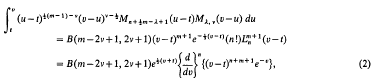
The results of this note are based on the following two integrals, which are derived from (1) by writing u – t = (v – t)x.
for m + 1 > 2v > – 1;

for m + 1 > 2v > – 1.
Further Integrals Involving E-Functions
-
- Journal:
- Proceedings of the Glasgow Mathematical Association / Volume 2 / Issue 2 / October 1954
- Published online by Cambridge University Press:
- 18 May 2009, pp. 77-84
-
- Article
-
- You have access
- Export citation
-
The formulae to be proved are
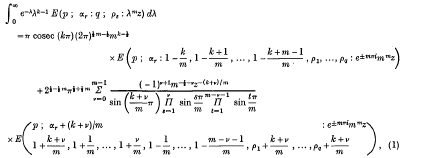
where m is a positive integer, p ≧ q + 1, R(mar + k) > 0, r = 1, 2, …, p, and | amp z |ππ. For other values of p and q the result holds if the integral is convergent.
GMJ volume 33 issue 2 Cover and Back matter
-
- Journal:
- Glasgow Mathematical Journal / Volume 33 / Issue 2 / May 1991
- Published online by Cambridge University Press:
- 18 May 2009, pp. b1-b2
-
- Article
-
- You have access
- Export citation
Uniform distribution of sequences in rings of integral quaternions
-
- Journal:
- Glasgow Mathematical Journal / Volume 23 / Issue 1 / January 1982
- Published online by Cambridge University Press:
- 18 May 2009, pp. 21-29
-
- Article
-
- You have access
- Export citation
Some recurrence relations and series for the generalised laplace transform
-
- Journal:
- Proceedings of the Glasgow Mathematical Association / Volume 4 / Issue 3 / January 1960
- Published online by Cambridge University Press:
- 18 May 2009, pp. 119-121
-
- Article
-
- You have access
- Export citation
-
The Laplace transform

has been generalised by Varma [4] by the relation

which reduces to (1.1) when k = -m + ½ by virtue of the identity

We shall define πk, m, λ (p) by the relation

The object of this paper is to obtain some recurrence formulae and series for πk, m, λ (p) and to use them to obtain recurrence formulae and series for MacRobert's E-function.
A note on Saleh's paper ‘Almost continuity implies closure continuity’†
-
- Journal:
- Glasgow Mathematical Journal / Volume 40 / Issue 3 / September 1998
- Published online by Cambridge University Press:
- 18 May 2009, p. 473
-
- Article
-
- You have access
- Export citation
