Refine search
Actions for selected content:
26075 results in Abstract analysis
A characterization of a class of barrelled sequence spaces
-
- Journal:
- Glasgow Mathematical Journal / Volume 19 / Issue 1 / January 1978
- Published online by Cambridge University Press:
- 18 May 2009, pp. 27-31
-
- Article
-
- You have access
- Export citation
Automorphisms of the semigroup of all differentiable functions
-
- Journal:
- Glasgow Mathematical Journal / Volume 8 / Issue 1 / January 1967
- Published online by Cambridge University Press:
- 18 May 2009, pp. 63-66
-
- Article
-
- You have access
- Export citation
Integral Harnack inequality
-
- Journal:
- Glasgow Mathematical Journal / Volume 26 / Issue 2 / July 1985
- Published online by Cambridge University Press:
- 18 May 2009, pp. 115-120
-
- Article
-
- You have access
- Export citation
-
Let D be a domain in Euclidean space of d dimensions and K a compact subset of D. The well known Harnack inequality assures the existence of a positive constant A depending only on D and K such that (l/A)u(x)<u(y)<Au(x) for all x and y in K and all positive harmonic functions u on D. In this we obtain a global integral version of this inequality under geometrical conditions on the domain. The result is the following: suppose D is a Lipschitz domain satisfying the uniform exterior sphere condition—stated in Section 2. If u is harmonic in D with continuous boundary data f then
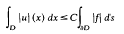
where ds is the d — 1 dimensional Hausdorff measure on the boundary ժD. A large class of domains satisfy this condition. Examples are C2-domains, convex domains, etc.
On polylogarithms
-
- Journal:
- Proceedings of the Glasgow Mathematical Association / Volume 6 / Issue 4 / July 1964
- Published online by Cambridge University Press:
- 18 May 2009, pp. 169-171
-
- Article
-
- You have access
- Export citation
-
The nth order polylogarithm Lin(z) is defined for |z| ≦ 1 by
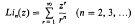
([4, p. 169], cf. [2, §1. 11 (14) and § 1. 11. 1]). The definition can be extended to all values of zin the z-plane cut along the real axis from 1 to ∝ by the formula

[2, §1. 11(3)]. Then Lin(z) is regular in the cut plane, and there is a differential recurrence relation [4, p. 169]

It is convenient to extend the sequence Lin(z) backwards in the manner suggested by (2) and define

Then Li1(z)= – log(l–z), and Lin(z) is a rational function of z for n= 0, – 1, – 2,…. Formula (2) now holds for all integers n.
GMJ volume 12 issue 2 Cover and Front matter
-
- Journal:
- Glasgow Mathematical Journal / Volume 12 / Issue 2 / September 1971
- Published online by Cambridge University Press:
- 18 May 2009, pp. f1-f2
-
- Article
-
- You have access
- Export citation
Isomorphic congruence groups and Hecke operators
-
- Journal:
- Proceedings of the Glasgow Mathematical Association / Volume 7 / Issue 3 / January 1966
- Published online by Cambridge University Press:
- 18 May 2009, p. 168
-
- Article
-
- You have access
- Export citation
Pure-complete subgroups of direct sums of Prüfer groups
-
- Journal:
- Glasgow Mathematical Journal / Volume 13 / Issue 1 / March 1972
- Published online by Cambridge University Press:
- 18 May 2009, pp. 47-48
-
- Article
-
- You have access
- Export citation
GMJ volume 1 issue 3 Cover and Front matter
-
- Journal:
- Proceedings of the Glasgow Mathematical Association / Volume 1 / Issue 3 / September 1953
- Published online by Cambridge University Press:
- 18 May 2009, pp. f1-f2
-
- Article
-
- You have access
- Export citation
On P. Hall's Generalisation of a Theorem of Frobenius
-
- Journal:
- Proceedings of the Glasgow Mathematical Association / Volume 5 / Issue 3 / January 1962
- Published online by Cambridge University Press:
- 18 May 2009, pp. 97-100
-
- Article
-
- You have access
- Export citation
Proper left type-A monoids revisited
-
- Journal:
- Glasgow Mathematical Journal / Volume 35 / Issue 3 / September 1993
- Published online by Cambridge University Press:
- 18 May 2009, pp. 293-306
-
- Article
-
- You have access
- Export citation
Measurable majorants in L1
-
- Journal:
- Glasgow Mathematical Journal / Volume 39 / Issue 2 / May 1997
- Published online by Cambridge University Press:
- 18 May 2009, pp. 183-192
-
- Article
-
- You have access
- Export citation
-
Given a probability space (X, ℱ, μ) and a σ-algebra A ⊂ ℱ, arguably the most powerful tool in gaining information about an ℱ-measurable function f from restricted knowledge of
 -measurability is that of the conditional expectation E(f | ); written
  throughout the remainder of this note. Two properties of conditional expectation that may be exploited to gain information, but which also limit conditional expectation's use are the following.
 -measurability is that of the conditional expectation E(f |
  throughout the remainder of this note. Two properties of conditional expectation that may be exploited to gain information, but which also limit conditional expectation's use are the following.
Extensions of semilattices by left type-A semigroups
-
- Journal:
- Glasgow Mathematical Journal / Volume 39 / Issue 1 / January 1997
- Published online by Cambridge University Press:
- 18 May 2009, pp. 7-16
-
- Article
-
- You have access
- Export citation
-
On a semigroup S let the relation ℛ*, sometimes denoted by ℛ
 , be defined by xℛ*y
 [(
[( sx = txsy = ty]. A semigroup S is called left type-A, iff the set Es of idempotents of S forms a semilattice under multiplication, each element x of Sis ℛ* related to a (necessarily unique) idempotent x+, and xe = (xe)+x for all x ∈ S, е ∈ Es.
 , be defined by xℛ*y
 [(
[( sx = tx
A result on hermitian operators
-
- Journal:
- Glasgow Mathematical Journal / Volume 31 / Issue 1 / January 1989
- Published online by Cambridge University Press:
- 18 May 2009, pp. 71-72
-
- Article
-
- You have access
- Export citation
-
Let X be a complex Banach space. For any bounded linear operator T on X, the (spatial) numerical range of T is denned as the set

If V(T) ⊆ R, then T is called hermitian. Vidav and Palmer (see Theorem 6 of [3, p. 78] proved that if the set {H + iK:H and K are hermitian} contains all operators, then X is a Hilbert space. It is natural to ask the following question.
A Few Infinite Integrals involving E-Functions
-
- Journal:
- Proceedings of the Glasgow Mathematical Association / Volume 2 / Issue 4 / February 1956
- Published online by Cambridge University Press:
- 18 May 2009, pp. 170-172
-
- Article
-
- You have access
- Export citation
-
The object of this paper is to evaluate a few infinite integrals involving E-functions by applying the Parseval-Goldstein [1] theorem of Operational Calculus; that, if

and

then

when the integrals are convergent.


Hook representations of the symmetric groups
-
- Journal:
- Glasgow Mathematical Journal / Volume 12 / Issue 2 / September 1971
- Published online by Cambridge University Press:
- 18 May 2009, pp. 136-149
-
- Article
-
- You have access
- Export citation
On minimal n-universal graphs
-
- Journal:
- Proceedings of the Glasgow Mathematical Association / Volume 7 / Issue 1 / January 1965
- Published online by Cambridge University Press:
- 18 May 2009, pp. 32-33
-
- Article
-
- You have access
- Export citation
Diagrams associated with subgroups of Fuchsian groups
-
- Journal:
- Glasgow Mathematical Journal / Volume 20 / Issue 2 / July 1979
- Published online by Cambridge University Press:
- 18 May 2009, pp. 103-114
-
- Article
-
- You have access
- Export citation
Autoclinisms and automorphisms of finite groups II
-
- Journal:
- Glasgow Mathematical Journal / Volume 21 / Issue 2 / July 1980
- Published online by Cambridge University Press:
- 18 May 2009, pp. 205-207
-
- Article
-
- You have access
- Export citation
A procedure for deriving inversion formulae for integral transform pairs of a general kind
-
- Journal:
- Glasgow Mathematical Journal / Volume 9 / Issue 1 / January 1968
- Published online by Cambridge University Press:
- 18 May 2009, pp. 67-77
-
- Article
-
- You have access
- Export citation
-
In recent years there have appeared solutions of several integral equations of the type

in which the kernel K(x) contains (as a factor) one of the classical orthogonal polynomials or a hypergeometric function.
On the endomorphism semigroup of an ordered set
-
- Journal:
- Glasgow Mathematical Journal / Volume 37 / Issue 2 / May 1995
- Published online by Cambridge University Press:
- 18 May 2009, pp. 173-178
-
- Article
-
- You have access
- Export citation
-
M. E. Adams and Matthew Gould [1] have obtained a remarkable classification of ordered sets P for which the monoid End P of endomorphisms (i.e. isotone maps) is regular, in the sense that for every f є End P there exists g є End P such that fgf = f. They show that the class of such ordered sets consists precisely of
(a) all antichains;
(b) all quasi-complete chains;
(c) all complete bipartite ordered sets (i.e. given non-zero cardinals α β an ordered set Kα,β of height 1 having α minimal elements and β maximal elements, every minimal element being less than every maximal element);
(d) for a non-zero cardinal α the lattice Mα consisting of a smallest element 0, a biggest element 1, and α atoms;
(e) for non-zero cardinals α, β the ordered set Nα,β of height 1 having α minimal elements and β maximal elements in which there is a unique minimal element α0 below all maximal elements and a unique maximal element β0 above all minimal elements (and no further ordering);
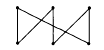
(f) the six-element crown C6 with Hasse diagram
A similar characterisation, which coincides with the above for sets of height at most 2 but differs for chains, was obtained by A. Ya. Aizenshtat [2].
