Refine search
Actions for selected content:
26076 results in Abstract analysis
Minimal theta functions
-
- Journal:
- Glasgow Mathematical Journal / Volume 30 / Issue 1 / January 1988
- Published online by Cambridge University Press:
- 18 May 2009, pp. 75-85
-
- Article
-
- You have access
- Export citation
-
Let
 be a positive definite binary quadratic form with real coefficients and discriminant b2 − 4ac = −1.
Among such forms, let
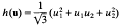 . The Epstein zeta function of f is denned to be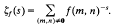
Rankin [7], Cassels [1], Ennola [5], and Diananda [4] between them proved that for every real s > 0,

We prove a corresponding result for theta functions. For real α > 0, let
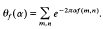
This function satisfies the functional equation

(This may be proved by using the formula (4) below, and then twice applying the identity (8).)
 be a positive definite binary quadratic form with real coefficients and discriminant b
 . The Epstein zeta function of f is denned to be
Eta-products which are simultaneous eigenforms of Hecke operators
-
- Journal:
- Glasgow Mathematical Journal / Volume 35 / Issue 3 / September 1993
- Published online by Cambridge University Press:
- 18 May 2009, pp. 307-323
-
- Article
-
- You have access
- Export citation
-
The Dedekind eta-function is defined for any τ in the upper half-plane by
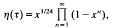
where x = exp(2πiτ) and x1/24 = exp(2πiτ/24). By an eta-product we shall mean a function

where N ≥ 1 and eachrδ ∈ ℤ. In addition, we shall always assume that
 is an integer. Using the Legendre-Jacobi symbol (—), we define a Dirichlet character ∈ by
when a is odd. If p is a prime for which ∈(p) ≠ 0and if F is a function with a Fourier series
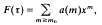
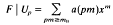
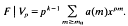
then we define a Hecke operator Tp by

where
and
 is an integer. Using the Legendre-Jacobi symbol (—), we define a Dirichlet character ∈ by
Residuation theory and matrix multiplication on orthomodular lattices
-
- Journal:
- Glasgow Mathematical Journal / Volume 10 / Issue 1 / January 1969
- Published online by Cambridge University Press:
- 18 May 2009, pp. 60-65
-
- Article
-
- You have access
- Export citation
-
In this paper we consider mappings induced by matrix multiplication which are defined on lattices of matrices whose coordinates come from a fixed orthomodular lattice L (i.e. a lattice with an orthocomplementation denoted by ′ in which a ≦ b ⇒ a ∨ (a′ ∧ b) = b).
 will denote the set of all m × n matrices over L with partial order and lattice operations defined coordinatewise. For conformal matrices A and B the (i,j)th coordinate of the matrix product AB is defined to be (AB)ij = Vk(Aik ∧ BkJ). We assume familiarity with the notation and results of [1]. is an orthomodular lattice and the (lattice) centre of is defined as
  , where we say that A commutes with B and write
  . In § 1 it is shown that mappings from into characterized by right multiplication X → XP (P ∈ ) are residuated if and only if p ∈ ℘ (). (Similarly for left multiplication.) This result is used to show the existence of residuated pairs. Hence, in § 2 we are able to extend a result of Blyth [3] which relates invertible and cancellable matrices (see Theorem 3 and its corollaries). Finally, for right (left) multiplication mappings, characterizations are given in § 3 for closure operators, quantifiers, range closed mappings, and Sasaki projections.
 will denote the set of all m × n matrices over L with partial order and lattice operations defined coordinatewise. For conformal matrices A and B the (i,j)th coordinate of the matrix product AB is defined to be (AB)
 , where we say that A commutes with B and write
  . In § 1 it is shown that mappings from
 On Sands' questions concerning strong and hereditary radicals
-
- Journal:
- Glasgow Mathematical Journal / Volume 28 / Issue 1 / January 1986
- Published online by Cambridge University Press:
- 18 May 2009, pp. 1-3
-
- Article
-
- You have access
- Export citation
On Prefrattini residuals†
-
- Journal:
- Glasgow Mathematical Journal / Volume 40 / Issue 2 / May 1998
- Published online by Cambridge University Press:
- 18 May 2009, pp. 187-197
-
- Article
-
- You have access
- Export citation
-
All groups considered in the sequel are finite. Let (ℭ and
 denote the formations of groups which consist of collections of groups that respectively either split over each normal subgroup (nC-groups) or for which the groups do not possess nontrivial Frattini chief factors [8]. The purpose of this article is to develop and expand a concept that arises naturally with the residuals for these formations, namely each G-chief factor
  is non-complemented (Frattini). With respect to a solid set X of maximal subgroups, these properties are generalized respectively to so-called X-parafrattini (X-profrattini) normal subgroups for which each type is closed relative to products. The relationships among the unique maximal normal subgroups that result from these products, the solid set of maximal subgroups X, X-prefrattini subgroups, and the residuals of formations are explored. This leads to a well-defined collected of formations, the partially nonsaturated formations, with properties analogous to those which are totally non-saturated. In the development, attention is given to a set of maximal subgroups which is the image of a solid function defined on all groups, a weaker condition than that of a solid set. A result of particular interest answers affirmatively the long-standing conjecture that a non-trivial nC-group G is solvable if and only if each G-chief factor is complemented by a maximal subgroup. This will force a critical re-examination of the classification problem for nC-groups. Since the article continues the investigations on finite groups initiated in [2], a familiarity with that article is assumed. All other notation and terminology is from [6]. If M is a maximal subgroup of a group G and G/C or e G(M) is a monolithic primitive group, i.e. a group with a unique minimal normal subgroup, then M is called a monolithic maximal subgroupof G.
 denote the formations of groups which consist of collections of groups that respectively either split over each normal subgroup (nC-groups) or for which the groups do not possess nontrivial Frattini chief factors [8]. The purpose of this article is to develop and expand a concept that arises naturally with the residuals for these formations, namely each G-chief factor
  is non-complemented (Frattini). With respect to a solid set X of maximal subgroups, these properties are generalized respectively to so-called X-parafrattini (X-profrattini) normal subgroups for which each type is closed relative to products. The relationships among the unique maximal normal subgroups that result from these products, the solid set of maximal subgroups X, X-prefrattini subgroups, and the residuals of formations are explored. This leads to a well-defined collected of formations, the partially nonsaturated formations, with properties analogous to those which are totally non-saturated. In the development, attention is given to a set of maximal subgroups which is the image of a solid function defined on all groups, a weaker condition than that of a solid set. A result of particular interest answers affirmatively the long-standing conjecture that a non-trivial nC-group G is solvable if and only if each G-chief factor is complemented by a maximal subgroup. This will force a critical re-examination of the classification problem for nC-groups. Since the article continues the investigations on finite groups initiated in [2], a familiarity with that article is assumed. All other notation and terminology is from [6]. If M is a maximal subgroup of a group G and G/C or e
 Joint spectra and joint numerical ranges for pairwise commuting operators in Banach spaces
-
- Journal:
- Glasgow Mathematical Journal / Volume 30 / Issue 2 / May 1988
- Published online by Cambridge University Press:
- 18 May 2009, pp. 145-153
-
- Article
-
- You have access
- Export citation
The Representations of Lie Algebras of Prime Characteristic
-
- Journal:
- Proceedings of the Glasgow Mathematical Association / Volume 2 / Issue 1 / April 1954
- Published online by Cambridge University Press:
- 18 May 2009, pp. 1-36
-
- Article
-
- You have access
- Export citation
The convolution x-r*xs
-
- Journal:
- Glasgow Mathematical Journal / Volume 17 / Issue 1 / January 1976
- Published online by Cambridge University Press:
- 18 May 2009, pp. 53-56
-
- Article
-
- You have access
- Export citation
-
In a recent paper [1], Jones extended the definition of the convolution of distributions so that further convolutions could be defined. The convolution w1*w2 of two distributions w1 and w2 was defined as the limit ofithe sequence {wln*w2n}, provided the limit w exists in the sense that

for all fine functions ф in the terminology of Jones [2], where
w1n(x) = wl(x)τ(x/n), W2n(x) = w2(x)τ(x/n)
and τ is an infinitely differentiable function satisfying the following conditions:
(i) τ(x) = τ(—x),
(ii)0 ≤ τ (x) ≤ l,
(iii)τ (x) = l for |x| ≤ ½,
(iv) τ (x) = 0 for |x| ≥ 1.
Abelian Ergodic Theorems for Vector-Valued Functions†
-
- Journal:
- Glasgow Mathematical Journal / Volume 17 / Issue 2 / July 1976
- Published online by Cambridge University Press:
- 18 May 2009, p. 154
-
- Article
-
- You have access
- Export citation
-
The definition of Ωf,a on p. 57 should read a

A simple proof of Hermite's theorem on the zeros of a polynomial
-
- Journal:
- Glasgow Mathematical Journal / Volume 24 / Issue 2 / July 1983
- Published online by Cambridge University Press:
- 18 May 2009, pp. 125-128
-
- Article
-
- You have access
- Export citation
Counting word-trees
-
- Journal:
- Glasgow Mathematical Journal / Volume 15 / Issue 2 / September 1974
- Published online by Cambridge University Press:
- 18 May 2009, pp. 148-149
-
- Article
-
- You have access
- Export citation
GMJ volume 32 issue 3 Cover and Back matter
-
- Journal:
- Glasgow Mathematical Journal / Volume 32 / Issue 3 / September 1990
- Published online by Cambridge University Press:
- 18 May 2009, pp. b1-b2
-
- Article
-
- You have access
- Export citation
Character modules, dimension and purity
-
- Journal:
- Glasgow Mathematical Journal / Volume 13 / Issue 2 / September 1972
- Published online by Cambridge University Press:
- 18 May 2009, pp. 144-146
-
- Article
-
- You have access
- Export citation
On the Theory of Relaxation
-
- Journal:
- Proceedings of the Glasgow Mathematical Association / Volume 1 / Issue 3 / September 1953
- Published online by Cambridge University Press:
- 18 May 2009, pp. 101-110
-
- Article
-
- You have access
- Export citation
On inequalities for integral operators
-
- Journal:
- Glasgow Mathematical Journal / Volume 11 / Issue 2 / July 1970
- Published online by Cambridge University Press:
- 18 May 2009, pp. 126-133
-
- Article
-
- You have access
- Export citation
-
In two papers [3] and [4], the author has extended the inequality of Schur (Theorem 319 of [2]) to cases involving kernels which satisfy identities of the form

The purpose of this paper is to prove a general inequality, which includes the above and also the inequality of Young (Theorem 281 of [2]) as special cases. We shall give the results a general setting by considering functions defined on abstract measure spaces. From this we shall deduce an extension to n dimensions of the results given in [3], which also generalises a similar extension of the Schur inequality given by Stein and Weiss. In fact some cases of the other results given in [5] will follow directly from our theorem.
On the spectrum of n-tuples of p-hyponormal operators
-
- Journal:
- Glasgow Mathematical Journal / Volume 40 / Issue 1 / March 1998
- Published online by Cambridge University Press:
- 18 May 2009, pp. 123-131
-
- Article
-
- You have access
- Export citation
The translational hull of a completely 0-simple semigroup
-
- Journal:
- Glasgow Mathematical Journal / Volume 9 / Issue 1 / January 1968
- Published online by Cambridge University Press:
- 18 May 2009, pp. 1-11
-
- Article
-
- You have access
- Export citation
Banach spaces with property (w)
-
- Journal:
- Glasgow Mathematical Journal / Volume 35 / Issue 2 / May 1993
- Published online by Cambridge University Press:
- 18 May 2009, pp. 207-217
-
- Article
-
- You have access
- Export citation
Faithful linear representations of certain free nilpotent groups
-
- Journal:
- Glasgow Mathematical Journal / Volume 37 / Issue 1 / January 1995
- Published online by Cambridge University Press:
- 18 May 2009, pp. 33-36
-
- Article
-
- You have access
- Export citation
Product submanifolds with pointwise 3-planar normal sections
-
- Journal:
- Glasgow Mathematical Journal / Volume 37 / Issue 1 / January 1995
- Published online by Cambridge University Press:
- 18 May 2009, pp. 73-81
-
- Article
-
- You have access
- Export citation
-
Let M be a smooth m-dimensional submanifold in (m + d)-dimensional Euclidean space ℝm+d For x ∊ M and a non-zero vector X in TXM, we define the (d + l)-dimensional affine subspace E(x, X) ofℝm+d by

