Refine search
Actions for selected content:
26070 results in Abstract analysis
Projective representations of extra-special p-groups
-
- Journal:
- Glasgow Mathematical Journal / Volume 19 / Issue 2 / July 1978
- Published online by Cambridge University Press:
- 18 May 2009, pp. 149-152
-
- Article
-
- You have access
- Export citation
-
Let G be a finite group (with neutral element e) which operates trivially on the multiplicative group R* of a commutative ring R (with identity 1). Let H2(G, R*) denote the second cohomology group of G with respect to the trivial G-module R*. With every
 represented by the central factor system
  we associate the so called twisted group algebra (R, G, f) (see [3, V, 23.7] for the definition). (R, G, f) is determined by f up to R-algebra isomorphism. In this note we shall describe its representations in the case R is an algebraically closed field C of characteristic zero and G is an extra-special p-group P.
 represented by the central factor system
  we associate the so called twisted group algebra (R, G, f) (see [3, V, 23.7] for the definition). (R, G, f) is determined by f up to R-algebra isomorphism. In this note we shall describe its representations in the case R is an algebraically closed field C of characteristic zero and G is an extra-special p-group P.
Construction of semiabelian Galois extensions
-
- Journal:
- Glasgow Mathematical Journal / Volume 37 / Issue 1 / January 1995
- Published online by Cambridge University Press:
- 18 May 2009, pp. 99-104
-
- Article
-
- You have access
- Export citation
Packing of spheres in lp†
-
- Journal:
- Glasgow Mathematical Journal / Volume 11 / Issue 1 / January 1970
- Published online by Cambridge University Press:
- 18 May 2009, pp. 72-80
-
- Article
-
- You have access
- Export citation
-
The Banach space lp(p≥1) is the space of all infinite sequences x = (x1, x2, x3, …) of real or complex numbers such that
 is convergent, with the norm defined by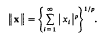
The unit sphere S of lp is the set of all points x ∈ lp with ∥x∥ ≤ 1 and the sphere of radius a ≥ 0 centred at y ∈ lp is denoted by Sa(y), so that

 is convergent, with the norm defined by
On the construction of ring extensions
-
- Journal:
- Glasgow Mathematical Journal / Volume 17 / Issue 1 / January 1976
- Published online by Cambridge University Press:
- 18 May 2009, pp. 1-11
-
- Article
-
- You have access
- Export citation
Multiplicity of Boardman strata and deformations of map germs
-
- Journal:
- Glasgow Mathematical Journal / Volume 40 / Issue 1 / March 1998
- Published online by Cambridge University Press:
- 18 May 2009, pp. 21-32
-
- Article
-
- You have access
- Export citation
-
We define algebraically for each map germ f:Kn,0→Kp, 0 and for each Boardman symbol i=(i1,…,ik) a number ci(f) which is
 -invariant. If f is finitely determined, this number is the generalization of the Milnor number of f when p = 1, the number of cusps of f when n = p = 2, or the number of cross caps when n = 2, p = 3. We study some properties of this number and prove that, in some particular cases, this number can be interpreted geometrically as the number of Σi points that appear in a generic deformation of f. In the last part, we compute this number in the case that the map germ is a projection and give some applications to catastrophe map germs.
 -invariant. If f is finitely determined, this number is the generalization of the Milnor number of f when p = 1, the number of cusps of f when n = p = 2, or the number of cross caps when n = 2, p = 3. We study some properties of this number and prove that, in some particular cases, this number can be interpreted geometrically as the number of Σ
Trigonometric sums over primes II
-
- Journal:
- Glasgow Mathematical Journal / Volume 24 / Issue 1 / January 1983
- Published online by Cambridge University Press:
- 18 May 2009, pp. 23-37
-
- Article
-
- You have access
- Export citation
GMJ volume 38 issue 3 Cover and Back matter
-
- Journal:
- Glasgow Mathematical Journal / Volume 38 / Issue 3 / September 1996
- Published online by Cambridge University Press:
- 18 May 2009, pp. b1-b2
-
- Article
-
- You have access
- Export citation
Asymptotic formulae for linear equations
-
- Journal:
- Glasgow Mathematical Journal / Volume 13 / Issue 2 / September 1972
- Published online by Cambridge University Press:
- 18 May 2009, pp. 147-152
-
- Article
-
- You have access
- Export citation
-
Numerous formulae have been given which exhibit the asymptotic behaviour as t → ∞solutions of

where F(t) is essentially positive and
 Several of these results have been unified by a theorem of F. V. Atkinson [1]. It is the purpose of this paper to establish results, analogous to the theorem of Atkinson, for the third order equation
and for the fourth order equation


 Several of these results have been unified by a theorem of F. V. Atkinson [
Finite groups generated by subnormal T-subgroups
-
- Journal:
- Glasgow Mathematical Journal / Volume 37 / Issue 3 / September 1995
- Published online by Cambridge University Press:
- 18 May 2009, pp. 363-371
-
- Article
-
- You have access
- Export citation
-
Our aim in this paper is to investigate the restrictions placed on the structure of a finite group if it can be generated by subnormal T-subgroups (a T-group is a group in which every subnormal subgroup is normal). For notational convenience we denote by
 the class of finite groups that can be generated by subnormal T-subgroups and by
  the subclass of of those finite groups generated by normal T-subgroups; and for the remainder of this paper we will only consider finite groups.
 the class of finite groups that can be generated by subnormal T-subgroups and by
  the subclass of
 A characterization of minimal prime ideals
-
- Journal:
- Glasgow Mathematical Journal / Volume 40 / Issue 2 / May 1998
- Published online by Cambridge University Press:
- 18 May 2009, pp. 223-236
-
- Article
-
- You have access
- Export citation
A Minimum Problem for the Epstein Zeta-Function
-
- Journal:
- Proceedings of the Glasgow Mathematical Association / Volume 1 / Issue 4 / December 1953
- Published online by Cambridge University Press:
- 18 May 2009, pp. 149-158
-
- Article
-
- You have access
- Export citation
-
In some recent work by D. G. Kendall and the author † on the number of points of a lattice which lie in a random circle the mean value of the variance emerged as a constant multiple of the value of the Epstein zeta-function Z(s) associated with the lattice, taken at the point s=
 . Because of the connexion with the problems of closest packing and covering it seemed likely that the minimum value of Z() would be attained for the hexagonal lattice; it is the purpose of this paper to prove this and to extend the result to other real values of the variable s.
 . Because of the connexion with the problems of closest packing and covering it seemed likely that the minimum value of Z(
Representations and positive definite functions on topological semigroups
-
- Journal:
- Glasgow Mathematical Journal / Volume 38 / Issue 1 / January 1996
- Published online by Cambridge University Press:
- 18 May 2009, pp. 99-111
-
- Article
-
- You have access
- Export citation
A functorial approach to weak amenability for commutative Banach algebras
-
- Journal:
- Glasgow Mathematical Journal / Volume 34 / Issue 2 / May 1992
- Published online by Cambridge University Press:
- 18 May 2009, pp. 241-251
-
- Article
-
- You have access
- Export citation
-
Let A be a commutative algebra, and let M be a bimodule over A. A derivation from A into M is a linear mapping D: A→M that satisfies

If M is only a left A-module, by a derivation from A into M we mean a linear mapping D: A→M such that

Each A-bimodule M is trivially a left module. However, unless it is commutative, i.e.

the two classes of linear operators from A into M characterized by (1) and (2), respectively, need not coincide.
On the number of terms in the irreducible factors of a polynomial over ℚ
-
- Journal:
- Glasgow Mathematical Journal / Volume 34 / Issue 1 / January 1992
- Published online by Cambridge University Press:
- 18 May 2009, pp. 11-15
-
- Article
-
- You have access
- Export citation
Fonction de Hilbert-Samuel dans les anneaux locaux réguliers non-commutatifs
-
- Journal:
- Glasgow Mathematical Journal / Volume 24 / Issue 1 / January 1983
- Published online by Cambridge University Press:
- 18 May 2009, pp. 65-69
-
- Article
-
- You have access
- Export citation
Integrals involving E-functions
-
- Journal:
- Proceedings of the Glasgow Mathematical Association / Volume 6 / Issue 1 / January 1963
- Published online by Cambridge University Press:
- 18 May 2009, pp. 31-33
-
- Article
-
- You have access
- Export citation
-
1. Introductory. The following two integrals will be established in § 2.
If m is a positive integer, if p ≧ q + 1 and if R(ar+kt) > 0 (r = 1, 2,…, p, t = 1, 2,…, m),
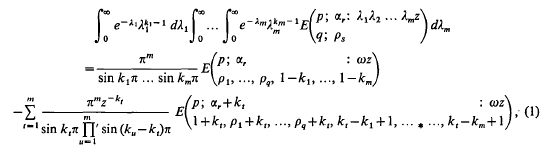
where co is 1 or e±in according as m is even or odd, the dash denotes that the factor sin (k,–k,)π does not appear and the asterisk that the parameter kt–kt + 1 is omitted. If pp ≧ qthe result holds if the integral is convergent.
Killing rational characteristic classes by surgery
-
- Journal:
- Glasgow Mathematical Journal / Volume 21 / Issue 1 / January 1980
- Published online by Cambridge University Press:
- 18 May 2009, pp. 209-212
-
- Article
-
- You have access
- Export citation
-
Let fr: Xr → BO(r) be a sequence of fibrations with maps gr: Xr → Xr+1 such that the usual diagram commutes. For such a situation R. Lashof defines the concept of an X-structure on manifolds (see [3]), and proves a Thom-isomorphism for the cobordism groups of such manifolds. Let n, m be positive integers which are fixed throughout this paper. If r is very big in comparison with n + m then X, is a simply connected CW-complex and the map
 is an isomorphism up to dimension n. Let γ be the pull-back over Xr of the universal r-linear bundle (which is, of course, a bundle over BO(r)). If r is very big in comparison with n + m, then we put X = Xr, and we assume that γ is orientable and oriented. The elements of H*(X; Q) of dimension not greater than n, will be called rational universal X-characteristic classes. It is well-known that many of the usual classes of manifolds may be described in terms of X-structures, (e.g. SO, SU, Spin-manifolds etc.).
 is an isomorphism up to dimension n. Let γ be the pull-back over X
On successive approximations for nonexpansive mappings in Banach spaces†
-
- Journal:
- Glasgow Mathematical Journal / Volume 12 / Issue 1 / April 1971
- Published online by Cambridge University Press:
- 18 May 2009, pp. 6-9
-
- Article
-
- You have access
- Export citation
Normal curvature of minimal submanifolds in a sphere
-
- Journal:
- Glasgow Mathematical Journal / Volume 39 / Issue 1 / January 1997
- Published online by Cambridge University Press:
- 18 May 2009, pp. 29-33
-
- Article
-
- You have access
- Export citation
-
Simons [5] has proved a pinching theorem for compact minimal submanifolds in a unit sphere, which led to an intrinsic rigidity result. Sakaki [4] improved this result of Simons for arbitrary codimension and has proved that if the scalar curvature S of the minimal submanifold Mn of Sn+P satisfies
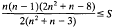
then either Mn is totally geodesic or S= 2/3 in which case n = 2 and M2 is the Veronese surface in a totally geodesic 4-sphere. This result of Sakaki was further improved by Shen [6] but only for dimension n=3, where it is shown that if S>4, then M3 is totally geodesic (cf. Theorem 3, p. 791).
Fitting classes of certain metanilpotent groups
-
- Journal:
- Glasgow Mathematical Journal / Volume 36 / Issue 2 / May 1994
- Published online by Cambridge University Press:
- 18 May 2009, pp. 185-195
-
- Article
-
- You have access
- Export citation
