Refine search
Actions for selected content:
26063 results in Abstract analysis
A Class of Irreducible matrix representations of an Arbitrary Inverse Semigroup
-
- Journal:
- Proceedings of the Glasgow Mathematical Association / Volume 5 / Issue 1 / January 1961
- Published online by Cambridge University Press:
- 18 May 2009, pp. 41-48
-
- Article
-
- You have access
- Export citation
On the dimension of Veblen-Wedderburn systems
-
- Journal:
- Glasgow Mathematical Journal / Volume 11 / Issue 2 / July 1970
- Published online by Cambridge University Press:
- 18 May 2009, pp. 114-116
-
- Article
-
- You have access
- Export citation
Conduction of Heat from Local Sources in a Medium Generating or Absorbing Heat
-
- Journal:
- Proceedings of the Glasgow Mathematical Association / Volume 1 / Issue 4 / December 1953
- Published online by Cambridge University Press:
- 18 May 2009, pp. 164-169
-
- Article
-
- You have access
- Export citation
The Fourier transform of vector-valued functions
-
- Journal:
- Glasgow Mathematical Journal / Volume 26 / Issue 2 / July 1985
- Published online by Cambridge University Press:
- 18 May 2009, pp. 181-186
-
- Article
-
- You have access
- Export citation
-
For each natural number n, let un(x)=(1—cos nx)/πnx2(xɛℝ). It is well–known that a bounded continuous function f on the real line ℝ is the Fourier transform of an integrable function on ℝ if and only if the functions Φn(f) (n= 1, 2,…), defined by

form a Cauchy sequence in the space L1(ℝ) (cf. [2]). Such a characterization, which can be extended to functions defined on a locally compact Abelian group more general than ℝ, is based on the fact that the space L1(ℝ) is complete with respect to convergence in mean.
Countable enlargements of norm topologies and the quasidistinguished property
-
- Journal:
- Glasgow Mathematical Journal / Volume 35 / Issue 2 / May 1993
- Published online by Cambridge University Press:
- 18 May 2009, pp. 235-238
-
- Article
-
- You have access
- Export citation
Covering a group with isolators of finitely many subgroups
-
- Journal:
- Glasgow Mathematical Journal / Volume 35 / Issue 2 / May 1993
- Published online by Cambridge University Press:
- 18 May 2009, pp. 253-259
-
- Article
-
- You have access
- Export citation
-
In [6] B. H. Neumann proved the following beautiful result: if a group G is covered by finitely many cosets, say G =
 xiHi, then we can omit from the union any xiHi, for which |G|Hj| is infinite. In particular, |G:Hj| is finite, for some j ∈ {l,…,n}.
In an unpublished result R. Baer characterized the groups covered by finitely many abelian subgroups, they are exactly the centre-by-finite groups [8]. Coverings by nilpotent subgroups or by Engel subgroups and by normal subgroups have been studied, for example, by R. Baer (see [8]), L. C. Kappe [2,1], M. A. Brodie and R. F. Chamberlain [1], and recently by M. J. Tomkinson [9].
 x
xGMJ volume 13 issue 1 Cover and Front matter
-
- Journal:
- Glasgow Mathematical Journal / Volume 13 / Issue 1 / March 1972
- Published online by Cambridge University Press:
- 18 May 2009, pp. f1-f2
-
- Article
-
- You have access
- Export citation
An Infinite Integral involving a Product of Two Modified Bessel Functions of the Second Kind
-
- Journal:
- Proceedings of the Glasgow Mathematical Association / Volume 1 / Issue 4 / December 1953
- Published online by Cambridge University Press:
- 18 May 2009, pp. 187-189
-
- Article
-
- You have access
- Export citation
-
The formula to be established is
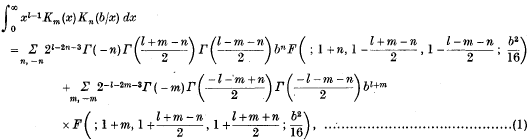
where l, m, n. are any numbers real or complex and R(b)>0. A similar result, involving Bessel Functions of the First Kind, was obtained by Hanumanta Rao [Mess, of Maths., XLVII. (1918), pp. 134–137].
A characterization of inaccessible cardinals
-
- Journal:
- Proceedings of the Glasgow Mathematical Association / Volume 5 / Issue 4 / July 1962
- Published online by Cambridge University Press:
- 18 May 2009, pp. 153-157
-
- Article
-
- You have access
- Export citation
Injectives in some small varieties of ockham algebras
-
- Journal:
- Glasgow Mathematical Journal / Volume 25 / Issue 2 / July 1984
- Published online by Cambridge University Press:
- 18 May 2009, pp. 183-191
-
- Article
-
- You have access
- Export citation
Certain congruence and quotient lattices related to completely 0-simple and primitive regular semigroups
-
- Journal:
- Glasgow Mathematical Journal / Volume 10 / Issue 1 / January 1969
- Published online by Cambridge University Press:
- 18 May 2009, pp. 21-24
-
- Article
-
- You have access
- Export citation
A note on locally soluble, normal closures of cyclic subgroups
-
- Journal:
- Glasgow Mathematical Journal / Volume 36 / Issue 1 / January 1994
- Published online by Cambridge University Press:
- 18 May 2009, pp. 33-36
-
- Article
-
- You have access
- Export citation
Dehn functions and complexes of groups
-
- Journal:
- Glasgow Mathematical Journal / Volume 40 / Issue 1 / March 1998
- Published online by Cambridge University Press:
- 18 May 2009, pp. 33-46
-
- Article
-
- You have access
- Export citation
Integrals involving E-functions
-
- Journal:
- Proceedings of the Glasgow Mathematical Association / Volume 1 / Issue 3 / September 1953
- Published online by Cambridge University Press:
- 18 May 2009, pp. 129-136
-
- Article
-
- You have access
- Export citation
-
§ 1. Introductory. The formula to be proved is

where b>0.
Outer automorphisms of hypercentral p-groups
-
- Journal:
- Glasgow Mathematical Journal / Volume 37 / Issue 2 / May 1995
- Published online by Cambridge University Press:
- 18 May 2009, pp. 243-247
-
- Article
-
- You have access
- Export citation
A further note on dual trigonometrical series
-
- Journal:
- Proceedings of the Glasgow Mathematical Association / Volume 4 / Issue 4 / September 1960
- Published online by Cambridge University Press:
- 18 May 2009, pp. 198-200
-
- Article
-
- You have access
- Export citation
-
This note discusses the determination of the coefficients an in the dual trigonometrical series

where p = ± 1 and F(x), G(x) are prescribed functions of X. It is shown that this problem and the corresponding one in which the sines in equations (1) are replaced by cosines are easily reduced to a form in which the results I have recently given in this journal [1] may be applied.
As with my previous paper on this subject, the analysis is purely formal and no attempt is made to give precise conditions for which the solution is valid.
Circles of numbers
-
- Journal:
- Glasgow Mathematical Journal / Volume 19 / Issue 2 / July 1978
- Published online by Cambridge University Press:
- 18 May 2009, pp. 115-119
-
- Article
-
- You have access
- Export citation
Representations of infinite soluble groups
-
- Journal:
- Glasgow Mathematical Journal / Volume 24 / Issue 1 / January 1983
- Published online by Cambridge University Press:
- 18 May 2009, pp. 43-52
-
- Article
-
- You have access
- Export citation
A weaker condition for normality
-
- Journal:
- Glasgow Mathematical Journal / Volume 36 / Issue 2 / May 1994
- Published online by Cambridge University Press:
- 18 May 2009, pp. 249-253
-
- Article
-
- You have access
- Export citation
-
One of the most important results of operator theory is the spectral theorem for normal operators. This states that a normal operator (that is, a Hilbert space operator T such that T*T= TT*), can be represented as an integral with respect to a countably additive spectral measure,

Here E is a measure that associates an orthogonal projection with each Borel subset of ℂ. The countable additivity of this measure means that if x Eℋ can be written as a sum of eigenvectors
 then this sum must converge unconditionally.

 then this sum must converge unconditionally.
Inductive and projective limits of normed spaces
-
- Journal:
- Glasgow Mathematical Journal / Volume 9 / Issue 2 / July 1968
- Published online by Cambridge University Press:
- 18 May 2009, pp. 103-105
-
- Article
-
- You have access
- Export citation
-
Let {Ui, Uij} be an inductive system of normed linear spaces Ui and continuous linear maps uij; Uj → Ui. (We write j ≺ i if uij: Uj → Ui.) An inductive limit of the system with respect to a class
 of spaces A in
  and maps f in
  is a space Uu in Uu and a system ui → Uu of maps in such that (i)
  whenever j ≺ i, and that (ii) if A is any space in and fi: Ui → A is any system of maps in for which
  then there is a unique map f: Uu → A in such that fi = fo ui for each i. If is the class of all vector spaces and is the class of linear maps, we obtain the algebraic inductive limit, which we denote simply by U. The usual choice is to take to be the class of locally convex spaces and the class of continuous linear maps; the inductive limit UL then always exists [1, § 16 C]. If is again the continuous linear mappings but contains only normed spaces, the corresponding inductive limit UN may not always exist. However, if in addition we require that contains just contractions (norm-decreasing linear mappings), then an inductive limit Uc will exist if every uij is a contraction [2]. We shall give a condition under which these limits coincide (as far as possible), and consider the corresponding condition for projective limits.
 of spaces A in
  and maps f in
  is a space U
 whenever j ≺ i, and that (ii) if A is any space in
  then there is a unique map f: U