Refine search
Actions for selected content:
26079 results in Abstract analysis
A generalization of centralizer near-rings
-
- Journal:
- Proceedings of the Edinburgh Mathematical Society / Volume 28 / Issue 2 / June 1985
- Published online by Cambridge University Press:
- 20 January 2009, pp. 159-165
-
- Article
-
- You have access
- Export citation
-
Let G be a group with identity 0 and let
 be a group of automorphisms of G. The centralizer near-ring determined by G and is the set
  for all α∈ and f(0)=0}, forming a near-ring under function addition and function composition. This class of nea-rings has been extensively studied (for example see [1], [2], [5] and [6]) and it is known that every finite simple near-ring with identity which is not a ring is isomorphic to C(;G) for a suitable pair (,G) see [6] page 131, Corollary 4.59 and Theorem 4.60.
 be a group of automorphisms of
  for all α∈
PEM volume 5 issue 1 Cover and Back matter
-
- Journal:
- Proceedings of the Edinburgh Mathematical Society / Volume 5 / Issue 1 / October 1936
- Published online by Cambridge University Press:
- 20 January 2009, pp. b1-b2
-
- Article
-
- You have access
- Export citation
Office-Bearers
-
- Journal:
- Proceedings of the Edinburgh Mathematical Society / Volume 20 / February 1901
- Published online by Cambridge University Press:
- 20 January 2009, p. 1
-
- Article
-
- You have access
- Export citation
Geometrical problem
-
- Journal:
- Proceedings of the Edinburgh Mathematical Society / Volume 2 / February 1883
- Published online by Cambridge University Press:
- 20 January 2009, p. 27
-
- Article
-
- You have access
- Export citation
On the Use of Symmetry in Geometry
-
- Journal:
- Proceedings of the Edinburgh Mathematical Society / Volume 22 / February 1903
- Published online by Cambridge University Press:
- 20 January 2009, pp. 54-63
-
- Article
-
- You have access
- Export citation
TheJ-Differential and its Integral
-
- Journal:
- Proceedings of the Edinburgh Mathematical Society / Volume 12 / Issue 2 / December 1960
- Published online by Cambridge University Press:
- 20 January 2009, pp. 85-93
-
- Article
-
- You have access
- Export citation
-
We consider the possibility of generalising the statement

to the case

F. Kirwan, Complex algebraic curves (London Mathematical Society Student Texts 23, Cambridge University Press, Cambridge1992) pp. viii + 264, cloth 0 521 41251 X, £30, paper 0 521 42353 8, £13.95.
-
- Journal:
- Proceedings of the Edinburgh Mathematical Society / Volume 35 / Issue 3 / October 1992
- Published online by Cambridge University Press:
- 20 January 2009, pp. 521-522
-
- Article
-
- You have access
- Export citation
General hereditary for radical theory
-
- Journal:
- Proceedings of the Edinburgh Mathematical Society / Volume 20 / Issue 4 / September 1977
- Published online by Cambridge University Press:
- 20 January 2009, pp. 333-337
-
- Article
-
- You have access
- Export citation
The Borel structure of iterates of continuous functions
-
- Journal:
- Proceedings of the Edinburgh Mathematical Society / Volume 32 / Issue 3 / October 1989
- Published online by Cambridge University Press:
- 20 January 2009, pp. 483-494
-
- Article
-
- You have access
- Export citation
-
Let C[0,1] be the Banach space of continuous functions defined on [0,1] and let C be the set of functions f∈C[0,1] mapping [0,1] into itself. If f∈C, fk will denote the kth iterate of f and we put Ck = {fk:f∈C;}. The set of increasing (≡ nondecreasing) and decreasing (≡ nonincreasing) functions in C will be denoted by ℐ and D, respectively. If a function f is defined on an interval I, we let C(f) denote the set of points at which f is locally constant, i.e.

We let N denote the set of positive integers and NN denote the Baire space of sequences of positive integers.
J. Burlak, K. Brooke Russian-English Mathematical Vocabulary (University Mathematical Texts, Oliver and Boyd, Edinburgh, 1963), 311 pp., 21s - P. H. Nidditch Russian Reader in Pure and Applied Mathematics (University Mathematical Texts, Oliver and Boyd, Edinburgh, 1962), x + 166 pp., 10s. 6d
-
- Journal:
- Proceedings of the Edinburgh Mathematical Society / Volume 14 / Issue 4 / December 1965
- Published online by Cambridge University Press:
- 20 January 2009, pp. 343-344
-
- Article
-
- You have access
- Export citation
On Rhodes expansions of bands
-
- Journal:
- Proceedings of the Edinburgh Mathematical Society / Volume 39 / Issue 3 / October 1996
- Published online by Cambridge University Press:
- 20 January 2009, pp. 409-423
-
- Article
-
- You have access
- Export citation
On the blow-up and positive entire solutions of semilinear elliptic equations
-
- Journal:
- Proceedings of the Edinburgh Mathematical Society / Volume 43 / Issue 3 / October 2000
- Published online by Cambridge University Press:
- 20 January 2009, pp. 625-631
-
- Article
-
- You have access
- Export citation
-
In this paper we consider the following semilinear elliptic equation

where n ≥ 3,
 and β ≥ 0, γ ≥ 0, q > p ≥ 1, μ and ν are real constants. We note that if γ = 0, β > 0 and ν ≥ 2, then the equation above is called the Matukuma-type equation. If β = 0, γ > 0 and ν > 2, then the complete classification of all possible positive solutions had been conducted by Cheng and Ni. If β > 0, γ > 0 and μ ≥ ν ≥ 2, then some results about the maximal solution and positive solution structures can be found in Chern. The purpose of this paper is to discuss and investigate the blow-up and positive entire solutions of the equation above for the μ ≥ 2 ≥ ν case.
 and β ≥ 0, γ ≥ 0, q > p ≥ 1, μ and ν are real constants. We note that if γ = 0, β > 0 and ν ≥ 2, then the equation above is called the Matukuma-type equation. If β = 0, γ > 0 and ν > 2, then the complete classification of all possible positive solutions had been conducted by Cheng and Ni. If β > 0, γ > 0 and μ ≥ ν ≥ 2, then some results about the maximal solution and positive solution structures can be found in Chern. The purpose of this paper is to discuss and investigate the blow-up and positive entire solutions of the equation above for the μ ≥ 2 ≥ ν case.
E. A. Maxwell, Deductive Geometry (Pergamon Press, 1962), xiii + 176 pp., 12s. 6d.
-
- Journal:
- Proceedings of the Edinburgh Mathematical Society / Volume 13 / Issue 3 / June 1963
- Published online by Cambridge University Press:
- 20 January 2009, p. 260
-
- Article
-
- You have access
- Export citation
Note on Isogonal Conjugates
-
- Journal:
- Proceedings of the Edinburgh Mathematical Society / Volume 39 / February 1920
- Published online by Cambridge University Press:
- 20 January 2009, pp. 77-79
-
- Article
-
- You have access
- Export citation
G. H. Hardy, Collected Papers, Vol. III (Clarendon Press: Oxford University Press, 1969), 748 pp., 105s.
-
- Journal:
- Proceedings of the Edinburgh Mathematical Society / Volume 17 / Issue 2 / December 1970
- Published online by Cambridge University Press:
- 20 January 2009, pp. 189-191
-
- Article
-
- You have access
- Export citation
D. S. Bridges Constructive functional Analysis (Pitman Publishing Ltd.1979), £7·50.
-
- Journal:
- Proceedings of the Edinburgh Mathematical Society / Volume 24 / Issue 2 / June 1981
- Published online by Cambridge University Press:
- 20 January 2009, pp. 147-148
-
- Article
-
- You have access
- Export citation
Determinantal Systems of Apolar Triads in the Twisted Cubic
-
- Journal:
- Proceedings of the Edinburgh Mathematical Society / Volume 37 / February 1918
- Published online by Cambridge University Press:
- 20 January 2009, pp. 69-75
-
- Article
-
- You have access
- Export citation
D. R. Rutherford Fluid Dynamics, (University Mathematical Texts Series,Oliver and Boyd, 1959), ix + 260 pp., 10s. 6d.
-
- Journal:
- Proceedings of the Edinburgh Mathematical Society / Volume 12 / Issue 1 / June 1960
- Published online by Cambridge University Press:
- 20 January 2009, pp. 66-67
-
- Article
-
- You have access
- Export citation
A version of Runge's theorem for the Helmholtz equation with applications to scattering theory*
-
- Journal:
- Proceedings of the Edinburgh Mathematical Society / Volume 32 / Issue 1 / February 1989
- Published online by Cambridge University Press:
- 20 January 2009, pp. 107-119
-
- Article
-
- You have access
- Export citation
-
Let D be a bounded, simply connected domain in the plane R2 that is starlike with respect to the origin and has C2, α boundary, ∂D, described by the equation in polar coordinates
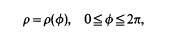
where C2, α denotes the space of twice Hölder continuously differentiable functions of index α. In this paper, it is shown that any solution
 of the Helmholtz equation
in D can be approximated in the space
 by an entire Herglotz wave function
with kernel g ∈ L2[0,2π] having support in an interval [0, η] with η chosen arbitrarily in 0 > η < 2π.
 of the Helmholtz equation
 by an entire Herglotz wave function
Generalized spectrum and commuting compact perturbations
-
- Journal:
- Proceedings of the Edinburgh Mathematical Society / Volume 36 / Issue 2 / June 1993
- Published online by Cambridge University Press:
- 20 January 2009, pp. 197-209
-
- Article
-
- You have access
- Export citation
