Refine search
Actions for selected content:
26079 results in Abstract analysis
Limit circle criteria for fourth order differential operators with an oscillatory coefficient
-
- Journal:
- Proceedings of the Edinburgh Mathematical Society / Volume 24 / Issue 2 / June 1981
- Published online by Cambridge University Press:
- 20 January 2009, pp. 105-117
-
- Article
-
- You have access
- Export citation
PEM volume 24 Back matter and figures
-
- Journal:
- Proceedings of the Edinburgh Mathematical Society / Volume 24 / February 1905
- Published online by Cambridge University Press:
- 20 January 2009, pp. b1-b18
-
- Article
-
- You have access
- Export citation
Generalised Dirichlet series and Hecke's functional equation†
-
- Journal:
- Proceedings of the Edinburgh Mathematical Society / Volume 15 / Issue 4 / December 1967
- Published online by Cambridge University Press:
- 20 January 2009, pp. 309-313
-
- Article
-
- You have access
- Export citation
-
The generalised zeta-function ζ(s, α) is defined by
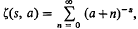
where α>0 and Res>l. Clearly, ζ(s, 1)=, where ζ(s) denotes the Riemann zeta-function. In this paper we consider a general class of Dirichlet series satisfying a functional equation similar to that of ζ(s). If ø(s) is such a series, we analogously define ø(s, α). We shall derive a representation for ø(s, α) which will be valid in the entire complex s-plane. From this representation we determine some simple properties of ø(s, α).
Multiparameter spectral theory and Taylor's joint spectrum in Hilbert space
-
- Journal:
- Proceedings of the Edinburgh Mathematical Society / Volume 31 / Issue 1 / February 1988
- Published online by Cambridge University Press:
- 20 January 2009, pp. 127-144
-
- Article
-
- You have access
- Export citation
-
Let n≧1 be an integer and suppose that for each i= 1,…,n, we have a Hilbert space Hi and a set of bounded linear operators Ti, Vij:Hi→Hi, j=1,…,n. We define the system of operators

where λ=(λ1,…,λn)∈ℂn. Coupled systems of the form (1.1) are called multiparameter systems and the spectral theory of such systems has been studied in many recent papers. Most of the literature on multiparameter theory deals with the case where the operators Ti and Vij are self-adjoint (see [14]). The non self-adjoint case, which has received relatively little attention, is discussed in [12] and [13].
Whittaker's Work on the Integral Representation of Harmonic Functions*
-
- Journal:
- Proceedings of the Edinburgh Mathematical Society / Volume 11 / Issue 1 / June 1958
- Published online by Cambridge University Press:
- 20 January 2009, pp. 11-24
-
- Article
-
- You have access
- Export citation
Normal semigroups of one-to-one transformations
-
- Journal:
- Proceedings of the Edinburgh Mathematical Society / Volume 34 / Issue 1 / February 1991
- Published online by Cambridge University Press:
- 20 January 2009, pp. 65-76
-
- Article
-
- You have access
- Export citation
-
Let X be an infinite set and S be a transformation semigroup on X invariant under conjugations by permutations of X. Such S is termed
 x-normal. In the paper, we describe elements of a x-normal semigroup S of one-to-one transformations.

On Mathematical Instruments and the accuracy to be obtained with them in some elementary practical problems
-
- Journal:
- Proceedings of the Edinburgh Mathematical Society / Volume 23 / February 1904
- Published online by Cambridge University Press:
- 20 January 2009, p. 93
-
- Article
-
- You have access
- Export citation
W. Popp, History of Mathematics: Topics for Schools (Transworld Publishers Ltd., 1975), vii + 150pp., £0·85.
-
- Journal:
- Proceedings of the Edinburgh Mathematical Society / Volume 20 / Issue 3 / March 1977
- Published online by Cambridge University Press:
- 20 January 2009, pp. 268-269
-
- Article
-
- You have access
- Export citation
On central automorphisms of finite-by-nilpotent groups
-
- Journal:
- Proceedings of the Edinburgh Mathematical Society / Volume 33 / Issue 2 / June 1990
- Published online by Cambridge University Press:
- 20 January 2009, pp. 191-201
-
- Article
-
- You have access
- Export citation
Serge Lang, Elliptic Functions, (Addison-Wesley/W. A. Benjamin, Inc., 1974), xii + 326 pp., $17.50.
-
- Journal:
- Proceedings of the Edinburgh Mathematical Society / Volume 19 / Issue 3 / March 1975
- Published online by Cambridge University Press:
- 20 January 2009, pp. 316-317
-
- Article
-
- You have access
- Export citation
Trigonometrical Mnemonics
-
- Journal:
- Proceedings of the Edinburgh Mathematical Society / Volume 5 / February 1886
- Published online by Cambridge University Press:
- 20 January 2009, p. 50
-
- Article
-
- You have access
- Export citation
Counterexamples in intersections for C*-tensor products
-
- Journal:
- Proceedings of the Edinburgh Mathematical Society / Volume 27 / Issue 3 / October 1984
- Published online by Cambridge University Press:
- 20 January 2009, pp. 301-302
-
- Article
-
- You have access
- Export citation
-
Let A and B be C*-algebras and A ⊗ B denote the minimal C*-tensor product of A and B. T. Huruya [1] gave examples of C*-tensor products A ⊗ B with C*-subalgebras A1⊗B2 and A2⊗B2 such that
 strictly contains
  , answering a question of S. Wassermann [3, Remark 23]. In this short note, we show that the same situation can occur even if A1 = A2
 strictly contains
  , answering a question of S. Wassermann [3, Remark 23]. In this short note, we show that the same situation can occur even if A
A Demonstration of the Apparatus used in Practical Skiagraphy by the Röntgen Rays
-
- Journal:
- Proceedings of the Edinburgh Mathematical Society / Volume 16 / February 1897
- Published online by Cambridge University Press:
- 20 January 2009, p. 46
-
- Article
-
- You have access
- Export citation
Converse Theory of the Binomial Theorem
-
- Journal:
- Proceedings of the Edinburgh Mathematical Society / Volume 16 / February 1897
- Published online by Cambridge University Press:
- 20 January 2009, p. 77
-
- Article
-
- You have access
- Export citation
-
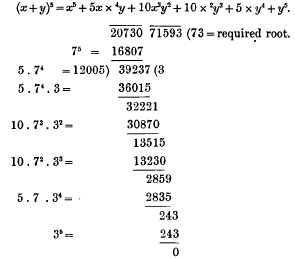
The method of extracting any root may be understood from the subjoined example of extracting the fifth root of 2,073,071,593.
J. T. Wloka, B. Rowley and B. Lawruk Boundary value problems for elliptic systems (Cambridge University Press, Cambridge, 1995), xiv + 641 pp., 0 521 43011 9 (hardback), £60 (US$89.95).
-
- Journal:
- Proceedings of the Edinburgh Mathematical Society / Volume 40 / Issue 2 / June 1997
- Published online by Cambridge University Press:
- 20 January 2009, p. 403
-
- Article
-
- You have access
- Export citation
1. A proof of Dupin's theorem with some simple illustrations of the method employed. 2. Two methods of obtaining Cayley's condition that a family of surfaces may form one of an orthogonal triad. 3. An extension of Dupin's theorem to the case in which a family of surfaces is cut orthogonally by two other families which intersect at a constant angle, with the condition that a family may be capable of being cut in this manner
-
- Journal:
- Proceedings of the Edinburgh Mathematical Society / Volume 29 / February 1910
- Published online by Cambridge University Press:
- 20 January 2009, pp. 41-64
-
- Article
-
- You have access
- Export citation
On the Tucker Circles of a Spherical Triangle
-
- Journal:
- Proceedings of the Edinburgh Mathematical Society / Volume 27 / February 1909
- Published online by Cambridge University Press:
- 20 January 2009, pp. 89-93
-
- Article
-
- You have access
- Export citation
PEM volume 31 issue 1 Cover and Back matter
-
- Journal:
- Proceedings of the Edinburgh Mathematical Society / Volume 31 / Issue 1 / February 1988
- Published online by Cambridge University Press:
- 20 January 2009, p. b1
-
- Article
-
- You have access
- Export citation
On Deducing the Properties of the Trigonometrical Functions from their Addition Equations
-
- Journal:
- Proceedings of the Edinburgh Mathematical Society / Volume 14 / February 1895
- Published online by Cambridge University Press:
- 20 January 2009, pp. 127-134
-
- Article
-
- You have access
- Export citation
-
Take first the Addition-Formula of the Tangent :


Assume that 1 – tanx tanO is not zero for all value of x II.
S. Colombo, Les transformations de Mellin et de Hankel, Monographies du Centre d'Études Mathématiques en vue des Applications, B. Méthodes de Calcul. (Centre National de la Recherche Scientifique, Paris, 1959), 99 pp., 15s. 6d.
-
- Journal:
- Proceedings of the Edinburgh Mathematical Society / Volume 12 / Issue 1 / June 1960
- Published online by Cambridge University Press:
- 20 January 2009, p. 60
-
- Article
-
- You have access
- Export citation
