Contents
Research Article
Engel-like elements in infinite soluble groups
-
- Published online by Cambridge University Press:
- 20 January 2009, pp. 337-343
-
- Article
-
- You have access
- Export citation
Further elementary techniques using the miracle octad generator
-
- Published online by Cambridge University Press:
- 20 January 2009, pp. 345-353
-
- Article
-
- You have access
- Export citation
Rings characterized by their right ideals or cyclic modules
-
- Published online by Cambridge University Press:
- 20 January 2009, pp. 355-362
-
- Article
-
- You have access
- Export citation
On the “zero-two” law for positive contractions*
-
- Published online by Cambridge University Press:
- 20 January 2009, pp. 363-370
-
- Article
-
- You have access
- Export citation
On pseudo-finite near-fields which have finite dimension over the centre
-
- Published online by Cambridge University Press:
- 20 January 2009, pp. 371-375
-
- Article
-
- You have access
- Export citation
Sufficient conditions for a well-behaved Kurosh-Amitsur radical theory
-
- Published online by Cambridge University Press:
- 20 January 2009, pp. 377-394
-
- Article
-
- You have access
- Export citation
Metric spaces and ideals of functions
-
- Published online by Cambridge University Press:
- 20 January 2009, pp. 395-400
-
- Article
-
- You have access
- Export citation
-
In each metric space (X, d) there is defined the space Lip X of complex-valued, bounded, and uniformly Lipschitzian functions. In the algebra Lip X, it is natural to ask for ideals closed in various notions of convergence, and also to identify the invertible elements. In particular, are the invertible elements exactly those with no zero in X? Wiener's Tauberian Theorem in Fourier analysis is the first and most remarkable example of this harmonious state of affairs. A moment's reflection confirms that, for the algebra Lip X, this is true only for compact metric spaces X, the trivial examples in our investigation. We therefore introduce a type of convergence weaker than convergence in norm; it has already proved useful in some problems in descriptive set theory and reflects in a subtle way the metric properties of X. A sequence (fn) in Lip X converges strongly to g, written s – limfn=g, if ∥fn∥≦C in the Banach space Lip X and lim fn(x)=g(x) for each element x of X. In Section 3 we explain how this is really a type of convergence in the dual space of a certain Banach space
 . This brings us to the edge of some recondite questions about iterated (or even transfinite) limits, and we have adhered to the notion of strong limits to avoid these questions. To illustrate the differences between these two approaches, we mention this problem: which maximal ideals of Lip X are closed with respect to strong convergence of sequences? This is not the problem studied in Section 1.
 . This brings us to the edge of some recondite questions about iterated (or even transfinite) limits, and we have adhered to the notion of strong limits to avoid these questions. To illustrate the differences between these two approaches, we mention this problem: which maximal ideals of Lip X are closed with respect to strong convergence of sequences? This is not the problem studied in Section 1.
Calculations of cylindrical p-homotopy groups
-
- Published online by Cambridge University Press:
- 20 January 2009, pp. 401-413
-
- Article
-
- You have access
- Export citation
Invariant subspace theorems for amenable groups
-
- Published online by Cambridge University Press:
- 20 January 2009, pp. 415-430
-
- Article
-
- You have access
- Export citation
Vanishing l1-sums of the Poisson kernel, and sums with positive coefficients
-
- Published online by Cambridge University Press:
- 20 January 2009, pp. 431-447
-
- Article
-
- You have access
- Export citation
-
For z in D and ζ in ∂D, we denote by pz(ζ) the Poisson kernel (1 − │z│2)│1 −
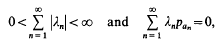
by which we mean that the series converges to zero in the norm of L1(∂D).
Convolution theorems of Titchmarsh type on discrete Rn
-
- Published online by Cambridge University Press:
- 20 January 2009, pp. 449-457
-
- Article
-
- You have access
- Export citation
-
This paper contains results related to Titchmarsh's convolution theorem and valid for
 , the additive group of Rn with the discrete topology. The method of proof consists in transferring the problem to Rn with the usual topology by a procedure which has been used earlier, for instance in Helson [3].
In Section 1, the classical support theorems are generalized to
. In [1], Titchmarsh's convolution theorem [6] on R was generalized to convolutions of functions belonging to certain weighted Lp-spaces on R. Section 2 contains a corresponding generalization to weighted l2(Rd).It should be observed that convolutions of elements f and g in l1(
) can be interpreted as convolutions of bounded discrete measures on Rn. Hence, in that case the support theorem (Theorem 4.33 of Hörmander [5]) is directly applicable to give the results of our Theorems 1 and 3. So the novelty in our theorems lies in the fact that they apply for instance to the case when it is only assumed f, g ∈l2(), together with support conditions. It is not known whether it suffices to assume f∈l1(), g∈lp(), when p > 2.
 , the additive group of
 Homotopy associativity of sphere extensions
-
- Published online by Cambridge University Press:
- 20 January 2009, pp. 459-472
-
- Article
-
- You have access
- Export citation
-
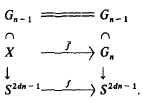
Throughout this paper, we work in the category of (p-localized) spaces having the homotopy type of connected CW-complexes of finite type with base point. We consider a principal bundle

where Gn = SU(n), U(n) or Sp(n) and d = 1, 1 or 2 respectively. In this case, the bundle is obtained as an induced bundle by a mapping f of base space S2dn−1 from the classical group extension as follows:
Atomic spaces and spectra
-
- Published online by Cambridge University Press:
- 20 January 2009, pp. 473-481
-
- Article
-
- You have access
- Export citation
The Borel structure of iterates of continuous functions
-
- Published online by Cambridge University Press:
- 20 January 2009, pp. 483-494
-
- Article
-
- You have access
- Export citation
-
Let C[0,1] be the Banach space of continuous functions defined on [0,1] and let C be the set of functions f∈C[0,1] mapping [0,1] into itself. If f∈C, fk will denote the kth iterate of f and we put Ck = {fk:f∈C;}. The set of increasing (≡ nondecreasing) and decreasing (≡ nonincreasing) functions in C will be denoted by ℐ and D, respectively. If a function f is defined on an interval I, we let C(f) denote the set of points at which f is locally constant, i.e.

We let N denote the set of positive integers and NN denote the Baire space of sequences of positive integers.
Book Reviews
K. M. Davies and Y.-C. Chang Lectures on Bochner-Riesz means (London Mathematical Society Lecture Note Series 114, Cambridge University Press, Cambridge, 1987), pp. x + 150, 0 521 31277 9, paper, £15.
-
- Published online by Cambridge University Press:
- 20 January 2009, p. 495
-
- Article
-
- You have access
- Export citation
R. Oliver Whitehead groups of finite groups (London Mathematical Society Lecture Note Series 132, Cambridge University Press, Cambridge1988) x + 349 pp, paper: 0 521 33646 5, £19.50.
-
- Published online by Cambridge University Press:
- 20 January 2009, pp. 495-496
-
- Article
-
- You have access
- Export citation
D. E. Evans and M. Takesaki Operator algebras and applications, Volume 1: Structure theory; K-theory, geometry and topology; Volume 2: Mathematical physics and subfactors (London Mathematical Society Lecture Note Series 135, 136, Cambridge University Press, Cambridge1988) Vol. 1, viii + 244 pp, paper: 0 521 36843 X, £17.50; Vol. 2, viii + 240 pp, paper: 0 521 36844 8, £17.50.
-
- Published online by Cambridge University Press:
- 20 January 2009, pp. 496-497
-
- Article
-
- You have access
- Export citation
F. Kirwan An introduction to intersection homology theory (Pitman Research Notes in Mathematics Series 187, Longman Scientific and Technical, 1988) 169 pp. 0 582 02879 5, £15.
-
- Published online by Cambridge University Press:
- 20 January 2009, p. 497
-
- Article
-
- You have access
- Export citation
M. Reid Undergraduate algebraic geometry (London Mathematical Society Student Texts 12, Cambridge University Press, Cambridge1988), viii + 129 pp, hard covers: 0 521 35559 1, £20; paper: 0 521 35662 8, £7.50.
-
- Published online by Cambridge University Press:
- 20 January 2009, pp. 497-498
-
- Article
-
- You have access
- Export citation
Front matter
PEM volume 32 issue 3 Cover and Front matter
-
- Published online by Cambridge University Press:
- 20 January 2009, pp. f1-f2
-
- Article
-
- You have access
- Export citation