Refine search
Actions for selected content:
26079 results in Abstract analysis
The Angular Momentum of an Electromagnetic Field
-
- Journal:
- Proceedings of the Edinburgh Mathematical Society / Volume 12 / Issue 4 / December 1961
- Published online by Cambridge University Press:
- 20 January 2009, pp. 171-176
-
- Article
-
- You have access
- Export citation
-
It is known that the behaviour of an electromagnetic field is consistent with it possessing a linear momentum density (1, p. 103)

(Girogi Units are used and the system of notation is the usual one).
H. A. Priestley, Introduction to complex analysis (Oxford University Press, 1985), 197 pp., £8.50.
-
- Journal:
- Proceedings of the Edinburgh Mathematical Society / Volume 30 / Issue 2 / June 1987
- Published online by Cambridge University Press:
- 20 January 2009, pp. 325-326
-
- Article
-
- You have access
- Export citation
Endomorphism near-rings
-
- Journal:
- Proceedings of the Edinburgh Mathematical Society / Volume 17 / Issue 1 / June 1970
- Published online by Cambridge University Press:
- 20 January 2009, pp. 71-78
-
- Article
-
- You have access
- Export citation
A Note on Evaluation of the Integral

-
- Journal:
- Proceedings of the Edinburgh Mathematical Society / Volume 14 / Issue 1 / June 1964
- Published online by Cambridge University Press:
- 20 January 2009, pp. 85-86
-
- Article
-
- You have access
- Export citation

PEM volume 26 issue 3 Cover and Front matter
-
- Journal:
- Proceedings of the Edinburgh Mathematical Society / Volume 26 / Issue 3 / October 1983
- Published online by Cambridge University Press:
- 20 January 2009, pp. f1-f2
-
- Article
-
- You have access
- Export citation
T. H. Hildebrandt, Introduction to the Theory of Integration (Pure and Applied Mathematics Series, Vol. XIII, Academic Press, New York, 1963), ix + 385 pp., 100s.
-
- Journal:
- Proceedings of the Edinburgh Mathematical Society / Volume 14 / Issue 2 / December 1964
- Published online by Cambridge University Press:
- 20 January 2009, p. 169
-
- Article
-
- You have access
- Export citation
BANACH SPACES OF CONTINUOUS VECTOR-VALUED FUNCTIONS OF ORDINALS
-
- Journal:
- Proceedings of the Edinburgh Mathematical Society / Volume 44 / Issue 1 / February 2001
- Published online by Cambridge University Press:
- 20 January 2009, pp. 49-62
-
- Article
-
- You have access
- Export citation
A note on the Wiman–Valiron method
-
- Journal:
- Proceedings of the Edinburgh Mathematical Society / Volume 37 / Issue 1 / February 1994
- Published online by Cambridge University Press:
- 20 January 2009, pp. 53-55
-
- Article
-
- You have access
- Export citation
J. R. Weeks, The shape of space: how to visualize surfaces and three-dimensional manifolds (Pure and Applied Mathematics Vol. 96, Marcel Dekker, New York, 1985), x + 324 pp., $59.50.
-
- Journal:
- Proceedings of the Edinburgh Mathematical Society / Volume 30 / Issue 2 / June 1987
- Published online by Cambridge University Press:
- 20 January 2009, p. 327
-
- Article
-
- You have access
- Export citation
2-groups with few conjugacy classes
-
- Journal:
- Proceedings of the Edinburgh Mathematical Society / Volume 43 / Issue 1 / February 2000
- Published online by Cambridge University Press:
- 20 January 2009, pp. 211-217
-
- Article
-
- You have access
- Export citation
On asymptotic behaviours of trigonometric series with δ-Quasi-monotone coefficients
-
- Journal:
- Proceedings of the Edinburgh Mathematical Society / Volume 16 / Issue 4 / December 1969
- Published online by Cambridge University Press:
- 20 January 2009, pp. 305-316
-
- Article
-
- You have access
- Export citation
-
Let
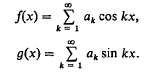
The asymptotic behaviours of ƒ(x) and g(x), as x→+0, were first given by G. H. Hardy in (4), (5). In his papers {an}; is a monotone decreasing sequence. Further results on the asymptotic behaviours of ƒ(x) and g(x), as x→+0, for monotone coefficients have been given in (9) and (1). Recently, the results have been generalized to quasi-monotone coefficients.
This paper is concerned with asymptotic behaviours of ƒ(x) and g(x) for δ-quasi-monotone coefficients.
In what follows, we shall denote by L(x) a slowly varying function in the sense of Karamata (6), i.e.
PEM volume 28 issue 1 Cover and Back matter
-
- Journal:
- Proceedings of the Edinburgh Mathematical Society / Volume 28 / Issue 1 / February 1985
- Published online by Cambridge University Press:
- 20 January 2009, p. b1
-
- Article
-
- You have access
- Export citation
An exclusion theorem for tri-diagonal matrices
-
- Journal:
- Proceedings of the Edinburgh Mathematical Society / Volume 16 / Issue 3 / June 1969
- Published online by Cambridge University Press:
- 20 January 2009, pp. 251-253
-
- Article
-
- You have access
- Export citation
-
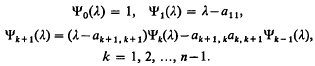
An n × n matrix An = (aij) is tri-diagonal if aij = 0 for |i−j|≧2. The latent roots of such matrices may be conveniently studied by forming the sequence of polynomials Ψk(λ)=|λI−Ak|, where Ak is the principal submatrix of Ak+1 obtained by deleting the last row and column of Ak+1, and then observing that these polynomials satisfy the following recurrence relation:
PEM volume 7 Cover and Front matter
-
- Journal:
- Proceedings of the Edinburgh Mathematical Society / Volume 7 / February 1888
- Published online by Cambridge University Press:
- 20 January 2009, pp. f1-f5
-
- Article
-
- You have access
- Export citation
J. P. Jans Rings and Homology (Holt, Rinehart and Winston, London, 1964), 88 pp., 28s.
-
- Journal:
- Proceedings of the Edinburgh Mathematical Society / Volume 14 / Issue 4 / December 1965
- Published online by Cambridge University Press:
- 20 January 2009, pp. 339-340
-
- Article
-
- You have access
- Export citation
PEM volume 43 issue 3 Cover and Back matter
-
- Journal:
- Proceedings of the Edinburgh Mathematical Society / Volume 43 / Issue 3 / October 2000
- Published online by Cambridge University Press:
- 20 January 2009, pp. b1-b2
-
- Article
-
- You have access
- Export citation
Differential properties of some dense subalgebras of C*-algebras
-
- Journal:
- Proceedings of the Edinburgh Mathematical Society / Volume 37 / Issue 3 / October 1994
- Published online by Cambridge University Press:
- 20 January 2009, pp. 399-422
-
- Article
-
- You have access
- Export citation
-
The paper studies some classes of dense *-subalgebras B of C*-algebras A whose properties are close to the properties of the algebras of differentiable functions. In terms of a set of norms
 on B it defines
  -subalgebras of A and establishes that they are locally normal Q*-subalgebras. If x = x* ∈ B and f(t) is a function on Sp(x), some sufficient conditions are given for f(x) to belong to B. For p = 1, in particular, it is shown that
  -subalgebras are closed under C∞-calculus. If δ is a closed derivation of A, the algebras D(δp) are -subalgebras of A. In the case when δ is a generator of a one-parameter semigroup of automorphisms of A, it is proved that, in fact, D(δp) are -subalgebras. The paper also characterizes those Banach *-algebras which are isomorphic to subalgebras of C*-algebras.
 on B it defines
  -subalgebras of A and establishes that they are locally normal Q*-subalgebras. If x = x* ∈ B and f(t) is a function on Sp(x), some sufficient conditions are given for f(x) to belong to B. For p = 1, in particular, it is shown that
  -subalgebras are closed under C
E. Grosswald, Representations of integers as sums of squares (Springer-Verlag, 1985) 251 pp., DM 148.
-
- Journal:
- Proceedings of the Edinburgh Mathematical Society / Volume 30 / Issue 2 / June 1987
- Published online by Cambridge University Press:
- 20 January 2009, pp. 327-329
-
- Article
-
- You have access
- Export citation
More On the countability index and the density index of S(X)
-
- Journal:
- Proceedings of the Edinburgh Mathematical Society / Volume 33 / Issue 1 / February 1990
- Published online by Cambridge University Press:
- 20 January 2009, pp. 159-164
-
- Article
-
- You have access
- Export citation
On some properties of the quadrilateral
-
- Journal:
- Proceedings of the Edinburgh Mathematical Society / Volume 8 / February 1889
- Published online by Cambridge University Press:
- 20 January 2009, pp. 27-29
-
- Article
-
- You have access
- Export citation
