Refine search
Actions for selected content:
26080 results in Abstract analysis
On a Signorini problem for inclusions in shells
-
- Journal:
- European Journal of Applied Mathematics / Volume 7 / Issue 5 / October 1996
- Published online by Cambridge University Press:
- 26 September 2008, pp. 499-510
-
- Article
- Export citation
EJM volume 6 issue 2 Cover and Front matter
-
- Journal:
- European Journal of Applied Mathematics / Volume 6 / Issue 2 / April 1995
- Published online by Cambridge University Press:
- 26 September 2008, pp. f1-f2
-
- Article
-
- You have access
- Export citation
On the asymptotics of solutions of a class of linear functional-differential equations
-
- Journal:
- European Journal of Applied Mathematics / Volume 7 / Issue 5 / October 1996
- Published online by Cambridge University Press:
- 26 September 2008, pp. 511-518
-
- Article
- Export citation
-
A sharp estimate of the growth of solutions of the initial value problem for systems of the form
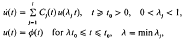
where Cj(t) are matrices with elements of power growth, is found. As a corollary of this result, it follows, for instance, that each solution of the initial value problem satisfies the estimate ‖u(t)‖ ≤ Cexp{γln2(1+|t|)} for some C > 0 and γ > 0.
Nucleation of superconductivity in decreasing fields. II
-
- Journal:
- European Journal of Applied Mathematics / Volume 5 / Issue 4 / December 1994
- Published online by Cambridge University Press:
- 26 September 2008, pp. 469-494
-
- Article
- Export citation
On nonclassical invertible transformations of hyperbolic equations
-
- Journal:
- European Journal of Applied Mathematics / Volume 6 / Issue 2 / April 1995
- Published online by Cambridge University Press:
- 26 September 2008, pp. 145-156
-
- Article
- Export citation
-
The main result of this paper is a complete description of local invertible transformations

relating one equation of the form uxy = F(x, y, u, ux, uy) to another equation of the form υxy = G(x, y, υ, υx, υy).
Slowly varying filtration combustion waves†
-
- Journal:
- European Journal of Applied Mathematics / Volume 4 / Issue 2 / June 1993
- Published online by Cambridge University Press:
- 26 September 2008, pp. 205-224
-
- Article
- Export citation
A one-dimensional quasi-static contact problem in linear thermoelasticity
-
- Journal:
- European Journal of Applied Mathematics / Volume 4 / Issue 2 / June 1993
- Published online by Cambridge University Press:
- 26 September 2008, pp. 151-174
-
- Article
- Export citation
A mathematical model of damage accumulation taking into account microstructural effects
-
- Journal:
- European Journal of Applied Mathematics / Volume 4 / Issue 3 / September 1993
- Published online by Cambridge University Press:
- 26 September 2008, pp. 225-240
-
- Article
- Export citation
Author Index to Volume 6
-
- Journal:
- European Journal of Applied Mathematics / Volume 6 / Issue 6 / December 1995
- Published online by Cambridge University Press:
- 26 September 2008, pp. 653-654
-
- Article
- Export citation
Theorem on the existence of solutions of quasi-static moving boundary problems
-
- Journal:
- European Journal of Applied Mathematics / Volume 6 / Issue 5 / October 1995
- Published online by Cambridge University Press:
- 26 September 2008, pp. 529-538
-
- Article
- Export citation
Author Index to Volume 7
-
- Journal:
- European Journal of Applied Mathematics / Volume 7 / Issue 6 / December 1996
- Published online by Cambridge University Press:
- 26 September 2008, pp. 669-670
-
- Article
- Export citation
On boundary value problems in fracture of elastic Composites
-
- Journal:
- European Journal of Applied Mathematics / Volume 6 / Issue 6 / December 1995
- Published online by Cambridge University Press:
- 26 September 2008, pp. 591-610
-
- Article
- Export citation
Variational model of sandpile growth
-
- Journal:
- European Journal of Applied Mathematics / Volume 7 / Issue 3 / June 1996
- Published online by Cambridge University Press:
- 26 September 2008, pp. 225-235
-
- Article
- Export citation
On the Bean critical-state model in superconductivity
-
- Journal:
- European Journal of Applied Mathematics / Volume 7 / Issue 3 / June 1996
- Published online by Cambridge University Press:
- 26 September 2008, pp. 237-247
-
- Article
- Export citation
The anomalous exponent of the Barenblatt equation
-
- Journal:
- European Journal of Applied Mathematics / Volume 5 / Issue 2 / June 1994
- Published online by Cambridge University Press:
- 26 September 2008, pp. 165-175
-
- Article
- Export citation
EJM volume 5 issue 1 Cover and Front matter
-
- Journal:
- European Journal of Applied Mathematics / Volume 5 / Issue 1 / March 1994
- Published online by Cambridge University Press:
- 26 September 2008, pp. f1-f2
-
- Article
-
- You have access
- Export citation
Thermal runaway in a non-local problem modelling Ohmic heating. Part II: General proof of blow-up and asymptotics of runaway
-
- Journal:
- European Journal of Applied Mathematics / Volume 6 / Issue 3 / June 1995
- Published online by Cambridge University Press:
- 26 September 2008, pp. 201-224
-
- Article
- Export citation
-
We consider the non-local problem

It is found that for the case of decreasing f then: (i) for

there is a unique steady state which is globally asymptotically stable; (ii) for

then the problem can be scaled so that

in which case: (a) for λ < 8 there is a unique steady state which is globally asymptotically stable; (b) for λ = 8 there is no steady state and u is unbounded; (c) for λ > 8 there is no steady state and u blows up for all x, −1 < x, < 1. Some formal asymptotic estimates for the local behaviour of u as it blows up are obtained.


Diffractive optics in nonlinear media with periodic structure
-
- Journal:
- European Journal of Applied Mathematics / Volume 6 / Issue 6 / December 1995
- Published online by Cambridge University Press:
- 26 September 2008, pp. 573-590
-
- Article
- Export citation
On the solution of a class of polydisperse spray problems
-
- Journal:
- European Journal of Applied Mathematics / Volume 7 / Issue 1 / February 1996
- Published online by Cambridge University Press:
- 26 September 2008, pp. 75-96
-
- Article
- Export citation
EJM volume 7 issue 4 Cover and Back matter
-
- Journal:
- European Journal of Applied Mathematics / Volume 7 / Issue 4 / August 1996
- Published online by Cambridge University Press:
- 26 September 2008, pp. b1-b2
-
- Article
-
- You have access
- Export citation
