Refine search
Actions for selected content:
26080 results in Abstract analysis
Questions de corps de définition pour les variétés abéliennes en caractéristique positive
- Part of
-
- Journal:
- Journal of the Institute of Mathematics of Jussieu / Volume 7 / Issue 4 / October 2008
- Published online by Cambridge University Press:
- 07 October 2008, pp. 623-639
- Print publication:
- October 2008
-
- Article
- Export citation
On types of CB-rank 1 in simple theories
- Part of
-
- Journal:
- Journal of the Institute of Mathematics of Jussieu / Volume 7 / Issue 4 / October 2008
- Published online by Cambridge University Press:
- 07 October 2008, pp. 895-899
- Print publication:
- October 2008
-
- Article
- Export citation
De non ordinaria recognitione PSL2
- Part of
-
- Journal:
- Journal of the Institute of Mathematics of Jussieu / Volume 7 / Issue 4 / October 2008
- Published online by Cambridge University Press:
- 07 October 2008, pp. 723-734
- Print publication:
- October 2008
-
- Article
- Export citation
Mappings of finite distortion: a new proof for discreteness and openness
-
- Journal:
- Proceedings of the Royal Society of Edinburgh. Section A: Mathematics / Volume 138 / Issue 5 / October 2008
- Published online by Cambridge University Press:
- 08 October 2008, pp. 1097-1102
- Print publication:
- October 2008
-
- Article
- Export citation
-
We give a new and elementary proof of the known result: a non-constant mapping of finite distortion f : Ω ⊂ ℝn → ℝn is discrete and open, provided that its distortion function
 if n = 2 and that
  for some p > n − 1 if n ≥ 3.
 if n = 2 and that
  for some p > n − 1 if n ≥ 3.
Logicum Lugdunensis
-
- Journal:
- Journal of the Institute of Mathematics of Jussieu / Volume 7 / Issue 4 / October 2008
- Published online by Cambridge University Press:
- 07 October 2008, p. 621
- Print publication:
- October 2008
-
- Article
- Export citation
Stationary surfaces in Lorentz–Minkowski space
-
- Journal:
- Proceedings of the Royal Society of Edinburgh. Section A: Mathematics / Volume 138 / Issue 5 / October 2008
- Published online by Cambridge University Press:
- 08 October 2008, pp. 1067-1096
- Print publication:
- October 2008
-
- Article
- Export citation
Solutions to a model for interface motion by interface diffusion
-
- Journal:
- Proceedings of the Royal Society of Edinburgh. Section A: Mathematics / Volume 138 / Issue 5 / October 2008
- Published online by Cambridge University Press:
- 08 October 2008, pp. 923-955
- Print publication:
- October 2008
-
- Article
- Export citation
EJM volume 6 issue 3 Cover and Back matter
-
- Journal:
- European Journal of Applied Mathematics / Volume 6 / Issue 3 / June 1995
- Published online by Cambridge University Press:
- 26 September 2008, pp. b1-b5
-
- Article
-
- You have access
- Export citation
Some mathematical results in the pricing of American options
-
- Journal:
- European Journal of Applied Mathematics / Volume 4 / Issue 4 / December 1993
- Published online by Cambridge University Press:
- 26 September 2008, pp. 381-398
-
- Article
- Export citation
EJM volume 7 issue 2 Cover and Back matter
-
- Journal:
- European Journal of Applied Mathematics / Volume 7 / Issue 2 / April 1996
- Published online by Cambridge University Press:
- 26 September 2008, pp. b1-b3
-
- Article
-
- You have access
- Export citation
Mathematical model and method for spontaneous potential well-logging
-
- Journal:
- European Journal of Applied Mathematics / Volume 5 / Issue 2 / June 1994
- Published online by Cambridge University Press:
- 26 September 2008, pp. 123-139
-
- Article
- Export citation
Mullins–Sekerka stability analysis for melting-freezing waves in helium
-
- Journal:
- European Journal of Applied Mathematics / Volume 5 / Issue 1 / March 1994
- Published online by Cambridge University Press:
- 26 September 2008, pp. 21-37
-
- Article
- Export citation
A sharp interface limit of the phase field equations: one-dimensional and axisymmetric
-
- Journal:
- European Journal of Applied Mathematics / Volume 7 / Issue 6 / December 1996
- Published online by Cambridge University Press:
- 26 September 2008, pp. 603-633
-
- Article
- Export citation
-
We study the singular limit of the dimensionless phase-field equations
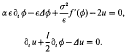
We consider two cases: either the space dimension is 1 and then ɛ tends to zero; or the solutions are radially symmetric and then both ɛ and α tend to zero. It turns out that, in the first case, the limiting functions solve the Stefan problem with kinetic undercooling, provided the initial temperature is small compared to the surface tension and the latent heat. In the second case, the limiting functions satisfy the Stefan problem coupled with the Gibbs–Thomson law for the melting temperature. We show, in addition, that the multiplicity of the interface is always one, in a sense to be explained at the end of § 1. As main tool we use energy type estimates, and prove that the formal first-order asymptotic expansion with respect to ɛ in fact gives an approximation of the exact solution. Our results hold without smoothness assumptions on the limiting Stefan problem.
EJM volume 7 issue 5 Cover and Front matter
-
- Journal:
- European Journal of Applied Mathematics / Volume 7 / Issue 5 / October 1996
- Published online by Cambridge University Press:
- 26 September 2008, pp. f1-f2
-
- Article
-
- You have access
- Export citation
Author Index to Volume 4
-
- Journal:
- European Journal of Applied Mathematics / Volume 4 / Issue 4 / December 1993
- Published online by Cambridge University Press:
- 26 September 2008, pp. 449-450
-
- Article
- Export citation
B-determining equations: applications to nonlinear partial differential equations
-
- Journal:
- European Journal of Applied Mathematics / Volume 6 / Issue 3 / June 1995
- Published online by Cambridge University Press:
- 26 September 2008, pp. 265-286
-
- Article
- Export citation
Thermal runaway in a non-local problem modelling Ohmic heating: Part I: Model derivation and some special cases
-
- Journal:
- European Journal of Applied Mathematics / Volume 6 / Issue 2 / April 1995
- Published online by Cambridge University Press:
- 26 September 2008, pp. 127-144
-
- Article
- Export citation
-
We consider the non-local problem

which models the temperature when an electric current flows through a material with temperature dependent electrical resistivity f(u) > 0, subject to a fixed potential difference. It is found that for some special cases where f is decreasing and

so the problem can be scaled to make

then:(a) for λ < 8 there is a unique steady state which is globally asymptotically stable: (b) for λ = 8 there is no steady state and u is unbounded; (c) for λ > 8 there is no steady state and u blows up for all x, – 1 < x < 1.


EJM volume 4 issue 1 Cover and Back matter
-
- Journal:
- European Journal of Applied Mathematics / Volume 4 / Issue 1 / March 1993
- Published online by Cambridge University Press:
- 26 September 2008, pp. b1-b2
-
- Article
-
- You have access
- Export citation
EJM volume 4 issue 4 Cover and Front matter
-
- Journal:
- European Journal of Applied Mathematics / Volume 4 / Issue 4 / December 1993
- Published online by Cambridge University Press:
- 26 September 2008, pp. f1-f2
-
- Article
-
- You have access
- Export citation
On nonlinear interface dynamics in Hele-Shaw flows
-
- Journal:
- European Journal of Applied Mathematics / Volume 6 / Issue 5 / October 1995
- Published online by Cambridge University Press:
- 26 September 2008, pp. 399-420
-
- Article
- Export citation
