Refine search
Actions for selected content:
26080 results in Abstract analysis
10 - More criteria for strong regularity
-
- Book:
- J-Contractive Matrix Valued Functions and Related Topics
- Published online:
- 10 May 2010
- Print publication:
- 06 November 2008, pp 515-535
-
- Chapter
- Export citation
Preface
-
- Book:
- J-Contractive Matrix Valued Functions and Related Topics
- Published online:
- 10 May 2010
- Print publication:
- 06 November 2008, pp xi-xii
-
- Chapter
- Export citation
7 - Generalized interpolation problems
-
- Book:
- J-Contractive Matrix Valued Functions and Related Topics
- Published online:
- 10 May 2010
- Print publication:
- 06 November 2008, pp 358-419
-
- Chapter
- Export citation
5 - Reproducing kernel Hilbert spaces
-
- Book:
- J-Contractive Matrix Valued Functions and Related Topics
- Published online:
- 10 May 2010
- Print publication:
- 06 November 2008, pp 240-333
-
- Chapter
- Export citation
9 - Darlington representations and related inverse problems
-
- Book:
- J-Contractive Matrix Valued Functions and Related Topics
- Published online:
- 10 May 2010
- Print publication:
- 06 November 2008, pp 470-514
-
- Chapter
- Export citation
When is an Almost Monochromatic K4 Guaranteed?
-
- Journal:
- Combinatorics, Probability and Computing / Volume 17 / Issue 6 / November 2008
- Published online by Cambridge University Press:
- 01 November 2008, pp. 823-830
-
- Article
- Export citation
Coloured Loop-Erased Random Walk on the Complete Graph
-
- Journal:
- Combinatorics, Probability and Computing / Volume 17 / Issue 6 / November 2008
- Published online by Cambridge University Press:
- 01 November 2008, pp. 727-740
-
- Article
- Export citation
The Hitting Time for the Height of a Random Recursive Tree
-
- Journal:
- Combinatorics, Probability and Computing / Volume 17 / Issue 6 / November 2008
- Published online by Cambridge University Press:
- 01 November 2008, pp. 831-835
-
- Article
- Export citation
B2[g] Sets and a Conjecture of Schinzel and Schmidt
-
- Journal:
- Combinatorics, Probability and Computing / Volume 17 / Issue 6 / November 2008
- Published online by Cambridge University Press:
- 01 November 2008, pp. 741-747
-
- Article
- Export citation
-
A set of integers

 where ϵg → 0 when g → ∞. We show a connection between this problem and another one discussed by Schinzel and Schmidt, which can be considered its continuous version.

 where ϵ
Individual Displacements in Hashing with Coalesced Chains
-
- Journal:
- Combinatorics, Probability and Computing / Volume 17 / Issue 6 / November 2008
- Published online by Cambridge University Press:
- 01 November 2008, pp. 799-814
-
- Article
- Export citation
A Weakening of the Odd Hadwiger's Conjecture
-
- Journal:
- Combinatorics, Probability and Computing / Volume 17 / Issue 6 / November 2008
- Published online by Cambridge University Press:
- 01 November 2008, pp. 815-821
-
- Article
- Export citation
-
Gerards and Seymour (see [10], p. 115) conjectured that if a graph has no odd complete minor of order l, then it is (l − 1)-colourable. This is an analogue of the well-known conjecture of Hadwiger, and in fact, this would immediately imply Hadwiger's conjecture. The current best-known bound for the chromatic number of graphs with no odd complete minor of order l is
 by the recent result by Geelen, Gerards, Reed, Seymour and Vetta [8], and by Kawarabayashi [12] later, independently. But it seems very hard to improve this bound since this would also improve the current best-known bound for the chromatic number of graphs with no complete minor of order l.
Motivated by this problem, in this note we show that there exists an absolute constant f(k) such that any graph G with no odd complete minor of order k admits a vertex partition V1, . . ., V496k such that each component in the subgraph induced on Vi (i ≥ 1) has at most f(k) vertices. When f(k) = 1, this is a colouring of G. Hence this is a relaxation of colouring in a sense, and this is the first result in this direction for the odd Hadwiger's conjecture.
Our proof is based on a recent decomposition theorem due to Geelen, Gerards, Reed, Seymour and Vetta [8], together with a connectivity result that forces a huge complete bipartite minor in large graphs by Böhme, Kawarabayashi, Maharry and Mohar [3].
 by the recent result by Geelen, Gerards, Reed, Seymour and Vetta [8], and by Kawarabayashi [12] later, independently. But it seems very hard to improve this bound since this would also improve the current best-known bound for the chromatic number of graphs with no complete minor of order l.
Bounds For The Real Zeros of Chromatic Polynomials
-
- Journal:
- Combinatorics, Probability and Computing / Volume 17 / Issue 6 / November 2008
- Published online by Cambridge University Press:
- 01 November 2008, pp. 749-759
-
- Article
- Export citation
Winning Fast in Sparse Graph Construction Games
-
- Journal:
- Combinatorics, Probability and Computing / Volume 17 / Issue 6 / November 2008
- Published online by Cambridge University Press:
- 01 November 2008, pp. 781-791
-
- Article
- Export citation
On a Form of Coordinate Percolation
-
- Journal:
- Combinatorics, Probability and Computing / Volume 17 / Issue 6 / November 2008
- Published online by Cambridge University Press:
- 01 November 2008, pp. 837-845
-
- Article
- Export citation
-
Let ai,bi, i = 0, 1, 2, . . . be drawn uniformly and independently from the unit interval, and let t be a fixed real number. Let a site (i, j) ∈
 be open if ai + bj ≤ t, and closed otherwise. We obtain a simple, exact expression for the probability Θ(t) that there is an infinite path (oriented or not) of open sites, containing the origin. Θ(t) is continuous and has continuous first derivative except at the critical point (t=1), near which it has critical exponent (3 −
  )/2.
)/2.
 be open if a
 )/2.
)/2.A Weighted Generalization of Gao's n + D − 1 Theorem
-
- Journal:
- Combinatorics, Probability and Computing / Volume 17 / Issue 6 / November 2008
- Published online by Cambridge University Press:
- 01 November 2008, pp. 793-798
-
- Article
- Export citation
-
Let G denote a finite abelian group of order n and Davenport constant D, and put m = n + D − 1. Let x = (x1,. . .,xm) ∈ Gm. Gao's theorem states that there is a reordering (xj1, . . ., xjm) of x such that

Let w = (x1, . . ., wm) ∈ ℤm. As a corollary of the main result, we show that there are reorderings (xj1, . . ., xjm) of x and (wk1, . . ., wkm) of w, such that
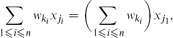 where xj1 is the most repeated value in x. For w = (1, . . ., 1), this result reduces to Gao's theorem.

Dobrushin Conditions and Systematic Scan
-
- Journal:
- Combinatorics, Probability and Computing / Volume 17 / Issue 6 / November 2008
- Published online by Cambridge University Press:
- 01 November 2008, pp. 761-779
-
- Article
- Export citation
Regularity at space-like and null infinity
- Part of
-
- Journal:
- Journal of the Institute of Mathematics of Jussieu / Volume 8 / Issue 1 / January 2009
- Published online by Cambridge University Press:
- 24 October 2008, pp. 179-208
- Print publication:
- January 2009
-
- Article
- Export citation
9 - Analysis on foliated spaces and arithmetic geometry
-
-
- Book:
- Groups and Analysis
- Published online:
- 12 May 2010
- Print publication:
- 16 October 2008, pp 174-190
-
- Chapter
- Export citation
10 - Reciprocity algebras and branching
-
-
- Book:
- Groups and Analysis
- Published online:
- 12 May 2010
- Print publication:
- 16 October 2008, pp 191-231
-
- Chapter
- Export citation
5 - Sharp spectral inequalities for the Heisenberg Laplacian
-
-
- Book:
- Groups and Analysis
- Published online:
- 12 May 2010
- Print publication:
- 16 October 2008, pp 100-115
-
- Chapter
- Export citation
