Refine search
Actions for selected content:
26080 results in Abstract analysis
Vector Fields Tangent to Foliations
-
- Journal:
- Proceedings of the Edinburgh Mathematical Society / Volume 51 / Issue 3 / October 2008
- Published online by Cambridge University Press:
- 12 December 2008, pp. 765-778
-
- Article
-
- You have access
- Export citation
Sylow Normalizers with a Normal Sylow 2-Subgroup
-
- Journal:
- Proceedings of the Edinburgh Mathematical Society / Volume 51 / Issue 3 / October 2008
- Published online by Cambridge University Press:
- 12 December 2008, pp. 779-783
-
- Article
-
- You have access
- Export citation
Non-Terminating Basic Hypergeometric Series and the q-Zeilberger Algorithm
-
- Journal:
- Proceedings of the Edinburgh Mathematical Society / Volume 51 / Issue 3 / October 2008
- Published online by Cambridge University Press:
- 12 December 2008, pp. 609-633
-
- Article
-
- You have access
- Export citation
The Distribution of Finite Values of Meromorphic Functions with Deficient Poles
-
- Journal:
- Proceedings of the Edinburgh Mathematical Society / Volume 51 / Issue 3 / October 2008
- Published online by Cambridge University Press:
- 12 December 2008, pp. 697-709
-
- Article
-
- You have access
- Export citation
William Dunham The Genius of Euler: Reflections on His Life and Work (Mathematical Association of America, 2007), 309 pp, 0 883 85558 5/9 780 883 85558 4 (hardback), £25.99 - C. Edward Sandifer The Early Mathematics of Leonhard Euler (Mathematical Association of America, 2007), 391 pp, 0 883 85559 3/9 780 883 85559 1 (hardback), £25.99.
-
- Journal:
- Proceedings of the Edinburgh Mathematical Society / Volume 51 / Issue 3 / October 2008
- Published online by Cambridge University Press:
- 12 December 2008, pp. 807-808
-
- Article
-
- You have access
- Export citation
On the Critical Fujita Exponent for a Degenerate Parabolic System Coupled Via Nonlinear Boundary Flux
-
- Journal:
- Proceedings of the Edinburgh Mathematical Society / Volume 51 / Issue 3 / October 2008
- Published online by Cambridge University Press:
- 12 December 2008, pp. 785-805
-
- Article
-
- You have access
- Export citation
The Spectrum of Periodic Jacobi Matrices with Slowly Oscillating Diagonal Terms
-
- Journal:
- Proceedings of the Edinburgh Mathematical Society / Volume 51 / Issue 3 / October 2008
- Published online by Cambridge University Press:
- 12 December 2008, pp. 751-763
-
- Article
-
- You have access
- Export citation
Algebraic and Geometric Theory of the Topological Ring of Colombeau Generalized Functions
-
- Journal:
- Proceedings of the Edinburgh Mathematical Society / Volume 51 / Issue 3 / October 2008
- Published online by Cambridge University Press:
- 12 December 2008, pp. 545-564
-
- Article
-
- You have access
- Export citation
-
We continue the investigation of the algebraic and topological structure of the algebra of Colombeau generalized functions with the aim of building up the algebraic basis for the theory of these functions. This was started in a previous work of Aragona and Juriaans, where the algebraic and topological structure of the Colombeau generalized numbers were studied. Here, among other important things, we determine completely the minimal primes of
 and introduce several invariants of the ideals of
  (Ω). The main tools we use are the algebraic results obtained by Aragona and Juriaans and the theory of differential calculus on generalized manifolds developed by Aragona and co-workers. The main achievement of the differential calculus is that all classical objects, such as distributions, become C∞-functions. Our purpose is to build an independent and intrinsic theory for Colombeau generalized functions and place them in a wider context.
 and introduce several invariants of the ideals of
  (Ω). The main tools we use are the algebraic results obtained by Aragona and Juriaans and the theory of differential calculus on generalized manifolds developed by Aragona and co-workers. The main achievement of the differential calculus is that all classical objects, such as distributions, become C
Lamé Equation, Quantum Euler Top and Elliptic Bernoulli Polynomials
-
- Journal:
- Proceedings of the Edinburgh Mathematical Society / Volume 51 / Issue 3 / October 2008
- Published online by Cambridge University Press:
- 12 December 2008, pp. 635-650
-
- Article
-
- You have access
- Export citation
Generalized Prüfer Angle and Variational Methods for p-Laplacian Eigenvalue Problems on the Half-Line
-
- Journal:
- Proceedings of the Edinburgh Mathematical Society / Volume 51 / Issue 3 / October 2008
- Published online by Cambridge University Press:
- 12 December 2008, pp. 565-579
-
- Article
-
- You have access
- Export citation
-
The nonlinear eigenvalue problem

for 0 ≤ x < ∞, fixed p ∈ (1, ∞), and with y′(0)/y(0) specified, is studied under conditions on q related to those of Brinck and Mol
 anov. Topics include Sturmian results, connections between problems on finite intervals and the half-line, and variational principles.
 anov. Topics include Sturmian results, connections between problems on finite intervals and the half-line, and variational principles.
A two-fluid model for tissue growth within a dynamic flow environment
-
- Journal:
- European Journal of Applied Mathematics / Volume 19 / Issue 6 / December 2008
- Published online by Cambridge University Press:
- 01 December 2008, pp. 607-634
-
- Article
- Export citation
Pulsating wave for mean curvature flow in inhomogeneous medium
-
- Journal:
- European Journal of Applied Mathematics / Volume 19 / Issue 6 / December 2008
- Published online by Cambridge University Press:
- 01 December 2008, pp. 661-699
-
- Article
- Export citation
On periodic Stokesian Hele-Shaw flows with surface tension
-
- Journal:
- European Journal of Applied Mathematics / Volume 19 / Issue 6 / December 2008
- Published online by Cambridge University Press:
- 01 December 2008, pp. 717-734
-
- Article
- Export citation
Reconstruction in the inverse crack problem by variational methods
-
- Journal:
- European Journal of Applied Mathematics / Volume 19 / Issue 6 / December 2008
- Published online by Cambridge University Press:
- 01 December 2008, pp. 635-660
-
- Article
- Export citation
Finding symmetries by incorporating initial conditions as side conditions
-
- Journal:
- European Journal of Applied Mathematics / Volume 19 / Issue 6 / December 2008
- Published online by Cambridge University Press:
- 01 December 2008, pp. 701-715
-
- Article
- Export citation
Réalisation de Hodge du polylogarithme d'un schéma abélien
- Part of
-
- Journal:
- Journal of the Institute of Mathematics of Jussieu / Volume 8 / Issue 1 / January 2009
- Published online by Cambridge University Press:
- 20 November 2008, pp. 1-38
- Print publication:
- January 2009
-
- Article
- Export citation
Uniqueness of nodal radial solutions superlinear elliptic equations in a ball
-
- Journal:
- Proceedings of the Royal Society of Edinburgh. Section A: Mathematics / Volume 138 / Issue 6 / December 2008
- Published online by Cambridge University Press:
- 12 November 2008, pp. 1331-1343
- Print publication:
- December 2008
-
- Article
- Export citation
-
The Dirichlet problem

is considered, where B = {x ∈ ℝN : |x| < 1}, N ≥ 3, p > 1, K ∈ C2[0, 1] and K(r) > 0 for 0 ≤ r ≤ 1. A sufficient condition is derived for the uniqueness of radial solutions of (*) possessing exactly k − 1 nodes, where k ∈ ℕ. It is also shown that there exists K ∈ C∞[0, 1] such that (*) has at least three radial solutions possessing exactly k − 1 nodes, in the case 1 < p < (N + 2)/(N − 2).
Boundary blow-up elliptic problems with nonlinear gradient terms and singular weights
-
- Journal:
- Proceedings of the Royal Society of Edinburgh. Section A: Mathematics / Volume 138 / Issue 6 / December 2008
- Published online by Cambridge University Press:
- 12 November 2008, pp. 1403-1424
- Print publication:
- December 2008
-
- Article
- Export citation
Homogenization of the nonlinear Maxwell model of viscoelasticity and of the Prandtl—Reuss model of elastoplasticity
-
- Journal:
- Proceedings of the Royal Society of Edinburgh. Section A: Mathematics / Volume 138 / Issue 6 / December 2008
- Published online by Cambridge University Press:
- 12 November 2008, pp. 1363-1401
- Print publication:
- December 2008
-
- Article
- Export citation
-
This paper deals with processes in nonlinear inelastic materials whose constitutive behaviour is represented by the inclusion
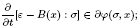
here we denote by σ the stress tensor, by ε the linearized strain tensor, by B(x) the compliance tensor and by ∂ϕ(·, x) the subdifferential of a convex function ϕ(·, x). This relation accounts for elasto-viscoplasticity, including a nonlinear version of the classical Maxwell model of viscoelasticity and the Prandtl—Reuss model of elastoplasticity.
The constitutive law is coupled with the equation of continuum dynamics, and well-posedness is proved for an initial- and boundary-value problem. The function ϕ and the tensor B are then assumed to oscillate periodically with respect to x and, as this period vanishes, a two-scale model of the asymptotic behaviour is derived via Nguetseng's notion of two-scale convergence. A fully homogenized single-scale model is also retrieved, and its equivalence with the two-scale problem is proved. This formulation is non-local in time and is at variance with that based on so-called analogical models that rest on a mean-field-type hypothesis.
Some reiteration results for interpolation methods defined by means of polygons
-
- Journal:
- Proceedings of the Royal Society of Edinburgh. Section A: Mathematics / Volume 138 / Issue 6 / December 2008
- Published online by Cambridge University Press:
- 12 November 2008, pp. 1179-1195
- Print publication:
- December 2008
-
- Article
- Export citation
