Refine search
Actions for selected content:
26080 results in Abstract analysis
Historical Notes on a Geometrical Theorem and its Developments. [18th century.]
-
- Journal:
- Proceedings of the Edinburgh Mathematical Society / Volume 5 / February 1886
- Published online by Cambridge University Press:
- 20 January 2009, pp. 62-78
-
- Article
-
- You have access
- Export citation
PEM volume 25 issue 1 Cover and Back matter
-
- Journal:
- Proceedings of the Edinburgh Mathematical Society / Volume 25 / Issue 1 / February 1982
- Published online by Cambridge University Press:
- 20 January 2009, p. b1
-
- Article
-
- You have access
- Export citation
Office-Bearers
-
- Journal:
- Proceedings of the Edinburgh Mathematical Society / Volume 9 / February 1890
- Published online by Cambridge University Press:
- 20 January 2009, p. 1
-
- Article
-
- You have access
- Export citation
The radical equation P(An) = (P(A))n
-
- Journal:
- Proceedings of the Edinburgh Mathematical Society / Volume 19 / Issue 3 / March 1975
- Published online by Cambridge University Press:
- 20 January 2009, pp. 257-259
-
- Article
-
- You have access
- Export citation
A series of “cut” Bessel functions
-
- Journal:
- Proceedings of the Edinburgh Mathematical Society / Volume 5 / Issue 3 / February 1938
- Published online by Cambridge University Press:
- 20 January 2009, pp. 159-168
-
- Article
-
- You have access
- Export citation
-
In Kottler's theoretical discussion1 of the diffraction of a plane wave of monochromatic light of wave-length 2π/k by a black halfplane, the function

where (r, θ, z) are cylindrical coordinates, plays an important part. In particular it is necessary to have asymptotic formulae for f (r, θ), valid when r is either very large or very small compared with the wave-length.
V. I. Arnold, Catastrophe theory (translated by R. K. Thomas, Springer-Verlag, Berlin-Heidelberg-New York1984), ix + 79 pp, DM 19.
-
- Journal:
- Proceedings of the Edinburgh Mathematical Society / Volume 29 / Issue 3 / October 1986
- Published online by Cambridge University Press:
- 20 January 2009, pp. 423-424
-
- Article
-
- You have access
- Export citation
B. Hughes and A. Ranicki Ends of complexes (Cambridge Tracts in Mathematics Vol. 123, Cambridge, 1996), xxv + 353pp., 0 521 57625 3 (hardback), £45.00 (US$64.95).
-
- Journal:
- Proceedings of the Edinburgh Mathematical Society / Volume 42 / Issue 1 / February 1999
- Published online by Cambridge University Press:
- 20 January 2009, pp. 213-214
-
- Article
-
- You have access
- Export citation
Atomic spaces and spectra
-
- Journal:
- Proceedings of the Edinburgh Mathematical Society / Volume 32 / Issue 3 / October 1989
- Published online by Cambridge University Press:
- 20 January 2009, pp. 473-481
-
- Article
-
- You have access
- Export citation
(p, r)-convex functions on vector lattices
-
- Journal:
- Proceedings of the Edinburgh Mathematical Society / Volume 37 / Issue 2 / June 1994
- Published online by Cambridge University Press:
- 20 January 2009, pp. 207-226
-
- Article
-
- You have access
- Export citation
A NOTE ON FINITE GROUPS GENERATED BY THEIR SUBNORMAL SUBGROUPS
-
- Journal:
- Proceedings of the Edinburgh Mathematical Society / Volume 44 / Issue 2 / June 2001
- Published online by Cambridge University Press:
- 20 January 2009, pp. 417-423
-
- Article
-
- You have access
- Export citation
Contact between a Curve and its Envelope
-
- Journal:
- Proceedings of the Edinburgh Mathematical Society / Volume 23 / February 1904
- Published online by Cambridge University Press:
- 20 January 2009, pp. 50-54
-
- Article
-
- You have access
- Export citation
On Extending Semigroup Characters
-
- Journal:
- Proceedings of the Edinburgh Mathematical Society / Volume 15 / Issue 3 / June 1967
- Published online by Cambridge University Press:
- 20 January 2009, pp. 199-202
-
- Article
-
- You have access
- Export citation
On Eddington's higher order equations of the gravitational field
-
- Journal:
- Proceedings of the Edinburgh Mathematical Society / Volume 8 / Issue 2 / October 1948
- Published online by Cambridge University Press:
- 20 January 2009, pp. 89-94
-
- Article
-
- You have access
- Export citation
-
Einstein's fundamental equations of the gravitational field are

where Tμν are the components of the energy tensor and λ is the cosmical constant. In empty space these equations become

which may be reduced to

since G = 4λ, by contraction of (2).
J. C. H. Gerretson, Lectures on Tensor Calculus and Differential Geometry (Noordhoff, 1962), xii+204 pp., Dfl. 25.
-
- Journal:
- Proceedings of the Edinburgh Mathematical Society / Volume 13 / Issue 4 / December 1963
- Published online by Cambridge University Press:
- 20 January 2009, p. 346
-
- Article
-
- You have access
- Export citation
Evaluation of Permanents
-
- Journal:
- Proceedings of the Edinburgh Mathematical Society / Volume 22 / Issue 1 / February 1979
- Published online by Cambridge University Press:
- 20 January 2009, pp. 27-32
-
- Article
-
- You have access
- Export citation
-
The permanent of an m x n matrix A = (aij), m ≤ n, is defined by
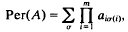
where the summation is over all one-to-one functions σ from {1, … , m} to { 1, …, n}. In other words, the permanent of A is the sum of all the diagonal products of A, that is, all the products of m entries of A no two of which lie in the same row or in the same column. Thus the permanent of A may be evaluated by first multiplying all the row sums of A and then subtracting from the product all terms that contain as factors two or more entries from the same column of A. This is the idea behind the formulas of Binet and of Ryser.
A. H. Schofield, Representations of rings over skew fields (London Mathematical Society Lecture Note Series 92, Cambridge University Press1985), xii + 223 pp., £12.95.
-
- Journal:
- Proceedings of the Edinburgh Mathematical Society / Volume 29 / Issue 3 / October 1986
- Published online by Cambridge University Press:
- 20 January 2009, p. 426
-
- Article
-
- You have access
- Export citation
A Method of Dividing the Circumference of a Circle into 360 equal parts
-
- Journal:
- Proceedings of the Edinburgh Mathematical Society / Volume 23 / February 1904
- Published online by Cambridge University Press:
- 20 January 2009, pp. 58-60
-
- Article
-
- You have access
- Export citation
T. W. Chaundy, Elementary Differential Equations (Oxford, at the Clarendon Press, 1969), xii+414 pp., £3·75; paperback £2·00.
-
- Journal:
- Proceedings of the Edinburgh Mathematical Society / Volume 17 / Issue 4 / December 1971
- Published online by Cambridge University Press:
- 20 January 2009, p. 374
-
- Article
-
- You have access
- Export citation
Recommendation regarding the Teaching of Proportion
-
- Journal:
- Proceedings of the Edinburgh Mathematical Society / Volume 18 / February 1900
- Published online by Cambridge University Press:
- 20 January 2009, p. 31
-
- Article
-
- You have access
- Export citation
N. Koblitz, A course in number theory and cryptography (Graduate Texts in Mathematics 114, Springer-Verlag, Berlin–Heidelberg–New York1987) viii + 208 pp. 3 540 96576 9, DM 74.
-
- Journal:
- Proceedings of the Edinburgh Mathematical Society / Volume 32 / Issue 2 / June 1989
- Published online by Cambridge University Press:
- 20 January 2009, pp. 333-334
-
- Article
-
- You have access
- Export citation
