Refine search
Actions for selected content:
26080 results in Abstract analysis
Mnemonics for

-
- Journal:
- Proceedings of the Edinburgh Mathematical Society / Volume 3 / February 1884
- Published online by Cambridge University Press:
- 20 January 2009, pp. 105-107
-
- Article
-
- You have access
- Export citation

Absolute norms on vector lattices
-
- Journal:
- Proceedings of the Edinburgh Mathematical Society / Volume 27 / Issue 2 / June 1984
- Published online by Cambridge University Press:
- 20 January 2009, pp. 215-222
-
- Article
-
- You have access
- Export citation
-
Recall that a norm
 and monotone if
  and monotone if
  If the norm is both absolute and monotone, itis called a Riesz norm. It is easy to show that a norm is Riesz if and only if
  whenever
  A Banach lattice is a vector lattice equipped with a complete Riesznorm.
 and monotone if
  and monotone if
  If the norm is both absolute and monotone, itis called a Riesz norm. It is easy to show that a norm is Riesz if and only if
  whenever
  A Banach lattice is a vector lattice equipped with a complete Riesznorm.
A note on skew-symmetric determinants
-
- Journal:
- Proceedings of the Edinburgh Mathematical Society / Volume 36 / Issue 2 / June 1993
- Published online by Cambridge University Press:
- 20 January 2009, pp. 335-338
-
- Article
-
- You have access
- Export citation
Bachman George, Introduction to p-Adic Numbers and Valuation Theory (Academic Press, New York, 1964), 173 pp., 24s. 6d.
-
- Journal:
- Proceedings of the Edinburgh Mathematical Society / Volume 15 / Issue 1 / June 1966
- Published online by Cambridge University Press:
- 20 January 2009, p. 83
-
- Article
-
- You have access
- Export citation
Particular Solutions of the Equation of Conduction of Heat in One Dimension
-
- Journal:
- Proceedings of the Edinburgh Mathematical Society / Volume 43 / February 1924
- Published online by Cambridge University Press:
- 20 January 2009, pp. 50-63
-
- Article
-
- You have access
- Export citation
An Extension of the Almost Isolated Singularity of Finite Exponential Order
-
- Journal:
- Proceedings of the Edinburgh Mathematical Society / Volume 14 / Issue 2 / December 1964
- Published online by Cambridge University Press:
- 20 January 2009, pp. 137-141
-
- Article
-
- You have access
- Export citation
-
Let f(z) be represented on its circle of convergence |z| = 1 by the Taylor series

and suppose that its sole singularity on |z| = 1 is an almost isolated singularity at z = 1. In the neighbourhood of such a singularity f(z) is regular on a sufficiently small disk, centre z = 1, with the outward drawn radius along the positive real axis excised. If also in this neighbourhood |f(z)| e−(1/δ)ρ remains bounded for some finite ρ, where δ is the distance from the excised radius, then the singularity is said to be of finite exponential order.
A Note on Griffith Cracks†
-
- Journal:
- Proceedings of the Edinburgh Mathematical Society / Volume 15 / Issue 2 / December 1966
- Published online by Cambridge University Press:
- 20 January 2009, pp. 131-134
-
- Article
-
- You have access
- Export citation
-
The problem of determining the distribution of stress in the neighbourhood of a Griffith crack, denned by ∣x∣ ≦ 1, y = 0, which is subject to an internal pressure varying along the length of the crack has been solved by Sneddon and Elliott (3) and by England and Green (1). In the former paper a Fourier cosine method is used to arrive at a solution while in the latter paper the problem is reduced to an Abel integral equation by making use of integral representations of the complex potentials given in Green and Zerna (2). Neither paper deals with the calculation of the stress intensity factor

which is extremely important to workers in fracture mechanics.
PEM volume 28 Cover and Front matter
-
- Journal:
- Proceedings of the Edinburgh Mathematical Society / Volume 28 / February 1909
- Published online by Cambridge University Press:
- 20 January 2009, pp. f1-f5
-
- Article
-
- You have access
- Export citation
The Brocard Points and the Brocard Angle
-
- Journal:
- Proceedings of the Edinburgh Mathematical Society / Volume 13 / February 1894
- Published online by Cambridge University Press:
- 20 January 2009, p. 28
-
- Article
-
- You have access
- Export citation
-
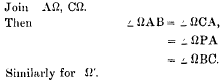
I. Construction for the Brocard points.
Let ABC be a triangle. Describe a circle touching AB in A and passing through C; draw the chord AP parallel to BC. Join BP meeting this circle in Ω
Office-Bearers
-
- Journal:
- Proceedings of the Edinburgh Mathematical Society / Volume 40 / February 1921
- Published online by Cambridge University Press:
- 20 January 2009, p. 1
-
- Article
-
- You have access
- Export citation
PEM volume 23 issue 3 Cover and Front matter
-
- Journal:
- Proceedings of the Edinburgh Mathematical Society / Volume 23 / Issue 3 / October 1980
- Published online by Cambridge University Press:
- 20 January 2009, pp. f1-f7
-
- Article
-
- You have access
- Export citation
On the capability of groups
-
- Journal:
- Proceedings of the Edinburgh Mathematical Society / Volume 41 / Issue 3 / October 1998
- Published online by Cambridge University Press:
- 20 January 2009, pp. 487-495
-
- Article
-
- You have access
- Export citation
Prime ideals and radicals in semigroup-graded rings
-
- Journal:
- Proceedings of the Edinburgh Mathematical Society / Volume 39 / Issue 1 / February 1996
- Published online by Cambridge University Press:
- 20 January 2009, pp. 1-25
-
- Article
-
- You have access
- Export citation
Inequalities for certain cyclic sums
-
- Journal:
- Proceedings of the Edinburgh Mathematical Society / Volume 17 / Issue 3 / June 1971
- Published online by Cambridge University Press:
- 20 January 2009, pp. 257-262
-
- Article
-
- You have access
- Export citation
-
Let M be a positive integer, let a1, a2, …, aM be non-negative reals, and put aM+i = ai for i = 1, 2, 3. Further let each of v1, v2, v3 and δ1, δ2, δ3 be 0 or 1, giving 26 possibilities. This note is concerned with the problem of finding bounds for each of the non-trivial cases out of the 26 cyclic sums

The fibred product near-rings and near-ring modules for certain categories
-
- Journal:
- Proceedings of the Edinburgh Mathematical Society / Volume 23 / Issue 1 / February 1980
- Published online by Cambridge University Press:
- 20 January 2009, pp. 15-25
-
- Article
-
- You have access
- Export citation
-
In somes categories, there are structures that look very much like groups, and they usually are. These structures are called group-objects and were first studied by Eckmann and Hilton (1). If our category
 has an object T such that hom(X, T)= {tx}, a singleton, for each object X ∈ Ob , T is called a terminal object. Our category must have products; i.e. for A1,…, An ∈;. Ob , there is an object A1 × … × An ∈ Ob and morphisms pi: A1 × … × An → Ai so that if fi: X → Ai, i = 1, 2, …, n, are morphisms of , then there is a unique morphism [f1, …, fn]: X → A1 × … × An such that
  for i = 1, 2, …, n.
 has an object T such that hom(X, T)= {t
 for i = 1, 2, …, n.
Sheila Macintyre, and Edith Witte, German-English Mathematical Vocabulary, 2nd edition (Oliver and Boyd, Edinburgh, 1966), ix + 95 pp., 10s. 6d.
-
- Journal:
- Proceedings of the Edinburgh Mathematical Society / Volume 16 / Issue 1 / June 1968
- Published online by Cambridge University Press:
- 20 January 2009, p. 85
-
- Article
-
- You have access
- Export citation
Duistermaat, J. J. and Kolk, J. A. C.Lie groups (Universitext, Springer, 2000), viii+344 pp., 3 540 15293 8 (softcover), £27
-
- Journal:
- Proceedings of the Edinburgh Mathematical Society / Volume 44 / Issue 1 / February 2001
- Published online by Cambridge University Press:
- 20 January 2009, pp. 219-220
-
- Article
-
- You have access
- Export citation
On certain formulae for Repeated Differentiation
-
- Journal:
- Proceedings of the Edinburgh Mathematical Society / Volume 3 / February 1884
- Published online by Cambridge University Press:
- 20 January 2009, pp. 94-95
-
- Article
-
- You have access
- Export citation
-
In many questions of analysis relating to the theory of plane curves, it is convenient to be able to obtain quickly the expansions of and of
 These may be obtained as follows:—
By an obvious extension of the theorem of Leibnitz we have

where d1,d2,…dn differentiate y1, y2,…yn respectively.
 These may be obtained as follows:—
Some new Properties of the Triangle
-
- Journal:
- Proceedings of the Edinburgh Mathematical Society / Volume 8 / February 1889
- Published online by Cambridge University Press:
- 20 January 2009, p. 5
-
- Article
-
- You have access
- Export citation
On Sylvester's Dialytic Method of Elimination
-
- Journal:
- Proceedings of the Edinburgh Mathematical Society / Volume 40 / February 1921
- Published online by Cambridge University Press:
- 20 January 2009, pp. 62-63
-
- Article
-
- You have access
- Export citation
-
Consider any two algebraic equations, which for simplicity we shall take to be a cubic

whose roots are y1, y2, y3, and a quadratic

whose roots are x1, x2.
