Refine search
Actions for selected content:
26080 results in Abstract analysis
On Professor Whittaker's solution of differential equations by definite integrals: Part II: Applications of the methods of non-commutative Algebra
-
- Journal:
- Proceedings of the Edinburgh Mathematical Society / Volume 2 / Issue 4 / June 1931
- Published online by Cambridge University Press:
- 20 January 2009, pp. 220-239
-
- Article
-
- You have access
- Export citation
-
In Part I it has been shown that, given a contact transformation, two equations

can be derived which lead to the compatible differential equations

It will be shown in the present communication that the necessary and sufficient condition that (1.3), (1.4) should be compatible is that

regarded as an equation in the non-commutative variables q, p which themselves satisfy the condition

We shall call functions satisfying this condition conjugate functions. From this point of view the method employed by Professor Whittaker in his original paper, involving the use of a contact transformation,, was really a particular method of generating conjugate functions. This powerful method may be supplemented and extended by the other methods developed in the following pages.
The Equilateral and the Equiangular Polygon
-
- Journal:
- Proceedings of the Edinburgh Mathematical Society / Volume 5 / February 1886
- Published online by Cambridge University Press:
- 20 January 2009, pp. 28-38
-
- Article
-
- You have access
- Export citation
Olav Kallenberg (editor), Random Measures (Akademie-Verlag and Academic Press, 1977), 104 pp., £6.
-
- Journal:
- Proceedings of the Edinburgh Mathematical Society / Volume 21 / Issue 1 / March 1978
- Published online by Cambridge University Press:
- 20 January 2009, p. 92
-
- Article
-
- You have access
- Export citation
PEM volume 30 issue 2 Cover and Front matter
-
- Journal:
- Proceedings of the Edinburgh Mathematical Society / Volume 30 / Issue 2 / June 1987
- Published online by Cambridge University Press:
- 20 January 2009, pp. f1-f2
-
- Article
-
- You have access
- Export citation
An upper bound for λ1 for Γ(q) and Γ0(q)
-
- Journal:
- Proceedings of the Edinburgh Mathematical Society / Volume 33 / Issue 2 / June 1990
- Published online by Cambridge University Press:
- 20 January 2009, pp. 241-250
-
- Article
-
- You have access
- Export citation
-
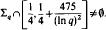
Under the assumption of the Selberg conjecture I establish by means of the Selberg trace formula the following:
Theorem. Let Γ denote Γ(q) or Γ0(q), q square-free. Let Δq denote the Laplace operator on L2(Γ\H), and let Σq denote its discrete spectrum. Then there exists an absolute positive constant A such that for q≧A
A note on UMD spaces and transference in vector-valued function spaces*
-
- Journal:
- Proceedings of the Edinburgh Mathematical Society / Volume 39 / Issue 3 / October 1996
- Published online by Cambridge University Press:
- 20 January 2009, pp. 485-490
-
- Article
-
- You have access
- Export citation
Newton's Conception of a Limit as interpreted by Jurin and Robins respectively
-
- Journal:
- Proceedings of the Edinburgh Mathematical Society / Volume 40 / February 1921
- Published online by Cambridge University Press:
- 20 January 2009, pp. 9-20
-
- Article
-
- You have access
- Export citation
Matrix Differentiation of the Characteristic Function
-
- Journal:
- Proceedings of the Edinburgh Mathematical Society / Volume 2 / Issue 4 / June 1931
- Published online by Cambridge University Press:
- 20 January 2009, pp. 256-264
-
- Article
-
- You have access
- Export citation
-
The following work is a sequel to three previous communications, and more particularly to the first. The present object is to shew the effect of repeated operation with the matrix differential operator
 , when it acts upon a scalar matrix formed from an n rowed determinant |xij|, or sums of principal minors, the n2 elements xij being treated as independent variables. Thus when z is a scalar quantity ω z means the matrix [∂z/∂xij], whose ijth element is the derivative.
 , when it acts upon a scalar matrix formed from an n rowed determinant |x
Thirty-Seventh Session. 1918–19
-
- Journal:
- Proceedings of the Edinburgh Mathematical Society / Volume 37 / February 1918
- Published online by Cambridge University Press:
- 20 January 2009, pp. iv-v
-
- Article
-
- You have access
- Export citation
Rings that are FGC relative to filters of ideals
-
- Journal:
- Proceedings of the Edinburgh Mathematical Society / Volume 32 / Issue 1 / February 1989
- Published online by Cambridge University Press:
- 20 January 2009, pp. 11-18
-
- Article
-
- You have access
- Export citation
-
All our rings will be commutative with identity not equal to zero. Also R will always denote a ring.
 is a filter of ideals of R if is a nonempty set of ideals of R satisfying: I∈ and J is an ideal of R with I⊂J, then J∈, and if I, J∈ then I∩J∈. A Gabriel topology of R is a filter of ideals of R satisfying: if J∈ and I is an ideal of R with (I:x)∈ for all x∈J, then I∈. See the B. Stenström text [6]. We say that a ring R is an FGC ring if every finitely generated R-module is a direct sum of cyclic R-modules. Use mspec R for the set of all maximal ideals of R.
 is a filter of ideals of R if
 The vanishing of Poincaré series
-
- Journal:
- Proceedings of the Edinburgh Mathematical Society / Volume 23 / Issue 2 / June 1980
- Published online by Cambridge University Press:
- 20 January 2009, pp. 151-161
-
- Article
-
- You have access
- Export citation
-
Every holomorphic modular form of weight k > 2 is a sum of Poincaré series; see, for example, Chapter 5 of (5). In particular, every cusp form of even weight k ≧ 4 for the full modular group Γ(1) is a linear combination over the complex field C of the Poincaré series
 .
.Here mis any positive integer, z ∈ H ={z ∈ C: Im z>0} and

The summation is over all matrices

with different second rows in the (homogeneous) modular group, i.e. in SL(2, Z).The factor ½ is introducted for convenience.


Office Bearers
-
- Journal:
- Proceedings of the Edinburgh Mathematical Society / Volume 26 / February 1907
- Published online by Cambridge University Press:
- 20 January 2009, p. 1
-
- Article
-
- You have access
- Export citation
Congruence Properties of G-Functions
-
- Journal:
- Proceedings of the Edinburgh Mathematical Society / Volume 4 / Issue 2 / January 1935
- Published online by Cambridge University Press:
- 20 January 2009, pp. 61-66
-
- Article
-
- You have access
- Export citation
-
Denoting the sum of the products of the first n natural numbers taken r at a time by the symbol G(n, r), I have shown that

with the initial values
 and
and
In general it was shown that


Defining G (x, r) by the fundamental relation:

for all values of x, we get


 and
and
H. E. Salzer, C. H. Richards and I. Arsham, Table for the solution of Cubic Equations (McGraw-Hill Book Company, New York, 1958), 161 pp., 50s.
-
- Journal:
- Proceedings of the Edinburgh Mathematical Society / Volume 12 / Issue 3 / June 1961
- Published online by Cambridge University Press:
- 20 January 2009, p. 163
-
- Article
-
- You have access
- Export citation
I. M. James, Fibrewise topology (Cambridge Tracts in Mathematics 91, Cambridge University Press, Cambridge, 1989), x + 198 pp., 0 521 36090 0, £27.50.
-
- Journal:
- Proceedings of the Edinburgh Mathematical Society / Volume 33 / Issue 2 / June 1990
- Published online by Cambridge University Press:
- 20 January 2009, p. 336
-
- Article
-
- You have access
- Export citation
On the Composition of Simultaneous Differential Systems of the First Order
-
- Journal:
- Proceedings of the Edinburgh Mathematical Society / Volume 3 / Issue 2 / July 1932
- Published online by Cambridge University Press:
- 20 January 2009, pp. 128-131
-
- Article
-
- You have access
- Export citation
-
§ 1. Consider the system of n first order linear differential equations:

together with the n boundary conditions

where aij, bij are constants and where we assume for simplicity of notation that gii = 0.
PEM volume 43 issue 1 Cover and Front matter
-
- Journal:
- Proceedings of the Edinburgh Mathematical Society / Volume 43 / Issue 1 / February 2000
- Published online by Cambridge University Press:
- 20 January 2009, pp. f1-f2
-
- Article
-
- You have access
- Export citation
PEM volume 29 issue 1 Cover and Front matter
-
- Journal:
- Proceedings of the Edinburgh Mathematical Society / Volume 29 / Issue 1 / February 1986
- Published online by Cambridge University Press:
- 20 January 2009, pp. f1-f2
-
- Article
-
- You have access
- Export citation
An arithmetical problem
-
- Journal:
- Proceedings of the Edinburgh Mathematical Society / Volume 12 / February 1893
- Published online by Cambridge University Press:
- 20 January 2009, p. 22
-
- Article
-
- You have access
- Export citation
A Geometrical Proof of a Theorem of Hurwitz
-
- Journal:
- Proceedings of the Edinburgh Mathematical Society / Volume 35 / February 1916
- Published online by Cambridge University Press:
- 20 January 2009, pp. 59-65
-
- Article
-
- You have access
- Export citation
-
In the study of rational approximations to irrational numbers the following problem presents itself: Let ω be a real irrational number, and let us consider the rational fractions satisfying the inequality

how small can the positive quantity k be chosen with the certainty that there will always be an infinite number of fractions satisfying the inequality whatever the value (irrational) of ω?
