Refine search
Actions for selected content:
26080 results in Abstract analysis
Multiple solutions for elliptic resonant problems
-
- Journal:
- Proceedings of the Royal Society of Edinburgh. Section A: Mathematics / Volume 138 / Issue 6 / December 2008
- Published online by Cambridge University Press:
- 12 November 2008, pp. 1281-1289
- Print publication:
- December 2008
-
- Article
- Export citation
Periodic motions in the Fermi—Ulam model
-
- Journal:
- Proceedings of the Royal Society of Edinburgh. Section A: Mathematics / Volume 138 / Issue 6 / December 2008
- Published online by Cambridge University Press:
- 12 November 2008, pp. 1235-1259
- Print publication:
- December 2008
-
- Article
- Export citation
-
We consider the periodic solutions of the equation

satisfying −1 ≤ x ≤ 1 ẋ(t−) = −ẋ(t+) if x(t) = ±1, where f is a continuous function, periodic in t. A sequence of periodic solutions is obtained via the variational method.

A singular Gierer—Meinhardt system with different source terms*
-
- Journal:
- Proceedings of the Royal Society of Edinburgh. Section A: Mathematics / Volume 138 / Issue 6 / December 2008
- Published online by Cambridge University Press:
- 12 November 2008, pp. 1215-1234
- Print publication:
- December 2008
-
- Article
- Export citation
The symmetric cross-cap number of the groups Cm × Dn
-
- Journal:
- Proceedings of the Royal Society of Edinburgh. Section A: Mathematics / Volume 138 / Issue 6 / December 2008
- Published online by Cambridge University Press:
- 12 November 2008, pp. 1197-1213
- Print publication:
- December 2008
-
- Article
- Export citation
-
Every finite group G acts as an automorphism group of some non-orientable Klein surfaces without boundary. The minimal genus of these surfaces is called the symmetric cross-cap number and denoted by
 . This number is related to other parameters defined on surfaces as the symmetric genus and the strong symmetric genus.
The systematic study of the symmetric cross-cap number was begun by C. L. May, who also calculated it for certain finite groups. Here we obtain the symmetric cross-cap number for the groups Cm × Dn. As an application of this result, we obtain arithmetic sequences of integers which are the symmetric cross-cap number of some group. Finally, we recall the several different genera of the groups Cm × Dn.
 . This number is related to other parameters defined on surfaces as the symmetric genus and the strong symmetric genus.
Heteroclinic connections for multiple-well potentials: the anisotropic case
-
- Journal:
- Proceedings of the Royal Society of Edinburgh. Section A: Mathematics / Volume 138 / Issue 6 / December 2008
- Published online by Cambridge University Press:
- 12 November 2008, pp. 1313-1330
- Print publication:
- December 2008
-
- Article
- Export citation
Strong approximation of sets in BV(Ω)
-
- Journal:
- Proceedings of the Royal Society of Edinburgh. Section A: Mathematics / Volume 138 / Issue 6 / December 2008
- Published online by Cambridge University Press:
- 12 November 2008, pp. 1291-1312
- Print publication:
- December 2008
-
- Article
- Export citation
-
Taking the argument used by De Giorgi to obtain the rectifiability of the reduced boundary of a set of finite perimeter in ℝN, we prove that a set E of finite perimeter in an open set Ω of ℝN may be approached, in the sense of the BV(Ω) norm, by sets whose boundary is included in a finite union of
 1 hypersurfaces; more precisely, arbitrarily large parts (for the
  N−1 measure in Ω) of the essential boundaries of E and of the approximating set coincide and are included in a single 1 hypersurface.


Radially symmetric critical points of non-convex functionals
-
- Journal:
- Proceedings of the Royal Society of Edinburgh. Section A: Mathematics / Volume 138 / Issue 6 / December 2008
- Published online by Cambridge University Press:
- 12 November 2008, pp. 1261-1280
- Print publication:
- December 2008
-
- Article
- Export citation
-
We investigate critical points of the functional
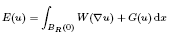
over a ball in ℝn. Here, W is radially symmetric but not convex. We embed the functional into a family of functionals

where E0,0(u) = E(u). A global bifurcation analysis yields a branch of non-trivial critical points depending on λ and positive ε, where we can set λ = 0. The geometric properties preserved on that branch, due to the maximum principle, prove compactness such that the singular limit as ε ↘ 0 exists. Under natural conditions on W and G the critical point obtained in this way is a minimizer of the original functional. That plan can be carried out only under the restriction of radial symmetry, since the maximum principle applies only to special elliptic equations of fourth order. That restriction, however, is not essential since every minimizer of the functional is radially symmetric.
Bernoulli free-boundary problems in strip-like domains and a property of permanent waves on water of finite depth
-
- Journal:
- Proceedings of the Royal Society of Edinburgh. Section A: Mathematics / Volume 138 / Issue 6 / December 2008
- Published online by Cambridge University Press:
- 12 November 2008, pp. 1345-1362
- Print publication:
- December 2008
-
- Article
- Export citation
4 - J–contractive and J–inner matrix valued functions
-
- Book:
- J-Contractive Matrix Valued Functions and Related Topics
- Published online:
- 10 May 2010
- Print publication:
- 06 November 2008, pp 169-239
-
- Chapter
- Export citation
6 - Operator nodes and passive systems
-
- Book:
- J-Contractive Matrix Valued Functions and Related Topics
- Published online:
- 10 May 2010
- Print publication:
- 06 November 2008, pp 334-357
-
- Chapter
- Export citation
2 - Algebraic preliminaries
-
- Book:
- J-Contractive Matrix Valued Functions and Related Topics
- Published online:
- 10 May 2010
- Print publication:
- 06 November 2008, pp 13-82
-
- Chapter
- Export citation
Frontmatter
-
- Book:
- J-Contractive Matrix Valued Functions and Related Topics
- Published online:
- 10 May 2010
- Print publication:
- 06 November 2008, pp i-vi
-
- Chapter
- Export citation
Subject index
-
- Book:
- J-Contractive Matrix Valued Functions and Related Topics
- Published online:
- 10 May 2010
- Print publication:
- 06 November 2008, pp 571-575
-
- Chapter
- Export citation
Bibliography
-
- Book:
- J-Contractive Matrix Valued Functions and Related Topics
- Published online:
- 10 May 2010
- Print publication:
- 06 November 2008, pp 551-566
-
- Chapter
- Export citation
1 - Introduction
-
- Book:
- J-Contractive Matrix Valued Functions and Related Topics
- Published online:
- 10 May 2010
- Print publication:
- 06 November 2008, pp 1-12
-
- Chapter
- Export citation
11 - Formulas for entropy functionals
-
- Book:
- J-Contractive Matrix Valued Functions and Related Topics
- Published online:
- 10 May 2010
- Print publication:
- 06 November 2008, pp 536-550
-
- Chapter
- Export citation
Contents
-
- Book:
- J-Contractive Matrix Valued Functions and Related Topics
- Published online:
- 10 May 2010
- Print publication:
- 06 November 2008, pp vii-x
-
- Chapter
- Export citation
8 - Generalized Krein extension problems
-
- Book:
- J-Contractive Matrix Valued Functions and Related Topics
- Published online:
- 10 May 2010
- Print publication:
- 06 November 2008, pp 420-469
-
- Chapter
- Export citation
3 - The Nevanlinna class of meromorphic mvf's
-
- Book:
- J-Contractive Matrix Valued Functions and Related Topics
- Published online:
- 10 May 2010
- Print publication:
- 06 November 2008, pp 83-168
-
- Chapter
- Export citation
Notation index
-
- Book:
- J-Contractive Matrix Valued Functions and Related Topics
- Published online:
- 10 May 2010
- Print publication:
- 06 November 2008, pp 567-570
-
- Chapter
- Export citation
