Refine search
Actions for selected content:
25990 results in Abstract analysis
On self-similar solutions of Barenblatt's nonlinear filtration equation
-
- Journal:
- European Journal of Applied Mathematics / Volume 7 / Issue 2 / April 1996
- Published online by Cambridge University Press:
- 26 September 2008, pp. 151-167
-
- Article
- Export citation
Hele–Shaw flows with free boundaries driven along infinite strips by a pressure difference
-
- Journal:
- European Journal of Applied Mathematics / Volume 7 / Issue 4 / August 1996
- Published online by Cambridge University Press:
- 26 September 2008, pp. 345-366
-
- Article
- Export citation
Eulogy: P. Ya. Polubarinova-Kochina
-
- Journal:
- European Journal of Applied Mathematics / Volume 5 / Issue 2 / June 1994
- Published online by Cambridge University Press:
- 26 September 2008, p. 95
-
- Article
- Export citation
Hele–Shaw flows with time-dependent free boundaries in which the fluid occupies a multiply-connected region
-
- Journal:
- European Journal of Applied Mathematics / Volume 5 / Issue 2 / June 1994
- Published online by Cambridge University Press:
- 26 September 2008, pp. 97-122
-
- Article
- Export citation
Travelling wave solutions of a reaction—infiltration problem and a related free boundary problem
-
- Journal:
- European Journal of Applied Mathematics / Volume 5 / Issue 3 / September 1994
- Published online by Cambridge University Press:
- 26 September 2008, pp. 255-265
-
- Article
- Export citation
Oscillatory flow over a cylinder resting on a plane boundary
-
- Journal:
- European Journal of Applied Mathematics / Volume 7 / Issue 6 / December 1996
- Published online by Cambridge University Press:
- 26 September 2008, pp. 545-558
-
- Article
- Export citation
A mathematical model for washing a tow of fibres: Part 2
-
- Journal:
- European Journal of Applied Mathematics / Volume 6 / Issue 1 / February 1995
- Published online by Cambridge University Press:
- 26 September 2008, pp. 25-44
-
- Article
- Export citation
-
In Part I of this paper (Terrill & Byatt-Smith, 1993) the problem of the flow between an obstacle in the form of a wedge and a porous flexible tow was modelled using lubrication theory. In the region close to the wedge where bending is important the following equation

was derived for the non-dimensional gap width, H(X), between the tow and the wedge.
Convergence of attractors for the simplified magnetic Bénard equations
-
- Journal:
- European Journal of Applied Mathematics / Volume 7 / Issue 1 / February 1996
- Published online by Cambridge University Press:
- 26 September 2008, pp. 53-62
-
- Article
- Export citation
EJM volume 7 issue 6 Cover and Front matter
-
- Journal:
- European Journal of Applied Mathematics / Volume 7 / Issue 6 / December 1996
- Published online by Cambridge University Press:
- 26 September 2008, pp. f1-f2
-
- Article
-
- You have access
- Export citation
EJM volume 7 issue 1 Cover and Front matter
-
- Journal:
- European Journal of Applied Mathematics / Volume 7 / Issue 1 / February 1996
- Published online by Cambridge University Press:
- 26 September 2008, pp. f1-f2
-
- Article
-
- You have access
- Export citation
A free boundary problem arising in the modelling of internal oxidation of binary alloys
-
- Journal:
- European Journal of Applied Mathematics / Volume 6 / Issue 3 / June 1995
- Published online by Cambridge University Press:
- 26 September 2008, pp. 225-245
-
- Article
- Export citation
Boundary integral equations for contact problems of plane quasi-steady viscous flows
-
- Journal:
- European Journal of Applied Mathematics / Volume 4 / Issue 2 / June 1993
- Published online by Cambridge University Press:
- 26 September 2008, pp. 175-187
-
- Article
- Export citation
Development of singularities in some moving boundary problems
-
- Journal:
- European Journal of Applied Mathematics / Volume 6 / Issue 5 / October 1995
- Published online by Cambridge University Press:
- 26 September 2008, pp. 491-507
-
- Article
- Export citation
Laminates and microstructure
-
- Journal:
- European Journal of Applied Mathematics / Volume 4 / Issue 2 / June 1993
- Published online by Cambridge University Press:
- 26 September 2008, pp. 121-149
-
- Article
- Export citation
Self-similar solutions of the second kind for the modified porous medium equation
-
- Journal:
- European Journal of Applied Mathematics / Volume 5 / Issue 3 / September 1994
- Published online by Cambridge University Press:
- 26 September 2008, pp. 391-403
-
- Article
- Export citation
-
We construct compactly supported self-similar solutions of the modified porous medium equation (MPME)
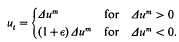
They have the form

where the similarity exponents α and β depend on ε, m and the dimension N. This corresponds to what is known in the literature as anomalous exponents or self-similarity of the second kind, a not completely understood phenomenon. This paper performs a detailed study of the properties of the anomalous exponents of the MPME.

Existence and uniqueness of radially symmetric stationary points within the gradient theory of phase transitions
-
- Journal:
- European Journal of Applied Mathematics / Volume 6 / Issue 1 / February 1995
- Published online by Cambridge University Press:
- 26 September 2008, pp. 45-67
-
- Article
- Export citation
-
We study radially symmetric stationary points of the functional

where u denotes the density of a fluid confined to a container Ω, W(u) is the course-grain free energy and ε accounts for surface energy. Under the further assumption of small energy, that is

for small ε, we prove existence of precisely two solutions for the corresponding Euler-Lagrange equation. Each of these solutions is monotone in the radial direction and converges as ε→0 to one of two possible radially symmetric single interface minimizers of E0. Our main tool is the method of matched asymptotic expansions from which we construct exact solutions.

Solution of a contact lens problem
-
- Journal:
- European Journal of Applied Mathematics / Volume 7 / Issue 6 / December 1996
- Published online by Cambridge University Press:
- 26 September 2008, pp. 595-602
-
- Article
- Export citation
-
In this paper we study the question of existence and uniqueness of solutions to the equation

which occurs in the modelling of hard contact lenses. Using ‘shooting’ arguments, we show that, depending on the parameters in the problem, there are cases where there is precisely one solution, others where there is more than one, and others where there are none.

EJM volume 6 issue 6 Cover and Front matter
-
- Journal:
- European Journal of Applied Mathematics / Volume 6 / Issue 6 / December 1995
- Published online by Cambridge University Press:
- 26 September 2008, pp. f1-f2
-
- Article
-
- You have access
- Export citation
Effective constitutive algorithms in elastoplasticity and elastoviscoplasticity
-
- Journal:
- European Journal of Applied Mathematics / Volume 5 / Issue 3 / September 1994
- Published online by Cambridge University Press:
- 26 September 2008, pp. 313-335
-
- Article
- Export citation
Global solutions of Maxwell's equations in an electromagnetic field with a temperature-dependent electrical conductivity
-
- Journal:
- European Journal of Applied Mathematics / Volume 5 / Issue 1 / March 1994
- Published online by Cambridge University Press:
- 26 September 2008, pp. 57-64
-
- Article
- Export citation
