Refine search
Actions for selected content:
26080 results in Abstract analysis
A Survey in Mathematics for Industry An efficient method for the numerical simulation of magneto-mechanical sensors and actuators
-
- Journal:
- European Journal of Applied Mathematics / Volume 18 / Issue 2 / April 2007
- Published online by Cambridge University Press:
- 01 April 2007, pp. 233-271
-
- Article
- Export citation
Stability of patterns with arbitrary period for a Ginzburg-Landau equation with a mean field
-
- Journal:
- European Journal of Applied Mathematics / Volume 18 / Issue 2 / April 2007
- Published online by Cambridge University Press:
- 01 April 2007, pp. 129-151
-
- Article
- Export citation
-
We consider the following system of equations:
![\left\{\begin{array}{@{}l} A_t= A_{xx} + A - A^3 -AB, \quad t>0,\,0 < x <\frac{L}{2},\\[2mm] B_t = \sigma B_{xx} + \mu (A^2)_{xx}, \quad t>0,\,0<x<\frac{L}{2}, \\[2mm] A_x\left(0\right)=A_x\left(\frac{L}{2}\right)=0, \\[2mm] B_x(0)=B_x\left(\frac{L}{2}\right)=0, \end{array} \right.](//static.cambridge.org/content/id/urn%3Acambridge.org%3Aid%3Aarticle%3AS0956792507006894/resource/name/S0956792507006894_eqnU1.gif?pub-status=live) where the spatial average ⟨ B ⟩ = 0 and μ > σ > 0. This system plays an important role as a Ginzburg-Landau equation with a mean field in several areas of the applied sciences and the steady-states of this system extend to periodic steady-states with period L on the real line which are observed in experiments. Our approach is by combining methods of nonlinear functional analysis such as nonlocal eigenvalue problems and the variational characterization of eigenvalues with Jacobi elliptic integrals. This enables us to give a complete classification of all stable steady-states for any positive L.
where the spatial average ⟨ B ⟩ = 0 and μ > σ > 0. This system plays an important role as a Ginzburg-Landau equation with a mean field in several areas of the applied sciences and the steady-states of this system extend to periodic steady-states with period L on the real line which are observed in experiments. Our approach is by combining methods of nonlinear functional analysis such as nonlocal eigenvalue problems and the variational characterization of eigenvalues with Jacobi elliptic integrals. This enables us to give a complete classification of all stable steady-states for any positive L.
![\left\{\begin{array}{@{}l} A_t= A_{xx} + A - A^3 -AB, \quad t>0,\,0 < x <\frac{L}{2},\\[2mm] B_t = \sigma B_{xx} + \mu (A^2)_{xx}, \quad t>0,\,0<x<\frac{L}{2}, \\[2mm] A_x\left(0\right)=A_x\left(\frac{L}{2}\right)=0, \\[2mm] B_x(0)=B_x\left(\frac{L}{2}\right)=0, \end{array} \right.](http://static.cambridge.org/content/id/urn%3Acambridge.org%3Aid%3Aarticle%3AS0956792507006894/resource/name/S0956792507006894_eqnU1.gif?pub-status=live)
On steady states of van der Waals force driven thin film equations
-
- Journal:
- European Journal of Applied Mathematics / Volume 18 / Issue 2 / April 2007
- Published online by Cambridge University Press:
- 01 April 2007, pp. 153-180
-
- Article
- Export citation
-
Let
, N ≥2 be a bounded smooth domain and α > 1. We are interested in the singular elliptic equation
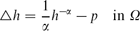 with Neumann boundary conditions. In this paper, a complete description of all continuous radially symmetric solutions is given. In particular, we construct nontrivial smooth solutions as well as rupture solutions. Here a continuous solution is said to be a rupture solution if its zero set is nonempty. When N = 2 and α = 3, the equation is used to model steady states of van der Waals force driven thin films of viscous fluids. We also consider the physical problem when total volume of the fluid is prescribed.
A note on the flow of a homogeneous intrusion into a two-layer fluid
-
- Journal:
- European Journal of Applied Mathematics / Volume 18 / Issue 2 / April 2007
- Published online by Cambridge University Press:
- 01 April 2007, pp. 181-193
-
- Article
- Export citation
METHODS FOR $p$-ADIC MONODROMY
-
- Journal:
- Journal of the Institute of Mathematics of Jussieu / Volume 7 / Issue 2 / April 2008
- Published online by Cambridge University Press:
- 22 March 2007, pp. 247-268
- Print publication:
- April 2008
-
- Article
- Export citation
LAMINATIONS DANS LES ESPACES PROJECTIFS COMPLEXES
-
- Journal:
- Journal of the Institute of Mathematics of Jussieu / Volume 7 / Issue 1 / January 2008
- Published online by Cambridge University Press:
- 15 March 2007, pp. 67-91
- Print publication:
- January 2008
-
- Article
- Export citation
Maximizing Several Cuts Simultaneously
-
- Journal:
- Combinatorics, Probability and Computing / Volume 16 / Issue 2 / March 2007
- Published online by Cambridge University Press:
- 01 March 2007, pp. 277-283
-
- Article
- Export citation
-
Consider two graphs G1 and G2 on the same vertex set V and suppose that Gi has mi edges. Then there is a bipartition of V into two classes A and B so that, for both i = 1, 2, we have
Multi-Path Matroids
-
- Journal:
- Combinatorics, Probability and Computing / Volume 16 / Issue 2 / March 2007
- Published online by Cambridge University Press:
- 01 March 2007, pp. 193-217
-
- Article
- Export citation
On the Ashkin–Teller Model and Tutte–Whitney Functions
-
- Journal:
- Combinatorics, Probability and Computing / Volume 16 / Issue 2 / March 2007
- Published online by Cambridge University Press:
- 01 March 2007, pp. 251-260
-
- Article
- Export citation
Edge Colouring with Delays
-
- Journal:
- Combinatorics, Probability and Computing / Volume 16 / Issue 2 / March 2007
- Published online by Cambridge University Press:
- 01 March 2007, pp. 173-191
-
- Article
- Export citation
Colouring Random 4-Regular Graphs
-
- Journal:
- Combinatorics, Probability and Computing / Volume 16 / Issue 2 / March 2007
- Published online by Cambridge University Press:
- 01 March 2007, pp. 309-344
-
- Article
- Export citation
Additive and Multiplicative Structure in Matrix Spaces
-
- Journal:
- Combinatorics, Probability and Computing / Volume 16 / Issue 2 / March 2007
- Published online by Cambridge University Press:
- 01 March 2007, pp. 219-238
-
- Article
- Export citation
-
Let A be a set of N matrices. Let g(A) ≔ |A + A| + |A · A|, where A + A = {a1 + a2 ∣ ai ∈ A} and A · A = {a1a2 ∣ ai ∈ A} are the sum set and product set. We prove that if the determinant of the difference of any two distinct matrices in A is nonzero, then g(A) cannot be bounded below by cN for any constant c. We also prove that if A is a set of d × d symmetric matrices, then there exists ϵ = ϵ(d)>0 such that g(A)>N1+ϵ. For the first result, we use the bound on the number of factorizations in a generalized progression. For the symmetric case, we use a technical proposition which provides an affine space V containing a large subset E of A, with the property that if an algebraic property holds for a large subset of E, then it holds for V. Then we show that the system a2 : a ∈ V is commutative, allowing us to decompose
The Application of Non-Crossing Partitions to Improving Percolation Threshold Bounds
-
- Journal:
- Combinatorics, Probability and Computing / Volume 16 / Issue 2 / March 2007
- Published online by Cambridge University Press:
- 01 March 2007, pp. 285-307
-
- Article
- Export citation
Hamiltonian Cycles in Regular Tournaments
-
- Journal:
- Combinatorics, Probability and Computing / Volume 16 / Issue 2 / March 2007
- Published online by Cambridge University Press:
- 01 March 2007, pp. 239-249
-
- Article
- Export citation
Strong Isometric Dimension, Biclique Coverings, and Sperner's Theorem
-
- Journal:
- Combinatorics, Probability and Computing / Volume 16 / Issue 2 / March 2007
- Published online by Cambridge University Press:
- 01 March 2007, pp. 271-275
-
- Article
- Export citation
Adversarial Deletion in a Scale-Free Random Graph Process
-
- Journal:
- Combinatorics, Probability and Computing / Volume 16 / Issue 2 / March 2007
- Published online by Cambridge University Press:
- 01 March 2007, pp. 261-270
-
- Article
- Export citation
STABILITY OF $\gamma$-FACTORS FOR QUASI-SPLIT GROUPS
-
- Journal:
- Journal of the Institute of Mathematics of Jussieu / Volume 7 / Issue 1 / January 2008
- Published online by Cambridge University Press:
- 14 February 2007, pp. 27-66
- Print publication:
- January 2008
-
- Article
- Export citation
THE FOCUSING NONLINEAR SCHRÖDINGER EQUATION ON THE QUARTER PLANE WITH TIME-PERIODIC BOUNDARY CONDITION: A RIEMANN–HILBERT APPROACH
-
- Journal:
- Journal of the Institute of Mathematics of Jussieu / Volume 6 / Issue 4 / October 2007
- Published online by Cambridge University Press:
- 12 February 2007, pp. 579-611
- Print publication:
- October 2007
-
- Article
- Export citation
ON THE LOCALITY OF THE PSEUDOVARIETY DG
-
- Journal:
- Journal of the Institute of Mathematics of Jussieu / Volume 7 / Issue 1 / January 2008
- Published online by Cambridge University Press:
- 12 February 2007, pp. 93-180
- Print publication:
- January 2008
-
- Article
- Export citation
COMPTAGE DE G-CHTOUCAS : LA PARTIE RÉGULIÈRE ELLIPTIQUE
-
- Journal:
- Journal of the Institute of Mathematics of Jussieu / Volume 7 / Issue 1 / January 2008
- Published online by Cambridge University Press:
- 12 February 2007, pp. 181-203
- Print publication:
- January 2008
-
- Article
- Export citation
