Refine search
Actions for selected content:
26079 results in Abstract analysis
On Phase Transition in the Hard-Core Model on ${\mathbb Z}^d$
-
- Journal:
- Combinatorics, Probability and Computing / Volume 13 / Issue 2 / March 2004
- Published online by Cambridge University Press:
- 03 March 2004, pp. 137-164
-
- Article
- Export citation
Distributed Colouring and Communication in Rings with Local Knowledge
-
- Journal:
- Combinatorics, Probability and Computing / Volume 13 / Issue 2 / March 2004
- Published online by Cambridge University Press:
- 03 March 2004, pp. 123-136
-
- Article
- Export citation
On the Number of Edges in Random Planar Graphs
-
- Journal:
- Combinatorics, Probability and Computing / Volume 13 / Issue 2 / March 2004
- Published online by Cambridge University Press:
- 03 March 2004, pp. 165-183
-
- Article
- Export citation
On the use of Hadamard expansions in hyperasymptotic evaluation: differential equations of hypergeometric type
-
- Journal:
- Proceedings of the Royal Society of Edinburgh. Section A: Mathematics / Volume 134 / Issue 1 / February 2004
- Published online by Cambridge University Press:
- 12 July 2007, pp. 159-178
- Print publication:
- February 2004
-
- Article
- Export citation
Connection formulae for spectral functions associated with singular Dirac equations
-
- Journal:
- Proceedings of the Royal Society of Edinburgh. Section A: Mathematics / Volume 134 / Issue 1 / February 2004
- Published online by Cambridge University Press:
- 12 July 2007, pp. 215-223
- Print publication:
- February 2004
-
- Article
- Export citation
-
We consider the Dirac equation given by
 with initial condition y1 (0) cos α + y2(0) sin α = 0, α ε [0; π ) and suppose the equation is in the limit-point case at infinity. Using
 to denote the derivative of the corresponding spectral function, a formula for
Very singular solutions to a nonlinear parabolic equation with absorption II. Uniqueness
-
- Journal:
- Proceedings of the Royal Society of Edinburgh. Section A: Mathematics / Volume 134 / Issue 1 / February 2004
- Published online by Cambridge University Press:
- 12 July 2007, pp. 39-54
- Print publication:
- February 2004
-
- Article
- Export citation
-
We prove the uniqueness of the very singular solution to
 when 1 < p < (N + 2)/(N + 1), thus completing the previous result by Qi and Wang, restricted to self-similar solutions.
Bouncing solutions of an equation with attractive singularity
-
- Journal:
- Proceedings of the Royal Society of Edinburgh. Section A: Mathematics / Volume 134 / Issue 1 / February 2004
- Published online by Cambridge University Press:
- 12 July 2007, pp. 201-213
- Print publication:
- February 2004
-
- Article
- Export citation
An elliptic boundary problem involving a semi-definite weight
-
- Journal:
- Proceedings of the Royal Society of Edinburgh. Section A: Mathematics / Volume 134 / Issue 1 / February 2004
- Published online by Cambridge University Press:
- 12 July 2007, pp. 109-136
- Print publication:
- February 2004
-
- Article
- Export citation
Bifurcation results for semilinear elliptic problems in RN
-
- Journal:
- Proceedings of the Royal Society of Edinburgh. Section A: Mathematics / Volume 134 / Issue 1 / February 2004
- Published online by Cambridge University Press:
- 12 July 2007, pp. 11-32
- Print publication:
- February 2004
-
- Article
- Export citation
Estimates for the energy of the solutions to elliptic Dirichlet problems on convex domains
-
- Journal:
- Proceedings of the Royal Society of Edinburgh. Section A: Mathematics / Volume 134 / Issue 1 / February 2004
- Published online by Cambridge University Press:
- 12 July 2007, pp. 89-107
- Print publication:
- February 2004
-
- Article
- Export citation
An existence result on positive solutions for a class of semilinear elliptic systems
-
- Journal:
- Proceedings of the Royal Society of Edinburgh. Section A: Mathematics / Volume 134 / Issue 1 / February 2004
- Published online by Cambridge University Press:
- 12 July 2007, pp. 137-141
- Print publication:
- February 2004
-
- Article
- Export citation
-
Consider the system
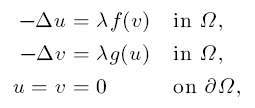 where λ is a positive parameter and Ω is a bounded domain in RN. We prove the existence of a large positive solution for λ large when limx → ∞ (f(Mg(x))/x) = 0 for every M > 0. In particular, we do not need any monotonicity assumptions on f, g, nor any sign conditions on f(0), g(0).
Topologically trivial holomorphic vector bundles on infinite-dimensional projective varieties
-
- Journal:
- Proceedings of the Royal Society of Edinburgh. Section A: Mathematics / Volume 134 / Issue 1 / February 2004
- Published online by Cambridge University Press:
- 12 July 2007, pp. 33-38
- Print publication:
- February 2004
-
- Article
- Export citation
Curvatures of complete hypersurfaces in space forms
-
- Journal:
- Proceedings of the Royal Society of Edinburgh. Section A: Mathematics / Volume 134 / Issue 1 / February 2004
- Published online by Cambridge University Press:
- 12 July 2007, pp. 55-68
- Print publication:
- February 2004
-
- Article
- Export citation
Uniqueness and exact multiplicity of solutions for a class of fourth-order semilinear problems
-
- Journal:
- Proceedings of the Royal Society of Edinburgh. Section A: Mathematics / Volume 134 / Issue 1 / February 2004
- Published online by Cambridge University Press:
- 12 July 2007, pp. 179-190
- Print publication:
- February 2004
-
- Article
- Export citation
Multiple solutions for a non-homogeneous elliptic equation at the critical exponent
-
- Journal:
- Proceedings of the Royal Society of Edinburgh. Section A: Mathematics / Volume 134 / Issue 1 / February 2004
- Published online by Cambridge University Press:
- 12 July 2007, pp. 69-87
- Print publication:
- February 2004
-
- Article
- Export citation
Existence of a positive solution of an elliptic equation on RN
-
- Journal:
- Proceedings of the Royal Society of Edinburgh. Section A: Mathematics / Volume 134 / Issue 1 / February 2004
- Published online by Cambridge University Press:
- 12 July 2007, pp. 191-200
- Print publication:
- February 2004
-
- Article
- Export citation
-
We prove the existence of a positive solution for the Schrödinger-type equation on RN,−Δu + V(x)u = f(u) for u ∈ H1(RN), provided that
 The result is obtained in two cases. (a) lim|x|→ ∞V(x) = V (∞) ∈ (0,∞), f is subcritical and supt>0 2F(t)t−2 < V (∞). (b) There exist V > 0 and R* > 0 such that f(t)t−1 < V ∞ ≤ V (x) for all t > 0 and |x| ≥ R*.
Closed characteristics of second-order Lagrangians
-
- Journal:
- Proceedings of the Royal Society of Edinburgh. Section A: Mathematics / Volume 134 / Issue 1 / February 2004
- Published online by Cambridge University Press:
- 12 July 2007, pp. 143-158
- Print publication:
- February 2004
-
- Article
- Export citation
Energy and pointwise bounds in some non-standard parabolic problems
-
- Journal:
- Proceedings of the Royal Society of Edinburgh. Section A: Mathematics / Volume 134 / Issue 1 / February 2004
- Published online by Cambridge University Press:
- 12 July 2007, pp. 1-9
- Print publication:
- February 2004
-
- Article
- Export citation
-
We study a class of initial-boundary-value problems for which an auxiliary condition of the form
 is prescribed. We determine bounds on an energy expression by means of differential inequalities and derive pointwise bounds for the solution and its gradient by use of a parabolic maximum principle.
Thin film epitaxy with or without slope selection
-
- Journal:
- European Journal of Applied Mathematics / Volume 14 / Issue 6 / December 2003
- Published online by Cambridge University Press:
- 26 January 2004, pp. 713-743
-
- Article
- Export citation
Blow-up in a fourth-order semilinear parabolic equation from explosion-convection theory
-
- Journal:
- European Journal of Applied Mathematics / Volume 14 / Issue 6 / December 2003
- Published online by Cambridge University Press:
- 26 January 2004, pp. 745-764
-
- Article
- Export citation
