Refine search
Actions for selected content:
26063 results in Abstract analysis
PRM volume 129 issue 1 Cover and Front matter
-
- Journal:
- Proceedings of the Royal Society of Edinburgh. Section A: Mathematics / Volume 129 / Issue 1 / 1999
- Published online by Cambridge University Press:
- 14 November 2011, pp. f1-f2
- Print publication:
- 1999
-
- Article
-
- You have access
- Export citation
On Random Intersection Graphs: The Subgraph Problem
-
- Journal:
- Combinatorics, Probability and Computing / Volume 8 / Issue 1-2 / January 1999
- Published online by Cambridge University Press:
- 01 January 1999, pp. 131-159
-
- Article
- Export citation
Existence of multiple non-trivial solutions for nonlinear p-Laplacian problems on ℝN
-
- Journal:
- Proceedings of the Royal Society of Edinburgh. Section A: Mathematics / Volume 129 / Issue 4 / 1999
- Published online by Cambridge University Press:
- 14 November 2011, pp. 855-883
- Print publication:
- 1999
-
- Article
- Export citation
-
We shall prove multiplicity of non-trivial solutions for the following p-Laplacian problems

where f(x,u) is continuous, periodic in x and has superlinear growth in u.
Combinatorial Nullstellensatz
-
- Journal:
- Combinatorics, Probability and Computing / Volume 8 / Issue 1-2 / January 1999
- Published online by Cambridge University Press:
- 01 January 1999, pp. 7-29
-
- Article
- Export citation
Harmonic morphisms as a variational problem
-
- Journal:
- Proceedings of the Royal Society of Edinburgh. Section A: Mathematics / Volume 129 / Issue 2 / 1999
- Published online by Cambridge University Press:
- 14 November 2011, pp. 385-393
- Print publication:
- 1999
-
- Article
- Export citation
Sturm—Liouville problems and discontinuous eigenvalues
-
- Journal:
- Proceedings of the Royal Society of Edinburgh. Section A: Mathematics / Volume 129 / Issue 4 / 1999
- Published online by Cambridge University Press:
- 14 November 2011, pp. 707-716
- Print publication:
- 1999
-
- Article
- Export citation
Linear stability analysis and metastable solutions for a phase-field model
-
- Journal:
- Proceedings of the Royal Society of Edinburgh. Section A: Mathematics / Volume 129 / Issue 3 / 1999
- Published online by Cambridge University Press:
- 14 November 2011, pp. 571-600
- Print publication:
- 1999
-
- Article
- Export citation
Asymptotics of the Titchmarsh—Weyl m-coefficient for non-integrable potentials
-
- Journal:
- Proceedings of the Royal Society of Edinburgh. Section A: Mathematics / Volume 129 / Issue 4 / 1999
- Published online by Cambridge University Press:
- 14 November 2011, pp. 663-683
- Print publication:
- 1999
-
- Article
- Export citation
Stability of non-monotone waves in a three-species reaction—diffusion model
-
- Journal:
- Proceedings of the Royal Society of Edinburgh. Section A: Mathematics / Volume 129 / Issue 1 / 1999
- Published online by Cambridge University Press:
- 14 November 2011, pp. 125-152
- Print publication:
- 1999
-
- Article
- Export citation
On compactness results for multi-scale convergence
-
- Journal:
- Proceedings of the Royal Society of Edinburgh. Section A: Mathematics / Volume 129 / Issue 3 / 1999
- Published online by Cambridge University Press:
- 14 November 2011, pp. 467-476
- Print publication:
- 1999
-
- Article
- Export citation
Some geometric properties of the set of generalized Young functionals
-
- Journal:
- Proceedings of the Royal Society of Edinburgh. Section A: Mathematics / Volume 129 / Issue 3 / 1999
- Published online by Cambridge University Press:
- 14 November 2011, pp. 601-616
- Print publication:
- 1999
-
- Article
- Export citation
Point transfer matrices for the Schrödinger equation: the algebraic theory
-
- Journal:
- Proceedings of the Royal Society of Edinburgh. Section A: Mathematics / Volume 129 / Issue 4 / 1999
- Published online by Cambridge University Press:
- 14 November 2011, pp. 717-732
- Print publication:
- 1999
-
- Article
- Export citation
-
This paper deals with the theory of point interactions for the one-dimensional Schrödinger equation. The familiar example of the δ-potential V(x) = gδ(x−x0), for which the transfer matrix across the singularity (point transfer matrix) is given by

is extended to cover cases in which the transfer matrix M(z) is dependent on the (complex) spectral parameter z, and which can be obtained as limits of transfer matrices across finite intervals for sequences of approximating potentials Vn.
The case of point transfer matrices polynomially dependent on z is treated in detail, with a complete characterization of such matrices and a proof of their factorization as products of point transfer matrices linearly dependent on z.
The theory presented here has applications to the study of point interactions in quantum mechanics, and provides new classes of point interactions which can be obtained as limiting cases of regular potentials.

An eigenvalue problem for generalized Laplacian in Orlicz—Sobolev spaces
-
- Journal:
- Proceedings of the Royal Society of Edinburgh. Section A: Mathematics / Volume 129 / Issue 1 / 1999
- Published online by Cambridge University Press:
- 14 November 2011, pp. 153-163
- Print publication:
- 1999
-
- Article
- Export citation
-
Let m: [ 0, ∞) → [ 0, ∞) be an increasing continuous function with m(t) = 0 if and only if t = 0, m(t) → ∞ as t → ∞ and Ω C ℝN a bounded domain. In this note we show that for every r > 0 there exists a function ur solving the minimization problem

where
 Moreover, the function ur is a weak solution to the corresponding Euler–Lagrange equation
for some λ > 0. We emphasize that no Δ2-condition is needed for M or M; so the associated functionals are not continuously differentiable, in general.
 Moreover, the function u
Symmetric groupoids, free categories and E*-unitary inverse monoids
-
- Journal:
- Proceedings of the Royal Society of Edinburgh. Section A: Mathematics / Volume 129 / Issue 5 / 1999
- Published online by Cambridge University Press:
- 14 November 2011, pp. 959-984
- Print publication:
- 1999
-
- Article
- Export citation
Undercompressive shocks and Riemann problems for scalar conservation laws with non-convex fluxes
-
- Journal:
- Proceedings of the Royal Society of Edinburgh. Section A: Mathematics / Volume 129 / Issue 4 / 1999
- Published online by Cambridge University Press:
- 14 November 2011, pp. 733-754
- Print publication:
- 1999
-
- Article
- Export citation
A degree theoretic approach to N-species periodic competition systems on the whole ℝN
-
- Journal:
- Proceedings of the Royal Society of Edinburgh. Section A: Mathematics / Volume 129 / Issue 2 / 1999
- Published online by Cambridge University Press:
- 14 November 2011, pp. 295-318
- Print publication:
- 1999
-
- Article
- Export citation
The long-time behaviour of solutions to parabolic problems on unbounded intervals: the influence of boundary conditions
-
- Journal:
- Proceedings of the Royal Society of Edinburgh. Section A: Mathematics / Volume 129 / Issue 2 / 1999
- Published online by Cambridge University Press:
- 14 November 2011, pp. 319-329
- Print publication:
- 1999
-
- Article
- Export citation
-
For a non-negative function ū(x), we study the long-time behaviour of solutions of the heat equation

with the Dirichlet or Neumann boundary conditions at x = 0. We find a critical parameter λD > 0 such that the solution subjected to the Dirichlet boundary condition tends to a spatially localized wave travelling to infinity in the space variable. On the other hand, there exists a λN > 0 such that the corresponding solution of the Neumann problem converges to a non-trivial strictly positive stationary solution. Consequently, the dynamics is considerably influenced by the choice of boundary conditions.
On inhomogeneous biharmonic equations involving critical exponents
-
- Journal:
- Proceedings of the Royal Society of Edinburgh. Section A: Mathematics / Volume 129 / Issue 5 / 1999
- Published online by Cambridge University Press:
- 14 November 2011, pp. 925-946
- Print publication:
- 1999
-
- Article
- Export citation
-
In this paper, we consider the existence of multiple solutions of biharmonic equations boundary value problem
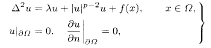
where Ω is a bounded smooth domain in ℝN, N ≥ 5; λ ∈ ℝ1 is a given constant; p = 2N/(N − 4) is the critical Sobolev exponent for the embedding
 ; Δ2 = ΔΔ denotes iterated N-dimensional Laplacian; f(x) is a given function. Some results on the existence and non-existence of multiple solutions for the above problem have been obtained by Ekeland's variational principle and the mountain-pass lemma under some assumptions on f(x) and N.
 ; Δ
; ΔFree quotients of infinite rank of GL2 over Dedekind domains
-
- Journal:
- Proceedings of the Royal Society of Edinburgh. Section A: Mathematics / Volume 129 / Issue 1 / 1999
- Published online by Cambridge University Press:
- 14 November 2011, pp. 77-84
- Print publication:
- 1999
-
- Article
- Export citation
Smooth solution for one-dimensional inhomogeneous Heisenberg chain equations
-
- Journal:
- Proceedings of the Royal Society of Edinburgh. Section A: Mathematics / Volume 129 / Issue 6 / 1999
- Published online by Cambridge University Press:
- 14 November 2011, pp. 1171-1184
- Print publication:
- 1999
-
- Article
- Export citation
