Refine search
Actions for selected content:
26076 results in Abstract analysis
A proof of the subgroup theorem for free products
-
- Journal:
- Mathematika / Volume 5 / Issue 1 / June 1958
- Published online by Cambridge University Press:
- 26 February 2010, pp. 13-19
- Print publication:
- June 1958
-
- Article
- Export citation
-
For each index β in a set J let Aβ be a group. The free product

is by definition a group generated by the Aβ in which any two distinct reduced words represent distinct elements. Here a reduced word is either the expression 1 or an expression

with each “syllable” ai ≠ 1 and each βi ≠ βi+1.
Note on a conformal transformation
-
- Journal:
- Mathematika / Volume 5 / Issue 1 / June 1958
- Published online by Cambridge University Press:
- 26 February 2010, pp. 62-66
- Print publication:
- June 1958
-
- Article
- Export citation
Stress relief in a cracked plate
-
- Journal:
- Mathematika / Volume 5 / Issue 1 / June 1958
- Published online by Cambridge University Press:
- 26 February 2010, pp. 67-81
- Print publication:
- June 1958
-
- Article
- Export citation
On the averages of some arithmetical functions of two variables
-
- Journal:
- Mathematika / Volume 5 / Issue 1 / June 1958
- Published online by Cambridge University Press:
- 26 February 2010, pp. 1-7
- Print publication:
- June 1958
-
- Article
- Export citation
-
The object of this paper is to prove theorems of the following type.
THEOREM 1. If p and q are restricted to odd primes, and
 denotes the Legendre symbol, then for x > 2
 denotes the Legendre symbol, then for x > 2
The separation of a viscous liquid at a straight edge
-
- Journal:
- Mathematika / Volume 5 / Issue 1 / June 1958
- Published online by Cambridge University Press:
- 26 February 2010, pp. 82-84
- Print publication:
- June 1958
-
- Article
- Export citation
An extension of a theorem of Heilbronn
-
- Journal:
- Mathematika / Volume 5 / Issue 1 / June 1958
- Published online by Cambridge University Press:
- 26 February 2010, pp. 30-37
- Print publication:
- June 1958
-
- Article
- Export citation
-
It was proved by Heilbronn that if ε > 0, N > 1 and ϑ is any real number then there exists an integer n satisfying 1 ≤ n ≤ N such that
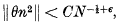
where C depends only on ε. Here ║α║ denotes the difference between α and the nearest integer, taken positively. Professor Heilbronn has remarked (in conversation) that the exponent of N cannot be decreased beyond -1, since if p is an odd prime and a is not divisible by p then
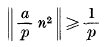
for 1 ≤ n ≤ p—1. He has also remarked that if one could improve the exponent of N to -1 + η, say, it would follow that the absolutely least quadratic non-residue (mod p) is less than Cpn. For if a is a quadratic non-residue (mod p) then so is each of the numbers an2 (1 ≤ n ≤ p—1) and ║an2/p║<Cp-1+η implies that an2 is congruent (mod p) to a number of absolute value less than Cpη.
Some inequalities concerning symmetric forms
-
- Journal:
- Mathematika / Volume 5 / Issue 1 / June 1958
- Published online by Cambridge University Press:
- 26 February 2010, pp. 49-57
- Print publication:
- June 1958
-
- Article
- Export citation
-
Let a1, …, am and b1, … bm be non-negative real numbers. The well-known inequality of Minkowski states that

if n ≥ 1. If n is a positive integer, this inequality asserts a property of a particular symmetric form (i.e. homogeneous polynomial) in m variables, namely the sum of the n-th powers of the variables. Some time ago, Prof. A. C. Aitken conjectured that similar properties are possessed by certain other symmetric forms. In particular, let E(n)(a) denote the n-th elementary symmetric function of a1, …, am and let C(n)(a) denote the n-th complete symmetric function of a1, …, am, the formal definitions being


Then Prof. Aitken conjectured that


The p-adic generalization of the Thue-Siegel-Roth theorem
-
- Journal:
- Mathematika / Volume 5 / Issue 1 / June 1958
- Published online by Cambridge University Press:
- 26 February 2010, pp. 40-48
- Print publication:
- June 1958
-
- Article
- Export citation
-
It was proved recently by Roth that if α is any real algebraic number, and κ > 2, then the inequality
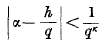
has only a finite number of solutions in integers h and q, where q > 0 and (h, q) = 1. This remarkable result answered finally a question which had been only partially answered by the work of Thue and Siegel.
MTK volume 5 issue 1 Front matter
-
- Journal:
- Mathematika / Volume 5 / Issue 1 / June 1958
- Published online by Cambridge University Press:
- 26 February 2010, pp. f1-f3
- Print publication:
- June 1958
-
- Article
-
- You have access
- Export citation
On sequences of integers
-
- Journal:
- Mathematika / Volume 5 / Issue 1 / June 1958
- Published online by Cambridge University Press:
- 26 February 2010, pp. 38-39
- Print publication:
- June 1958
-
- Article
- Export citation
VII.—Entropic Functions for Linear Algebras*
-
- Journal:
- Proceedings of the Royal Society of Edinburgh Section A: Mathematical and Physical Sciences / Volume 65 / Issue 1 / 1958
- Published online by Cambridge University Press:
- 14 February 2012, pp. 84-108
- Print publication:
- 1958
-
- Article
- Export citation
PRM volume 65 issue 1 Cover and Front matter
-
- Journal:
- Proceedings of the Royal Society of Edinburgh Section A: Mathematical and Physical Sciences / Volume 65 / Issue 1 / 1958
- Published online by Cambridge University Press:
- 14 February 2012, pp. f1-f2
- Print publication:
- 1958
-
- Article
-
- You have access
- Export citation
IV.—The Differential Equations Associated with the Uniformization of Certain Algebraic Curves*
-
- Journal:
- Proceedings of the Royal Society of Edinburgh Section A: Mathematical and Physical Sciences / Volume 65 / Issue 1 / 1958
- Published online by Cambridge University Press:
- 14 February 2012, pp. 35-62
- Print publication:
- 1958
-
- Article
- Export citation
-
Every algebraic equation can be uniformized by automorphic functions belonging to a certain group of bilinear transformations. In certain cases, such as for hyperelliptic equations, this group is a subgroup of the monodromic group of a differential equation of the form

where R(z) is a rational function which, in general, contains unknown parameters as coefficients. A conjecture of E. T. Whittaker regarding the values of these parameters for the hyperelliptic case is proved for a wide variety of algebraic equations whose branch points possess certain symmetric properties, and is extended to equations of higher type. In several cases, the uniformizing functions belong to subgroups of the groups of the Riemann-Schwarz triangle functions.

PRM volume 65 issue 1 Cover and Back matter
-
- Journal:
- Proceedings of the Royal Society of Edinburgh Section A: Mathematical and Physical Sciences / Volume 65 / Issue 1 / 1958
- Published online by Cambridge University Press:
- 14 February 2012, pp. b1-b2
- Print publication:
- 1958
-
- Article
-
- You have access
- Export citation
III.—On the Moments and Regression Equations of the Fourfold Negative and Fourfold Negative Factorial Binomial Distributions
-
- Journal:
- Proceedings of the Royal Society of Edinburgh Section A: Mathematical and Physical Sciences / Volume 65 / Issue 1 / 1958
- Published online by Cambridge University Press:
- 14 February 2012, pp. 29-34
- Print publication:
- 1958
-
- Article
- Export citation
VI.—Complex Four-dimensional Lie Algebras
-
- Journal:
- Proceedings of the Royal Society of Edinburgh Section A: Mathematical and Physical Sciences / Volume 65 / Issue 1 / 1958
- Published online by Cambridge University Press:
- 14 February 2012, pp. 72-83
- Print publication:
- 1958
-
- Article
- Export citation
V.—On Certain Classes of Linear Algebras of Genus One
-
- Journal:
- Proceedings of the Royal Society of Edinburgh Section A: Mathematical and Physical Sciences / Volume 65 / Issue 1 / 1958
- Published online by Cambridge University Press:
- 14 February 2012, pp. 63-71
- Print publication:
- 1958
-
- Article
- Export citation
II.—On Certain Moduli of Rectangular Matrices
-
- Journal:
- Proceedings of the Royal Society of Edinburgh Section A: Mathematical and Physical Sciences / Volume 65 / Issue 1 / 1958
- Published online by Cambridge University Press:
- 14 February 2012, pp. 13-28
- Print publication:
- 1958
-
- Article
- Export citation
-
In this paper are considered certain numbers called moduli associated with a rectangular matrix with complex elements. These moduli have to satisfy a set of conditions analogous to those satisfied by the modulus of a complex number. For a complex rectangular matrix A = (aij) it is shown that R(A), C(A) and | A |° are moduli of A where:
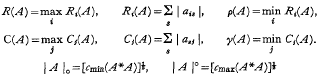
where cmin(H) and cmax(H) denote, respectively, the minimum and maximum characteristic values of the hermitian matrix H, A* being the transpose conjugate of A. Using the various properties of a modulus of a matrix and taking R(A), C(A) and | A |° as the moduli, a number of known results about the characteristic values of a matrix are obtained and extended. Relations between |A|°, |A |° R(A), p(A) and C(A), ɣ(A) are also studied. These relations provide a number of results about estimates of bounds of characteristic values of sums and products of matrices.
I.—On the Geometry of Metrisable Lie Algebras
-
- Journal:
- Proceedings of the Royal Society of Edinburgh Section A: Mathematical and Physical Sciences / Volume 65 / Issue 1 / 1958
- Published online by Cambridge University Press:
- 14 February 2012, pp. 1-12
- Print publication:
- 1958
-
- Article
- Export citation
The product of n linear forms in a field of series
-
- Journal:
- Mathematika / Volume 4 / Issue 2 / December 1957
- Published online by Cambridge University Press:
- 26 February 2010, pp. 132-137
- Print publication:
- December 1957
-
- Article
- Export citation
-
Let K be a field. We denote by K[t] the integral domain of all polynomials in an indeterminate t with coefficients in K, and by K(t) the quotient field of K[t], i.e. the field of all formal rational functions of t over K. A valuation |f| of the elements f of K(t) can be defined by

for f ≠ 0, and |0| = 0, where e > 1. This valuation is multiplicative, and has the properties


