Refine search
Actions for selected content:
26076 results in Abstract analysis
A note on the axially symmetrical punch problem*
-
- Journal:
- Mathematika / Volume 6 / Issue 2 / December 1959
- Published online by Cambridge University Press:
- 26 February 2010, pp. 118-119
- Print publication:
- December 1959
-
- Article
- Export citation
-
In a recent paper Segedin [1] has derived a solution of the problem in which a perfectly rigid punch in the form of a solid of revolution of prescribed shape with axis along the z-axis bears normally on the boundary z = 0 of the semi-infinite elastic body z ≥ 0, so that the area of contact is a circle whose radius is a. Segedin solves the problem by building up the solution in a direct way which avoids both the use of dual integral equations and the introduction of an awkward system of curvilinear coordinates. By introducing a kernel function K(ξ), Segedin derives new potentials of the form

where U(r, z, a) is the solution of the simplest punch problem (namely that of a flat-ended punch) satisfying the mixed boundary conditions

on the boundary z = 0. It can then be easily shown that, under wide conditions on K, the function Φ (r, z, a) satisfies the boundary conditions

provided that K(ξ) is chosen so that

The receptance function of a beam
-
- Journal:
- Mathematika / Volume 6 / Issue 2 / December 1959
- Published online by Cambridge University Press:
- 26 February 2010, pp. 134-141
- Print publication:
- December 1959
-
- Article
- Export citation
On the solution of some axisymmetric boundary value problems by means of integral equations, II: further problems for a circular disc and a spherical cap
-
- Journal:
- Mathematika / Volume 6 / Issue 2 / December 1959
- Published online by Cambridge University Press:
- 26 February 2010, pp. 120-133
- Print publication:
- December 1959
-
- Article
- Export citation
The defect of a one-dimensional local ring
-
- Journal:
- Mathematika / Volume 6 / Issue 2 / December 1959
- Published online by Cambridge University Press:
- 26 February 2010, pp. 91-97
- Print publication:
- December 1959
-
- Article
- Export citation
Two centred expansion of the retarded Green's function
-
- Journal:
- Mathematika / Volume 6 / Issue 2 / December 1959
- Published online by Cambridge University Press:
- 26 February 2010, pp. 108-117
- Print publication:
- December 1959
-
- Article
- Export citation
-
The two centred expansion of the Coulomb Green's function arises naturally in discussing the static interaction energy of two charge distributions ρ1, and ρ2. This is given by the well-known expression

Covering space with equal spheres
-
- Journal:
- Mathematika / Volume 6 / Issue 2 / December 1959
- Published online by Cambridge University Press:
- 26 February 2010, pp. 147-157
- Print publication:
- December 1959
-
- Article
- Export citation
-
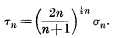
In a recent paper Rogers [13] has discussed packings of equal spheres in n-dimensional space and has shown that the density of such a packing cannot exceed a certain ratio σn. In this paper, we discuss coverings of space with equal spheres and, by using a method which is in some respects dual to that used by Rogers, we show that the density of such a covering must always be at least
On the enumerative geometry of triangles
-
- Journal:
- Mathematika / Volume 6 / Issue 2 / December 1959
- Published online by Cambridge University Press:
- 26 February 2010, pp. 158-164
- Print publication:
- December 1959
-
- Article
- Export citation
Rational polygons
-
- Journal:
- Mathematika / Volume 6 / Issue 2 / December 1959
- Published online by Cambridge University Press:
- 26 February 2010, p. 98
- Print publication:
- December 1959
-
- Article
- Export citation
Note on the motion of fluid in a curved pipe
-
- Journal:
- Mathematika / Volume 6 / Issue 1 / June 1959
- Published online by Cambridge University Press:
- 26 February 2010, pp. 77-85
- Print publication:
- June 1959
-
- Article
-
- You have access
- Export citation
MTK volume 6 issue 1 Front matter
-
- Journal:
- Mathematika / Volume 6 / Issue 1 / June 1959
- Published online by Cambridge University Press:
- 26 February 2010, pp. f1-f3
- Print publication:
- June 1959
-
- Article
-
- You have access
- Export citation
Lattice coverings of space
-
- Journal:
- Mathematika / Volume 6 / Issue 1 / June 1959
- Published online by Cambridge University Press:
- 26 February 2010, pp. 33-39
- Print publication:
- June 1959
-
- Article
- Export citation
-
Let K be a n-dimensional convex body. A lattice Λ will be called a covering lattice for K (or simply a covering lattice), if each point of space has at least one representation in the form k + g where k ε K and g ε Λ. The density ϑ(K, Λ) of the resultant covering of the whole of space by the bodies of the form K + g with g ε Λ is, quite naturally, defined to be the ratio V(K)/d(Λ), where V(K) is the volume of K and d(Λ) is the determinant of Λ (i.e. the volume of its fundamental parallepipeds). Clearly this density is at least 1. A number of authors, in particular H. Davenport [3], R. P. Bambah and K. F. Roth [2], G. L. Watson [8], C. A. Rogers [4], [5] and W. Schmidt [7], have either constructed or proved the existence of lattices for which the density ϑ(K, Λ) is reasonably small. But, when n is large, all the densities obtained are of the form cn where c is a constant greater than 1. The object of this note is to obtain some rather stronger results. In the general case we prove the existence of covering lattices Λ with

Where

as n→∞.

The stability of a column of rotating liquid
-
- Journal:
- Mathematika / Volume 6 / Issue 1 / June 1959
- Published online by Cambridge University Press:
- 26 February 2010, pp. 25-32
- Print publication:
- June 1959
-
- Article
- Export citation
The genus field and genus group in finite number fields
-
- Journal:
- Mathematika / Volume 6 / Issue 1 / June 1959
- Published online by Cambridge University Press:
- 26 February 2010, pp. 40-46
- Print publication:
- June 1959
-
- Article
- Export citation
Simple rings without zero-divisors, and Lie division rings
-
- Journal:
- Mathematika / Volume 6 / Issue 1 / June 1959
- Published online by Cambridge University Press:
- 26 February 2010, pp. 14-18
- Print publication:
- June 1959
-
- Article
- Export citation
Combinatorial extreme value distributions
-
- Journal:
- Mathematika / Volume 6 / Issue 1 / June 1959
- Published online by Cambridge University Press:
- 26 February 2010, pp. 63-76
- Print publication:
- June 1959
-
- Article
- Export citation
Products on spheres
-
- Journal:
- Mathematika / Volume 6 / Issue 1 / June 1959
- Published online by Cambridge University Press:
- 26 February 2010, pp. 1-13
- Print publication:
- June 1959
-
- Article
- Export citation
Elastic equilibrium of completely aeolotropic cylinders: extension by longitudinal lateral loading and end forces
-
- Journal:
- Mathematika / Volume 6 / Issue 1 / June 1959
- Published online by Cambridge University Press:
- 26 February 2010, pp. 47-62
- Print publication:
- June 1959
-
- Article
- Export citation
A generalization of Ascoli's theorem
-
- Journal:
- Mathematika / Volume 6 / Issue 1 / June 1959
- Published online by Cambridge University Press:
- 26 February 2010, pp. 19-24
- Print publication:
- June 1959
-
- Article
- Export citation
-
In its simplest form, the theorem of Ascoli with which we are concerned is an extension of the Bolzano-Weierstrass theorem: it states that, if X and Y are bounded closed sets, of real or complex numbers, and
 is a sequence of equicontinuous functions mapping X into Y, thenhas a uniformly convergent subsequence. As is well known, this result has played a fundamental part in the development of several theories; it has also been widely generalized, by processes of abstraction and localization, and a very useful version of the theorem runs as follows (cf. [4], 233–234):
(A) Suppose that X is a locally compact regular space, and that Y is a Hausdorff space whose topology is determined by a uniform structure
 . Let YX be the space of all functions that map X into Y, with the topology of locally uniform convergence with respect to. Then a closed setin YX is compact if, at each point x of X, (i) the set(x) is relatively compact, in Y, and, (ii) is equicontinuous with respect to.
 is a sequence of equicontinuous functions mapping X into Y, then
 . Let Y
XI.—The Free Commutative Entropic Logarithmetic*
-
- Journal:
- Proceedings of the Royal Society of Edinburgh Section A: Mathematical and Physical Sciences / Volume 65 / Issue 2 / 1959
- Published online by Cambridge University Press:
- 14 February 2012, pp. 177-192
- Print publication:
- 1959
-
- Article
- Export citation
-
The commutative and entropic congruence relations determine a homomorphism on the free logarithmetic
 , the arithmetic of the indices of powers of the generating element of a free cyclic groupoid. A necessary and sufficient condition that two indices should be concordant (i.e. congruent in the free commutative entropic logarithmetic) is that the bifurcating trees corresponding to these indices should have the same number of free ends at each altitude. It follows that the free commutative entropic logarithmetic can be represented faithfully by index ψ-polynomials (or θ-polynomials) in one indeterminate.
In the concluding section enumeration formulæ are obtained for the number of non-concordant indices of a given altitude and for the number of indices concordant to a given index.
 , the arithmetic of the indices of powers of the generating element of a free cyclic groupoid. A necessary and sufficient condition that two indices should be concordant (i.e. congruent in the free commutative entropic logarithmetic) is that the bifurcating trees corresponding to these indices should have the same number of free ends at each altitude. It follows that the free commutative entropic logarithmetic can be represented faithfully by index ψ-polynomials (or θ-polynomials) in one indeterminate.
VIII.—The Central Limit Theorem for a Convergent Non-homogeneous Finite Markov Chain*
-
- Journal:
- Proceedings of the Royal Society of Edinburgh Section A: Mathematical and Physical Sciences / Volume 65 / Issue 2 / 1959
- Published online by Cambridge University Press:
- 14 February 2012, pp. 109-120
- Print publication:
- 1959
-
- Article
- Export citation
