Refine search
Actions for selected content:
26076 results in Abstract analysis
MTK volume 8 issue 1 Front matter
-
- Journal:
- Mathematika / Volume 8 / Issue 1 / June 1961
- Published online by Cambridge University Press:
- 26 February 2010, pp. f1-f2
- Print publication:
- June 1961
-
- Article
-
- You have access
- Export citation
A note on the maximum resultant shear in the aeolotropic torsion problem
-
- Journal:
- Mathematika / Volume 8 / Issue 1 / June 1961
- Published online by Cambridge University Press:
- 26 February 2010, pp. 79-82
- Print publication:
- June 1961
-
- Article
- Export citation
On two-centred expansions in cylindrical polar co-ordinates
-
- Journal:
- Mathematika / Volume 8 / Issue 1 / June 1961
- Published online by Cambridge University Press:
- 26 February 2010, pp. 69-78
- Print publication:
- June 1961
-
- Article
- Export citation
-
In a recent paper (Shail [1]) the present author considered the problem of finding a two-centred expansion of the retarded Helmholtz Green's function
 This work formed an extension to that of Carlson and Rushbrooke [2] (also Buehler and Hirschfelder [3]) on the Coulomb Green's function and arose out of considerations of the interaction energy of two charge distributions taking account of electromagnetic retardation. The two-centred expansion obtained in [1] took the form of a double Taylor series, each term being interpreted as a Maxwell multipole—multipole interaction energy between two “charge” distributions coupled through a retarded scalar field. The first few terms in the expansion were also given in spherical polar coordinates.
 This work formed an extension to that of Carlson and Rushbrooke [2] (also Buehler and Hirschfelder [3]) on the Coulomb Green's function and arose out of considerations of the interaction energy of two charge distributions taking account of electromagnetic retardation. The two-centred expansion obtained in [1] took the form of a double Taylor series, each term being interpreted as a Maxwell multipole—multipole interaction energy between two “charge” distributions coupled through a retarded scalar field. The first few terms in the expansion were also given in spherical polar coordinates.
Cauchy problem for the generalised radially symmetric wave equation
-
- Journal:
- Mathematika / Volume 8 / Issue 1 / June 1961
- Published online by Cambridge University Press:
- 26 February 2010, pp. 66-68
- Print publication:
- June 1961
-
- Article
- Export citation
A note on binary cubic forms
-
- Journal:
- Mathematika / Volume 8 / Issue 1 / June 1961
- Published online by Cambridge University Press:
- 26 February 2010, pp. 58-62
- Print publication:
- June 1961
-
- Article
- Export citation
-
Let D(f) denote the discriminant of a binary cubic form

having integral coefficients. We restrict ourselves to forms with D(f) ≠ 0, and further (as a matter of convenience) to forms which are irreducible in the rational field. It is a problem of some interest, in connection with the approximation properties of transcendental numbers, to estimate the sum

as H→∞, where ‖f‖ = max(|a|, |b|, |c|, |d|). Since |D(f)| ≪ H4 when ‖f‖ < H, there is the trivial lower bound

Completely aeolotropic cylinders under general lateral loading
-
- Journal:
- Mathematika / Volume 8 / Issue 1 / June 1961
- Published online by Cambridge University Press:
- 26 February 2010, pp. 45-54
- Print publication:
- June 1961
-
- Article
- Export citation
The real cubic case of Mahler's conjecture
-
- Journal:
- Mathematika / Volume 8 / Issue 1 / June 1961
- Published online by Cambridge University Press:
- 26 February 2010, pp. 55-57
- Print publication:
- June 1961
-
- Article
- Export citation
-
For any (real or complex) transcendental number ξ and any integer n > 0 let ϑn(ξ) be the least upper bound of the set of all positive numbers σ for which there exist infinitely many polynomials p1(x), p2(x), … of degree n, with integer coefficients, satisfying

where ‖pi‖ denotes the “height” of pi(x), i.e. the maximum modulus of the coefficients. Plainly ϑn(ξ) serves as a measure of how well (or how badly) the number zero can be approximated by values of nth degree integral polynomials at the point ξ. It can be shown by means of the “Schubfachprinzip” that, at worst,

if the transcendental number ξ is real, and

if it is complex, i.e.ϑn(ξ) is never smaller than these bounds. Furthermore, a conjecture of K. Mahler may be interpreted as stating that for almost all real and for almost all complex numbers the equations (2) and (3), respectively, are actually true; in other words, almost all transcendental numbers have the worst possible approximation property for any degree n.
Indefinite quadratic Diophantine equations
-
- Journal:
- Mathematika / Volume 8 / Issue 1 / June 1961
- Published online by Cambridge University Press:
- 26 February 2010, pp. 32-38
- Print publication:
- June 1961
-
- Article
- Export citation
Note on a conjecture of L. A. Santaló
-
- Journal:
- Mathematika / Volume 8 / Issue 1 / June 1961
- Published online by Cambridge University Press:
- 26 February 2010, pp. 63-65
- Print publication:
- June 1961
-
- Article
- Export citation
-
Let
 be a plane bounded convex set whose width in the direction φ is
  . It has been shown by L. A. Santaló that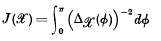
is invariant under unimodular affine transformations. Santaló [1] established a number of properties of this invariant and conjectured that if the area of
is A() then  and that equality characterizes triangles. In this note Santaló's conjecture is shown to be true.
 be a plane bounded convex set whose width in the direction φ is
  . It has been shown by L. A. Santaló that
 and that equality characterizes triangles. In this note Santaló's conjecture is shown to be true.
Functions continuous and singular with respect to a Hausdorff measure
-
- Journal:
- Mathematika / Volume 8 / Issue 1 / June 1961
- Published online by Cambridge University Press:
- 26 February 2010, pp. 1-31
- Print publication:
- June 1961
-
- Article
- Export citation
XXV.—Properties of I-extensions of Anti-commutative Algebras
-
- Journal:
- Proceedings of the Royal Society of Edinburgh Section A: Mathematical and Physical Sciences / Volume 65 / Issue 4 / 1961
- Published online by Cambridge University Press:
- 14 February 2012, pp. 345-357
- Print publication:
- 1961
-
- Article
- Export citation
XXVIII.—The Synthesis of 7-Substituted Fluoranthenes*
-
- Journal:
- Proceedings of the Royal Society of Edinburgh Section A: Mathematical and Physical Sciences / Volume 65 / Issue 4 / 1961
- Published online by Cambridge University Press:
- 14 February 2012, pp. 376-380
- Print publication:
- 1961
-
- Article
- Export citation
XXI—The Evaluation of a Definite Integral Which Occurs in Asymptotic Partition Theory*
-
- Journal:
- Proceedings of the Royal Society of Edinburgh Section A: Mathematical and Physical Sciences / Volume 65 / Issue 4 / 1961
- Published online by Cambridge University Press:
- 14 February 2012, pp. 283-309
- Print publication:
- 1961
-
- Article
- Export citation
-
In order to estimate the number of partitions of a multi-partite number, the components of which are all large and of approximately the same order of magnitude, it is necessary to evaluate for ℛ(z1) > o(l=1, 2, …,j — 1) the integral

where

for o < u < 2π min (1, |z1|−1, …, |zj−1|−1) and
 Asymptotic expansions are obtained for I when the z1 are small. Simple expressions give an approximate value of I when every zl is real and exact formulæ are derived when every Zl is real and rational.
 Asymptotic expansions are obtained for I when the z
XXIII.—Representations of a Number as the Sum of a Large Number of Squares*
-
- Journal:
- Proceedings of the Royal Society of Edinburgh Section A: Mathematical and Physical Sciences / Volume 65 / Issue 4 / 1961
- Published online by Cambridge University Press:
- 14 February 2012, pp. 318-331
- Print publication:
- 1961
-
- Article
- Export citation
XXIV.—Sets of Integers Containing not more than a Given Number of Terms in Arithmetical Progression*
-
- Journal:
- Proceedings of the Royal Society of Edinburgh Section A: Mathematical and Physical Sciences / Volume 65 / Issue 4 / 1961
- Published online by Cambridge University Press:
- 14 February 2012, pp. 332-344
- Print publication:
- 1961
-
- Article
- Export citation
PRM volume 65 issue 4 Cover and Front matter
-
- Journal:
- Proceedings of the Royal Society of Edinburgh Section A: Mathematical and Physical Sciences / Volume 65 / Issue 4 / 1961
- Published online by Cambridge University Press:
- 14 February 2012, pp. f1-f2
- Print publication:
- 1961
-
- Article
-
- You have access
- Export citation
XXVI.—Solution of the Equation (z + b)eZ+a = ±(z − b)
-
- Journal:
- Proceedings of the Royal Society of Edinburgh Section A: Mathematical and Physical Sciences / Volume 65 / Issue 4 / 1961
- Published online by Cambridge University Press:
- 14 February 2012, pp. 358-371
- Print publication:
- 1961
-
- Article
- Export citation
XXVII.—Hydrogenated 1-Naphthoic Acid Derivatives*
-
- Journal:
- Proceedings of the Royal Society of Edinburgh Section A: Mathematical and Physical Sciences / Volume 65 / Issue 4 / 1961
- Published online by Cambridge University Press:
- 14 February 2012, pp. 372-375
- Print publication:
- 1961
-
- Article
- Export citation
XXII.—Some Nilpotent Algebras with Centres of Given Dimension
-
- Journal:
- Proceedings of the Royal Society of Edinburgh Section A: Mathematical and Physical Sciences / Volume 65 / Issue 4 / 1961
- Published online by Cambridge University Press:
- 14 February 2012, pp. 310-317
- Print publication:
- 1961
-
- Article
- Export citation
PRM volume 65 issue 4 Cover and Back matter
-
- Journal:
- Proceedings of the Royal Society of Edinburgh Section A: Mathematical and Physical Sciences / Volume 65 / Issue 4 / 1961
- Published online by Cambridge University Press:
- 14 February 2012, pp. b1-b7
- Print publication:
- 1961
-
- Article
-
- You have access
- Export citation
