Refine search
Actions for selected content:
26076 results in Abstract analysis
XVI.—Dual Series Relations. III. Dual Relations Involving Trigonometric Series
-
- Journal:
- Proceedings of the Royal Society of Edinburgh Section A: Mathematical and Physical Sciences / Volume 66 / Issue 3 / 1963
- Published online by Cambridge University Press:
- 14 February 2012, pp. 173-184
- Print publication:
- 1963
-
- Article
- Export citation
XII.—Paraboloidal Co-ordinates and Laplace's Equation*†
-
- Journal:
- Proceedings of the Royal Society of Edinburgh Section A: Mathematical and Physical Sciences / Volume 66 / Issue 3 / 1963
- Published online by Cambridge University Press:
- 14 February 2012, pp. 129-139
- Print publication:
- 1963
-
- Article
- Export citation
PRM volume 66 issue 3 Cover and Back matter
-
- Journal:
- Proceedings of the Royal Society of Edinburgh Section A: Mathematical and Physical Sciences / Volume 66 / Issue 3 / 1963
- Published online by Cambridge University Press:
- 14 February 2012, pp. b1-b2
- Print publication:
- 1963
-
- Article
-
- You have access
- Export citation
XIV.—Dual Series Relations. I. Dual Relations Involving Fourier-Bessel Series*
-
- Journal:
- Proceedings of the Royal Society of Edinburgh Section A: Mathematical and Physical Sciences / Volume 66 / Issue 3 / 1963
- Published online by Cambridge University Press:
- 14 February 2012, pp. 150-160
- Print publication:
- 1963
-
- Article
- Export citation
-
The solution of the dual series relations

where {λn) is the sequence of positive zeros of the Bessel function Jν(αλ), arranged in order of increasing magnitude, þ and ν are real numbers (−1 <þ < 1, ν >0), the functions, f1(ρ), f2(ρ) being prescribed, is obtained by giving an integral representation of {αn} in terms of a single function g(t). The problem is reduced to that of solving a Fredholm integral equation of the second kind for the auxiliary function g(t).
PRM volume 66 issue 3 Cover and Front matter
-
- Journal:
- Proceedings of the Royal Society of Edinburgh Section A: Mathematical and Physical Sciences / Volume 66 / Issue 3 / 1963
- Published online by Cambridge University Press:
- 14 February 2012, pp. f1-f2
- Print publication:
- 1963
-
- Article
-
- You have access
- Export citation
XVIII.—The Emission of Long-Range Alpha Particles in Fission
-
- Journal:
- Proceedings of the Royal Society of Edinburgh Section A: Mathematical and Physical Sciences / Volume 66 / Issue 3 / 1963
- Published online by Cambridge University Press:
- 14 February 2012, pp. 192-209
- Print publication:
- 1963
-
- Article
- Export citation
Note on the basic assumptions of elastic plate theories
-
- Journal:
- Mathematika / Volume 9 / Issue 2 / December 1962
- Published online by Cambridge University Press:
- 26 February 2010, pp. 127-132
- Print publication:
- December 1962
-
- Article
- Export citation
Monoidal transformations in a one-dimensional local ring
-
- Journal:
- Mathematika / Volume 9 / Issue 2 / December 1962
- Published online by Cambridge University Press:
- 26 February 2010, pp. 135-144
- Print publication:
- December 1962
-
- Article
- Export citation
MTK volume 9 issue 2 Front matter
-
- Journal:
- Mathematika / Volume 9 / Issue 2 / December 1962
- Published online by Cambridge University Press:
- 26 February 2010, p. f1
- Print publication:
- December 1962
-
- Article
-
- You have access
- Export citation
Sets non-σ-finite for Hausdorff measures
-
- Journal:
- Mathematika / Volume 9 / Issue 2 / December 1962
- Published online by Cambridge University Press:
- 26 February 2010, pp. 95-103
- Print publication:
- December 1962
-
- Article
- Export citation
-
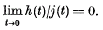
Let ℋ be the system of all continuous increasing functions h(t), denned for t ≥ 0, with h(0) = 0 and h(t)>0 for t > 0. Let Ω be a separable metric space. Then, for each h of ℋ, we may introduce a Hausdorff measure into Ω, by taking
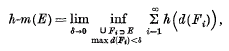
where d(Fi) denotes the diameter of Fi, and where the infimum is taken over all sequences {Fi} of closed sets, covering E and having diameters less than δ. We introduce a natural partial order in the system of these Hausdorff measures by writing j < h, if j, h are functions of ℋ and
On circuits and subgraphs of chromatic graphs
-
- Journal:
- Mathematika / Volume 9 / Issue 2 / December 1962
- Published online by Cambridge University Press:
- 26 February 2010, pp. 170-175
- Print publication:
- December 1962
-
- Article
- Export citation
Index to volume 9
-
- Journal:
- Mathematika / Volume 9 / Issue 2 / December 1962
- Published online by Cambridge University Press:
- 26 February 2010, p. 176
- Print publication:
- December 1962
-
- Article
- Export citation
Approximation properties of measures generated by continuous set functions
-
- Journal:
- Mathematika / Volume 9 / Issue 2 / December 1962
- Published online by Cambridge University Press:
- 26 February 2010, pp. 145-156
- Print publication:
- December 1962
-
- Article
- Export citation
-
Let X be a metric space and τ a non-negative function on the subsets of X. By the well-known Carathéodory process, we generate outer measures μδ(τ), for δ > 0, and
 (see §3). When, for every A ⊂ X, τA = (diamA)s for s ≥ 0, μ(τ) is the Hausdorff s-dimensional measure, and, if τA = h(diam A) for a monotone continuous function h with h(0) = 0, μ(τ) is the Hausdorff h-measure. In both of these cases, μ(τ) has been extensively studied.
 (see §3). When, for every A ⊂ X, τA = (diamA)
A result relating to the local uniformisation theorem
-
- Journal:
- Mathematika / Volume 9 / Issue 2 / December 1962
- Published online by Cambridge University Press:
- 26 February 2010, pp. 104-110
- Print publication:
- December 1962
-
- Article
- Export citation
The stability of an incompressible jet with an aligned magnetic field
-
- Journal:
- Mathematika / Volume 9 / Issue 2 / December 1962
- Published online by Cambridge University Press:
- 26 February 2010, pp. 162-169
- Print publication:
- December 1962
-
- Article
- Export citation
On the genus of curves over finite fields
-
- Journal:
- Mathematika / Volume 9 / Issue 2 / December 1962
- Published online by Cambridge University Press:
- 26 February 2010, pp. 115-117
- Print publication:
- December 1962
-
- Article
- Export citation
On non-ramified extensions with prescribed Galois group
-
- Journal:
- Mathematika / Volume 9 / Issue 2 / December 1962
- Published online by Cambridge University Press:
- 26 February 2010, pp. 133-134
- Print publication:
- December 1962
-
- Article
- Export citation
A transcendence measure for E-functions
-
- Journal:
- Mathematika / Volume 9 / Issue 2 / December 1962
- Published online by Cambridge University Press:
- 26 February 2010, pp. 157-161
- Print publication:
- December 1962
-
- Article
- Export citation
-
Siegel defined an E-function to be a function which admits a power series expansion
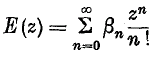
with complex coefficients βn, belonging to some algebraic number field K (of finite degree over the rationals Q), satisfying the following conditions:
(i) Given ε > 0, the maximum of the absolute values of the conjugates of βn, satisfies

A note on the Hilbert functions of certain ideals which are defined by matrices
-
- Journal:
- Mathematika / Volume 9 / Issue 2 / December 1962
- Published online by Cambridge University Press:
- 26 February 2010, pp. 118-126
- Print publication:
- December 1962
-
- Article
- Export citation
Average distances between points in a square
-
- Journal:
- Mathematika / Volume 9 / Issue 2 / December 1962
- Published online by Cambridge University Press:
- 26 February 2010, pp. 111-114
- Print publication:
- December 1962
-
- Article
- Export citation
-
Suppose we have a set
 of n points P1, …, Pn in a unit square. Let
and let Sn be the upper bound of d1+…dn taken over all positions of P1, …, Pn in the square. We prove that

 of n points P
