Refine search
Actions for selected content:
26076 results in Abstract analysis
Reversion of a formal power series
-
- Journal:
- Mathematika / Volume 9 / Issue 1 / June 1962
- Published online by Cambridge University Press:
- 26 February 2010, pp. 88-94
- Print publication:
- June 1962
-
- Article
- Export citation
-
If f(z) is a function of the complex variable z, regular in a neighbourhood of z = 0, with f (0) = 0 and f' (0) ≠ 0, then the equation w = f(z) admits a unique solution, regular in some neighbourhood of w = 0, given by

where C is an appropriate contour encircling z = 0. These formulae are well-known, being stages in the proof of the classical reversion † formula
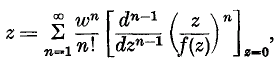
due to Lagrange.
Thermal damping of a vibrating elastic body
-
- Journal:
- Mathematika / Volume 9 / Issue 1 / June 1962
- Published online by Cambridge University Press:
- 26 February 2010, pp. 38-48
- Print publication:
- June 1962
-
- Article
- Export citation
A moment theory of elastic plates
-
- Journal:
- Mathematika / Volume 9 / Issue 1 / June 1962
- Published online by Cambridge University Press:
- 26 February 2010, pp. 11-24
- Print publication:
- June 1962
-
- Article
- Export citation
Two special cubic surfaces
-
- Journal:
- Mathematika / Volume 9 / Issue 1 / June 1962
- Published online by Cambridge University Press:
- 26 February 2010, pp. 54-56
- Print publication:
- June 1962
-
- Article
- Export citation
The addition of norm forms
-
- Journal:
- Mathematika / Volume 9 / Issue 1 / June 1962
- Published online by Cambridge University Press:
- 26 February 2010, pp. 75-82
- Print publication:
- June 1962
-
- Article
- Export citation
On some axisymmetrical two sphere potential problems
-
- Journal:
- Mathematika / Volume 9 / Issue 1 / June 1962
- Published online by Cambridge University Press:
- 26 February 2010, pp. 57-70
- Print publication:
- June 1962
-
- Article
- Export citation
An extension of a theorem of König on graphs
-
- Journal:
- Mathematika / Volume 9 / Issue 1 / June 1962
- Published online by Cambridge University Press:
- 26 February 2010, pp. 9-10
- Print publication:
- June 1962
-
- Article
- Export citation
Continued fractions of transcendental numbers
-
- Journal:
- Mathematika / Volume 9 / Issue 1 / June 1962
- Published online by Cambridge University Press:
- 26 February 2010, pp. 1-8
- Print publication:
- June 1962
-
- Article
- Export citation
-
It is well known that if, in a continued fraction

there is a subsequence of the an which increases very rapidly, then ξ is a transcendental number. A result of this kind follows from Liouville's Theorem on rational approximations to algebraic numbers, but the most precise result so far established is that which was deduced from Roth's Theorem by Davenport and Roth [1]. They proved (Theorem 3) that if ξ is algebraic, then

where qn is the denominator of the nth convergent to (1). Thus if

ξ is transcendental.
MTK volume 9 issue 1 Front matter
-
- Journal:
- Mathematika / Volume 9 / Issue 1 / June 1962
- Published online by Cambridge University Press:
- 26 February 2010, p. f1
- Print publication:
- June 1962
-
- Article
-
- You have access
- Export citation
Some axially symmetric stress distributions in elastic solids containing penny-shaped cracks. II. Cracks in solids under torsion
-
- Journal:
- Mathematika / Volume 9 / Issue 1 / June 1962
- Published online by Cambridge University Press:
- 26 February 2010, pp. 25-37
- Print publication:
- June 1962
-
- Article
- Export citation
A slow fluid motion between two spheres
-
- Journal:
- Mathematika / Volume 9 / Issue 1 / June 1962
- Published online by Cambridge University Press:
- 26 February 2010, pp. 83-87
- Print publication:
- June 1962
-
- Article
- Export citation
-
A slow steady motion of incompressible viscous liquid in the space between two fixed concentric spherical boundaries is considered. The motion arises from two point-sources of strengths ±2m at arbitrary points A, B on the outer sphere r = a. The velocity is calculated as the vector sum of the velocities in two simpler motions in each of which there is an axis of symmetry so that a stream function can be used. The force exerted by the liquid on the inner boundary r = b is similarly the resultant of two forces, each passing through the common centre of the spheres; it can be simply expressed in terms of a, b, m and the vector
 .
.
 .
.Some Abelian results for Dirichlet series
-
- Journal:
- Mathematika / Volume 9 / Issue 1 / June 1962
- Published online by Cambridge University Press:
- 26 February 2010, pp. 49-53
- Print publication:
- June 1962
-
- Article
- Export citation
-
If f(s) is the analytic function defined by the Dirichlet series
 and if
  where 0 ≤ b < 1, then the series converges for Re s > 1 and f(s) is regular in the half plane Re s > b except for a simple pole with residue C ≠ 0 at a s = 1. Thus f(s) has a Laurent expansion at s = 1 and it has been shown [1] that under these conditions
where

 and if
  where 0 ≤ b < 1, then the series converges for Re s > 1 and f(s) is regular in the half plane Re s > b except for a simple pole with residue C ≠ 0 at a s = 1. Thus f(s) has a Laurent expansion at s = 1 and it has been shown [1] that under these conditions
The group of rotations in a plane over GF(2n)
-
- Journal:
- Mathematika / Volume 9 / Issue 1 / June 1962
- Published online by Cambridge University Press:
- 26 February 2010, pp. 71-74
- Print publication:
- June 1962
-
- Article
- Export citation
XI.—On the Construction of Metrisable Lie Algebras*
-
- Journal:
- Proceedings of the Royal Society of Edinburgh Section A: Mathematical and Physical Sciences / Volume 66 / Issue 2 / 1962
- Published online by Cambridge University Press:
- 14 February 2012, pp. 116-127
- Print publication:
- 1962
-
- Article
- Export citation
I.—Focusing of Electron Beams in Crossed Static Electric and Magnetic Fields*
-
- Journal:
- Proceedings of the Royal Society of Edinburgh Section A: Mathematical and Physical Sciences / Volume 66 / Issue 1 / 1962
- Published online by Cambridge University Press:
- 14 February 2012, pp. 1-19
- Print publication:
- 1962
-
- Article
- Export citation
PRM volume 66 issue 2 Cover and Front matter
-
- Journal:
- Proceedings of the Royal Society of Edinburgh Section A: Mathematical and Physical Sciences / Volume 66 / Issue 2 / 1962
- Published online by Cambridge University Press:
- 14 February 2012, pp. f1-f2
- Print publication:
- 1962
-
- Article
-
- You have access
- Export citation
VII.–The Effect of the Transport of Heat on the Rate of Evaporation of Small Droplets‡ I. Evaporation into a Large Excess of a Gas
-
- Journal:
- Proceedings of the Royal Society of Edinburgh Section A: Mathematical and Physical Sciences / Volume 66 / Issue 2 / 1962
- Published online by Cambridge University Press:
- 14 February 2012, pp. 65-80
- Print publication:
- 1962
-
- Article
- Export citation
II.—Spontaneous Fission Rates and the Role of the “Excess” Neutrons in Heavy Nuclei*
-
- Journal:
- Proceedings of the Royal Society of Edinburgh Section A: Mathematical and Physical Sciences / Volume 66 / Issue 1 / 1962
- Published online by Cambridge University Press:
- 14 February 2012, pp. 20-32
- Print publication:
- 1962
-
- Article
- Export citation
IX.—Possible Applications of Coincidence Counter Techniques in Optical Intensity Correlation Studies*
-
- Journal:
- Proceedings of the Royal Society of Edinburgh Section A: Mathematical and Physical Sciences / Volume 66 / Issue 2 / 1962
- Published online by Cambridge University Press:
- 14 February 2012, pp. 93-110
- Print publication:
- 1962
-
- Article
- Export citation
VIII.—Theoretical Expressions for Relaxation Effects in the Thermal Conductivity of Gases as Measured in the Modified Co-axial Cylinder Apparatus of Callear and Robb
-
- Journal:
- Proceedings of the Royal Society of Edinburgh Section A: Mathematical and Physical Sciences / Volume 66 / Issue 2 / 1962
- Published online by Cambridge University Press:
- 14 February 2012, pp. 81-92
- Print publication:
- 1962
-
- Article
- Export citation
