Refine search
Actions for selected content:
26076 results in Abstract analysis
Index
-
- Journal:
- Proceedings of the Royal Society of Edinburgh Section A: Mathematical and Physical Sciences / Volume 65 / Issue 4 / 1961
- Published online by Cambridge University Press:
- 14 February 2012, pp. 381-383
- Print publication:
- 1961
-
- Article
- Export citation
Indefinite quadratic polynomials
-
- Journal:
- Mathematika / Volume 7 / Issue 2 / December 1960
- Published online by Cambridge University Press:
- 26 February 2010, pp. 141-144
- Print publication:
- December 1960
-
- Article
- Export citation
-
1. Let f = f(x1, …, xn) be an indefinite quadratic form in n variables with discriminant d = d(f) ¹ 0; and let ξ1, …, ξn be real numbers. We consider how closely the inhomogeneous quadratic polynomial

can be made to approximate to a given real number α by choice of suitable integral values of the variables xi. The best that is known seems to be that the inequalities

can always be satisfied if the implied constant is given a suitable value depending only on n. For α ≥ 0 this is a restatement of a result proved by Dr. D. M. E. Foster.
Green's functions for thin perforated elastic slabs
-
- Journal:
- Mathematika / Volume 7 / Issue 2 / December 1960
- Published online by Cambridge University Press:
- 26 February 2010, pp. 101-112
- Print publication:
- December 1960
-
- Article
- Export citation
Certain subgroups of free products
-
- Journal:
- Mathematika / Volume 7 / Issue 2 / December 1960
- Published online by Cambridge University Press:
- 26 February 2010, pp. 117-124
- Print publication:
- December 1960
-
- Article
- Export citation
-
Let G1,… Gn be groups, let *Gi be their free product, and let ´ Gi be their direct product. A homomorphism
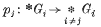 may be defined by requiring it to be trivial on Gj and the identity on Gi for i ¹ j. Let [G1 … Gn] = Çker pj. P. J. Hilton [2] proves that [G1, …, Gn] is a free group, and, if HiÌGi, i = 1, …, n, that [H1,… Hn] is a free factor of [G1 … Gn]. He asks whether, if Hλi Ì Gi, λ = 1, …, k, i = 1, …, n, and Hλ = [Hλ1, …, Hλn] the group generated by the Hλ is a free factor of [G1, …, Gn].
 may be defined by requiring it to be trivial on G
Some elastic and thermoelastic stress distributions in a semi-infinite solid
-
- Journal:
- Mathematika / Volume 7 / Issue 2 / December 1960
- Published online by Cambridge University Press:
- 26 February 2010, pp. 149-160
- Print publication:
- December 1960
-
- Article
- Export citation
On a theorem of P. J. Cohen
-
- Journal:
- Mathematika / Volume 7 / Issue 2 / December 1960
- Published online by Cambridge University Press:
- 26 February 2010, pp. 93-97
- Print publication:
- December 1960
-
- Article
- Export citation
-
Let N be a large positive integer and let n1, …, nN be any N distinct integers. Let

Hardy and Littlewood proposed the problem: to find a lower bound for

in terms of N, this lower bound to be a function of N which tends to infinity with N. It is easily seen, on examining the case when n1, …, nN art in arithmetic progression, that a lower bound of higher order than log N is impossible.

On a theorem of Mahler
-
- Journal:
- Mathematika / Volume 7 / Issue 2 / December 1960
- Published online by Cambridge University Press:
- 26 February 2010, pp. 139-140
- Print publication:
- December 1960
-
- Article
- Export citation
An application of Jensen's formula to polynomials
-
- Journal:
- Mathematika / Volume 7 / Issue 2 / December 1960
- Published online by Cambridge University Press:
- 26 February 2010, pp. 98-100
- Print publication:
- December 1960
-
- Article
- Export citation
Index to volume 7
-
- Journal:
- Mathematika / Volume 7 / Issue 2 / December 1960
- Published online by Cambridge University Press:
- 26 February 2010, p. 172
- Print publication:
- December 1960
-
- Article
- Export citation
Inequalities between mixed volumes of convex sets
-
- Journal:
- Mathematika / Volume 7 / Issue 2 / December 1960
- Published online by Cambridge University Press:
- 26 February 2010, pp. 125-138
- Print publication:
- December 1960
-
- Article
- Export citation
-
Let K = {K1, K2, …, Kp} be a system of p bounded closed convex sets in affine space An of n dimensions. If λ1, λ2,…, λp are any p real numbers, we use λ1K1+λ2K2+…λpKp to denote the bounded closed convex set consisting of all the points

The n-dimensional content or volume of this set is a homogeneous polynomial of degree n in the parameters λi, that is

where the summation is over all sets of suffixes 1 £ij, £p, for 1 £j £ n. Further the coefficients
 may be chosen to be positive and symmetric in their arguments
  These coefficients, which are
 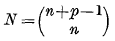 in number, are called the mixed volumes of the convex sets.
 may be chosen to be positive and symmetric in their arguments
  These coefficients, which are
  in number, are called the mixed volumes of the convex sets.
MTK volume 7 issue 2 Front matter
-
- Journal:
- Mathematika / Volume 7 / Issue 2 / December 1960
- Published online by Cambridge University Press:
- 26 February 2010, pp. f1-f2
- Print publication:
- December 1960
-
- Article
-
- You have access
- Export citation
A metric for plane affine geometry over GF(2n)
-
- Journal:
- Mathematika / Volume 7 / Issue 2 / December 1960
- Published online by Cambridge University Press:
- 26 February 2010, pp. 145-148
- Print publication:
- December 1960
-
- Article
- Export citation
Convex semi-lattices of continuous functions
-
- Journal:
- Mathematika / Volume 7 / Issue 2 / December 1960
- Published online by Cambridge University Press:
- 26 February 2010, pp. 113-116
- Print publication:
- December 1960
-
- Article
- Export citation
-
The purpose of this note is to settlo a question that was left incompletely solved in the author's paper [1].
Let E be a compact Hausdorff space, and C(E) the class of all continuous real-valued functions on E. A subset F of C(E) is called an upper semi-lattice (or, more briefly, is said to admit ں) if ƒ ں g ε F whenever ƒ, g ε F. A subset F of C(E) is said to be upper semi-equicontinuous (u.s.e.c.) if for every ε > 0 and s ε E there exists a neighbourhood U of s such that

We say that F is locally u.s.e.c. if every uniformly bounded subset of F is u.s.e.c.
Magneto-elastic wave propagation
-
- Journal:
- Mathematika / Volume 7 / Issue 2 / December 1960
- Published online by Cambridge University Press:
- 26 February 2010, pp. 161-171
- Print publication:
- December 1960
-
- Article
- Export citation
A combinatorial problem of T. G. Room
-
- Journal:
- Mathematika / Volume 7 / Issue 1 / June 1960
- Published online by Cambridge University Press:
- 26 February 2010, pp. 50-55
- Print publication:
- June 1960
-
- Article
- Export citation
Incidence matrices
-
- Journal:
- Mathematika / Volume 7 / Issue 1 / June 1960
- Published online by Cambridge University Press:
- 26 February 2010, pp. 41-49
- Print publication:
- June 1960
-
- Article
- Export citation
Distinct small values of quadratic forms
-
- Journal:
- Mathematika / Volume 7 / Issue 1 / June 1960
- Published online by Cambridge University Press:
- 26 February 2010, pp. 36-40
- Print publication:
- June 1960
-
- Article
- Export citation
The flow of a conducting fluid past a magnetized cylinder
-
- Journal:
- Mathematika / Volume 7 / Issue 1 / June 1960
- Published online by Cambridge University Press:
- 26 February 2010, pp. 64-77
- Print publication:
- June 1960
-
- Article
- Export citation
On Stokes flow about a torus
-
- Journal:
- Mathematika / Volume 7 / Issue 1 / June 1960
- Published online by Cambridge University Press:
- 26 February 2010, pp. 78-92
- Print publication:
- June 1960
-
- Article
- Export citation
The discriminants of relative extensions and the existence of integral bases
-
- Journal:
- Mathematika / Volume 7 / Issue 1 / June 1960
- Published online by Cambridge University Press:
- 26 February 2010, pp. 15-22
- Print publication:
- June 1960
-
- Article
- Export citation
-
Let Κ be a finite number field and let ο be the ring of algebraic integers in Κ. The algebraic integers in a finite extension field Λ of Κ form a ring
 . We shall be concerned here with the structure of such rings , viewed as modules over ο. It will be useful to begin with a brief discussion of a new concept of the discriminant of Λ/Κ, introduced in a preceding paper [1], which will be our principal tool (see also [2]).
 . We shall be concerned here with the structure of such rings