Refine search
Actions for selected content:
26076 results in Abstract analysis
PRM volume 65 issue 2 Cover and Back matter
-
- Journal:
- Proceedings of the Royal Society of Edinburgh Section A: Mathematical and Physical Sciences / Volume 65 / Issue 2 / 1959
- Published online by Cambridge University Press:
- 14 February 2012, pp. b1-b2
- Print publication:
- 1959
-
- Article
-
- You have access
- Export citation
X.—The Dynamic Stresses Produced in Elastic Bodies by Uneven Heating
-
- Journal:
- Proceedings of the Royal Society of Edinburgh Section A: Mathematical and Physical Sciences / Volume 65 / Issue 2 / 1959
- Published online by Cambridge University Press:
- 14 February 2012, pp. 143-176
- Print publication:
- 1959
-
- Article
- Export citation
PRM volume 65 issue 2 Cover and Front matter
-
- Journal:
- Proceedings of the Royal Society of Edinburgh Section A: Mathematical and Physical Sciences / Volume 65 / Issue 2 / 1959
- Published online by Cambridge University Press:
- 14 February 2012, pp. f1-f2
- Print publication:
- 1959
-
- Article
-
- You have access
- Export citation
IX.—The Propagation of Thermal Stresses in Thin Metallic Rods*
-
- Journal:
- Proceedings of the Royal Society of Edinburgh Section A: Mathematical and Physical Sciences / Volume 65 / Issue 2 / 1959
- Published online by Cambridge University Press:
- 14 February 2012, pp. 121-142
- Print publication:
- 1959
-
- Article
- Export citation
XII.—Solution of the Equation zez = a*
-
- Journal:
- Proceedings of the Royal Society of Edinburgh Section A: Mathematical and Physical Sciences / Volume 65 / Issue 2 / 1959
- Published online by Cambridge University Press:
- 14 February 2012, pp. 193-203
- Print publication:
- 1959
-
- Article
- Export citation
Indefinite quadratic forms
-
- Journal:
- Mathematika / Volume 5 / Issue 2 / December 1958
- Published online by Cambridge University Press:
- 26 February 2010, pp. 122-124
- Print publication:
- December 1958
-
- Article
- Export citation
-
Let Q(x1 …, xn) be an indefinite quadratic form in n variables with real coefficients. Suppose that when Q is expressed as a sum of squares of real linear forms, with positive and negative signs, there are r positive signs and n—r negative signs. It was proved recently by Birch and Davenport that, if

then for any ε > 0 the inequality

is soluble in integers x1, …, xn, not all 0.
A disproof of a conjecture of Pólya
-
- Journal:
- Mathematika / Volume 5 / Issue 2 / December 1958
- Published online by Cambridge University Press:
- 26 February 2010, pp. 141-145
- Print publication:
- December 1958
-
- Article
- Export citation
-
Let λ(n) be Liouville's function denned by
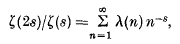
where v is the number of prime factors of n, repeated factors being counted according to their multiplicity. Alternatively, λ(n) may be denned by the relation
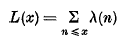
where ζ(s) is the zeta function of Riemann.
Index to volume 5
-
- Journal:
- Mathematika / Volume 5 / Issue 2 / December 1958
- Published online by Cambridge University Press:
- 26 February 2010, p. 161
- Print publication:
- December 1958
-
- Article
- Export citation
MTK volume 5 issue 2 Front matter
-
- Journal:
- Mathematika / Volume 5 / Issue 2 / December 1958
- Published online by Cambridge University Press:
- 26 February 2010, pp. f1-f2
- Print publication:
- December 1958
-
- Article
-
- You have access
- Export citation
Some extremal problems for convex bodies
-
- Journal:
- Mathematika / Volume 5 / Issue 2 / December 1958
- Published online by Cambridge University Press:
- 26 February 2010, pp. 93-102
- Print publication:
- December 1958
-
- Article
- Export citation
-
If K is a convex body in n-dimensional space, let SK denote the closed n-dimensional sphere with centre at the origin and with volume equal to that of K. If H and K are two such convex bodies let C(H, K) denote the least convex cover of the union of H and K, and let V*(H, K) denote the maximum, taken over all points x for which the intersection
 is not empty, of the volume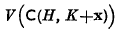
of the set
 . The object of this paper is to discuss some of the more interesting consequences of the following general theorem.
 is not empty, of the volume
 . The object of this paper is to discuss some of the more interesting consequences of the following general theorem.
Entity-structure
-
- Journal:
- Mathematika / Volume 5 / Issue 2 / December 1958
- Published online by Cambridge University Press:
- 26 February 2010, pp. 146-160
- Print publication:
- December 1958
-
- Article
- Export citation
On a class of simple rings
-
- Journal:
- Mathematika / Volume 5 / Issue 2 / December 1958
- Published online by Cambridge University Press:
- 26 February 2010, pp. 103-117
- Print publication:
- December 1958
-
- Article
- Export citation
-
Our object in this note is to construct rings such that

More generally we prove the following embedding theorem (Theorem 5.1) from which rings satisfying (I) are easily constructed:
Any algebra over a field F which contains no zero-divisors or unit-element may be embedded in an algebra over F satisfying (I).
An application in hydrodynamics of the Green's function of an elastic plate
-
- Journal:
- Mathematika / Volume 5 / Issue 2 / December 1958
- Published online by Cambridge University Press:
- 26 February 2010, pp. 85-92
- Print publication:
- December 1958
-
- Article
- Export citation
On Borel-type methods of summability
-
- Journal:
- Mathematika / Volume 5 / Issue 2 / December 1958
- Published online by Cambridge University Press:
- 26 February 2010, pp. 128-133
- Print publication:
- December 1958
-
- Article
- Export citation
-
Suppose throughout that l, an (n = 0, 1, …) are arbitrary complex numbers, that α is a fixed positive number and that x is a variable in the interval [0,µ]. Let

Note on a plane measure problem
-
- Journal:
- Mathematika / Volume 5 / Issue 2 / December 1958
- Published online by Cambridge University Press:
- 26 February 2010, pp. 125-127
- Print publication:
- December 1958
-
- Article
- Export citation
A doublet technique for solving Oseen's equations of axisymmetric flow
-
- Journal:
- Mathematika / Volume 5 / Issue 2 / December 1958
- Published online by Cambridge University Press:
- 26 February 2010, pp. 134-140
- Print publication:
- December 1958
-
- Article
- Export citation
Note on a sphere theorem for the axisymmetric stokes flow of a viscous fluid
-
- Journal:
- Mathematika / Volume 5 / Issue 2 / December 1958
- Published online by Cambridge University Press:
- 26 February 2010, pp. 118-121
- Print publication:
- December 1958
-
- Article
- Export citation
Criteria for cubic and quartic residuacity
-
- Journal:
- Mathematika / Volume 5 / Issue 1 / June 1958
- Published online by Cambridge University Press:
- 26 February 2010, pp. 20-29
- Print publication:
- June 1958
-
- Article
- Export citation
-
In a short and little known paper, Jacobi [1] gives conditions for the cubic residuacity of small primes q = 2, 3, ..., 37 to a prime p in terms of the quadratic partition

in the form L ≡ ±µM (mod q), and LM ≡ 0 (mod q).
Derivatives of vector-valued functions
-
- Journal:
- Mathematika / Volume 5 / Issue 1 / June 1958
- Published online by Cambridge University Press:
- 26 February 2010, pp. 58-61
- Print publication:
- June 1958
-
- Article
- Export citation
Indefinite quadratic forms in many variables
-
- Journal:
- Mathematika / Volume 5 / Issue 1 / June 1958
- Published online by Cambridge University Press:
- 26 February 2010, pp. 8-12
- Print publication:
- June 1958
-
- Article
- Export citation
-
Let Q(x1, …, xn) be an indefinite quadratic form in n variables with real coefficients. It is conjectured that, provided n ≥ 5, the inequality

is soluble for every ε > 0 in integers x1, …, xn, not all 0. The first progress towards proving this conjecture was made by Davenport in two recent papers; the result obtained involved, however, a condition on the type of the form as well as on n. We say that a non-singular Q is of type (r, n—r) if, when Q is expressed as a sum of squares of n real linear forms with positive and negative signs, there are r positive signs and n—r negative signs. It was proved that (1) is always soluble provided that

