Refine search
Actions for selected content:
26077 results in Abstract analysis
The product of n linear forms in a field of series
-
- Journal:
- Mathematika / Volume 4 / Issue 2 / December 1957
- Published online by Cambridge University Press:
- 26 February 2010, pp. 132-137
- Print publication:
- December 1957
-
- Article
- Export citation
-
Let K be a field. We denote by K[t] the integral domain of all polynomials in an indeterminate t with coefficients in K, and by K(t) the quotient field of K[t], i.e. the field of all formal rational functions of t over K. A valuation |f| of the elements f of K(t) can be defined by

for f ≠ 0, and |0| = 0, where e > 1. This valuation is multiplicative, and has the properties


On the expansion of functions satisfying four boundary conditions
-
- Journal:
- Mathematika / Volume 4 / Issue 2 / December 1957
- Published online by Cambridge University Press:
- 26 February 2010, pp. 140-145
- Print publication:
- December 1957
-
- Article
- Export citation
-
In the solution of many problems in applied mathematics it is often convenient to have expansions for functions, F(r), which satisfy the boundary conditions

In some recent work on hydrodynamic and hydromagnetic stability the author has found certain types of expansions for such functions which have proved very useful and which appear to be novel in this connection. In this note two types of such expansions will be considered and the principles underlying them will be described.
The twisted sphere
-
- Journal:
- Mathematika / Volume 4 / Issue 2 / December 1957
- Published online by Cambridge University Press:
- 26 February 2010, pp. 162-165
- Print publication:
- December 1957
-
- Article
- Export citation
Rational approximations to algebraic numbers
-
- Journal:
- Mathematika / Volume 4 / Issue 2 / December 1957
- Published online by Cambridge University Press:
- 26 February 2010, pp. 125-131
- Print publication:
- December 1957
-
- Article
- Export citation
-
It was proved by Roth in a recent paper that if α is any real algebraic number, and if K > 2, then the inequality

has only a finite number of solutions in relatively prime integers p, q (q > 0) The object of the present paper is to prove that the lower bound for κ can be reduced if conditions are imposed on p and q. The result obtained is as follows.
Cubic forms over algebraic number fields
-
- Journal:
- Mathematika / Volume 4 / Issue 2 / December 1957
- Published online by Cambridge University Press:
- 26 February 2010, pp. 97-101
- Print publication:
- December 1957
-
- Article
- Export citation
On a method for the determination of class number factors in number fields
-
- Journal:
- Mathematika / Volume 4 / Issue 2 / December 1957
- Published online by Cambridge University Press:
- 26 February 2010, pp. 113-121
- Print publication:
- December 1957
-
- Article
- Export citation
The relation between load and penetration for a spherical punch
-
- Journal:
- Mathematika / Volume 4 / Issue 2 / December 1957
- Published online by Cambridge University Press:
- 26 February 2010, pp. 156-161
- Print publication:
- December 1957
-
- Article
- Export citation
Index to volume 4
-
- Journal:
- Mathematika / Volume 4 / Issue 2 / December 1957
- Published online by Cambridge University Press:
- 26 February 2010, p. 169
- Print publication:
- December 1957
-
- Article
- Export citation
Note on two theorems about function algebras
-
- Journal:
- Mathematika / Volume 4 / Issue 2 / December 1957
- Published online by Cambridge University Press:
- 26 February 2010, pp. 138-139
- Print publication:
- December 1957
-
- Article
- Export citation
-
Let X be a locally compact space, C(X) the algebra (with point-wise operations) of continuous numerical functions on X. On C(X) we introduce the topology of compact convergence. If f ε C(X), Zf denotes the set of zeros of f; and if I is a subset of C(X), we define


MTK volume 4 issue 2 Front matter
-
- Journal:
- Mathematika / Volume 4 / Issue 2 / December 1957
- Published online by Cambridge University Press:
- 26 February 2010, pp. f1-f2
- Print publication:
- December 1957
-
- Article
-
- You have access
- Export citation
Homogeneous forms of odd degree in a large number of variables
-
- Journal:
- Mathematika / Volume 4 / Issue 2 / December 1957
- Published online by Cambridge University Press:
- 26 February 2010, pp. 102-105
- Print publication:
- December 1957
-
- Article
- Export citation
On the fractional parts of the powers of a rational number (II)
-
- Journal:
- Mathematika / Volume 4 / Issue 2 / December 1957
- Published online by Cambridge University Press:
- 26 February 2010, pp. 122-124
- Print publication:
- December 1957
-
- Article
- Export citation
-
About twenty years ago, in a note of the same title [2], I obtained the following result.
THEOREM 1. Let u and v be relatively prime integers satisfying u> v ≥ 2 and let ε be an arbitrarily small positive number. Suppose the inequality

is satisfied by an infinite sequence of positive integers n1 n2, … Then
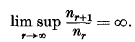
On the solution of problems of dynamic plane elasticity
-
- Journal:
- Mathematika / Volume 4 / Issue 2 / December 1957
- Published online by Cambridge University Press:
- 26 February 2010, pp. 166-168
- Print publication:
- December 1957
-
- Article
- Export citation
An inversion formula for a generalized transform
-
- Journal:
- Mathematika / Volume 4 / Issue 2 / December 1957
- Published online by Cambridge University Press:
- 26 February 2010, pp. 146-155
- Print publication:
- December 1957
-
- Article
- Export citation
-
Let λ be a random variable with the distribution function F(λ). A transform of F which has, in effect, been used in several recent papers ([1], [2], [3], [4]; see also [6]) is
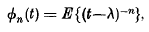
defined formally by the equation

It is the main purpose of this paper to prove the inversion formulae given in the two theorems below.
The distribution of quadratic residues and non-residues
-
- Journal:
- Mathematika / Volume 4 / Issue 2 / December 1957
- Published online by Cambridge University Press:
- 26 February 2010, pp. 106-112
- Print publication:
- December 1957
-
- Article
- Export citation
-
If p is a prime other than 2, half of the numbers
1, 2, … p—1
are quadratic residues (mod p) and the other half are quadratic non-residues. Various questions have been proposed concerning the distribution of the quadratic residues and non-residues for large p, but as yet only very incomplete answers to these questions are known. Many of the known results are deductions from the inequality

found independently by Pólya and Vinogradov, the symbol
 being Legendre's symbol of quadratic character.
 being Legendre's symbol of quadratic character.
Groups of order automorphisms of ordered sets
-
- Journal:
- Mathematika / Volume 4 / Issue 1 / June 1957
- Published online by Cambridge University Press:
- 26 February 2010, pp. 41-50
- Print publication:
- June 1957
-
- Article
- Export citation
-
Let S be an ordered set, i.e. a set with a transitive irreflexive binary relation “<” such that, for any a, bεS, either a = b or a < b or b < a. By an order automorphism of S we mean a one-one mapping α of S onto itself such that

Uniqueness theorems for thin clamped anisotropic plates
-
- Journal:
- Mathematika / Volume 4 / Issue 1 / June 1957
- Published online by Cambridge University Press:
- 26 February 2010, pp. 70-75
- Print publication:
- June 1957
-
- Article
- Export citation
Stress distribution in a notched plate
-
- Journal:
- Mathematika / Volume 4 / Issue 1 / June 1957
- Published online by Cambridge University Press:
- 26 February 2010, pp. 76-96
- Print publication:
- June 1957
-
- Article
- Export citation
A note on coverings
-
- Journal:
- Mathematika / Volume 4 / Issue 1 / June 1957
- Published online by Cambridge University Press:
- 26 February 2010, pp. 1-6
- Print publication:
- June 1957
-
- Article
- Export citation
A note on form rings and ideals
-
- Journal:
- Mathematika / Volume 4 / Issue 1 / June 1957
- Published online by Cambridge University Press:
- 26 February 2010, pp. 51-60
- Print publication:
- June 1957
-
- Article
- Export citation
