Refine search
Actions for selected content:
26063 results in Abstract analysis
PRM volume 129 issue 6 Cover and Back Matter
-
- Journal:
- Proceedings of the Royal Society of Edinburgh. Section A: Mathematics / Volume 129 / Issue 6 / 1999
- Published online by Cambridge University Press:
- 14 November 2011, pp. b1-b3
- Print publication:
- 1999
-
- Article
- Export citation
Stratified path spaces and fibrations
-
- Journal:
- Proceedings of the Royal Society of Edinburgh. Section A: Mathematics / Volume 129 / Issue 2 / 1999
- Published online by Cambridge University Press:
- 14 November 2011, pp. 351-384
- Print publication:
- 1999
-
- Article
- Export citation
On isotropic rank 1 convex functions
-
- Journal:
- Proceedings of the Royal Society of Edinburgh. Section A: Mathematics / Volume 129 / Issue 5 / 1999
- Published online by Cambridge University Press:
- 14 November 2011, pp. 1081-1105
- Print publication:
- 1999
-
- Article
- Export citation
-
Let f be a rotationally invariant function defined on the set Lin+ of all tensors with positive determinant on a vector space of arbitrary dimension. Necessary and sufficient conditions are given for the rank 1 convexity of f in terms of its representation
 through the singular values. For the global rank 1 convexity on Lin+, the result is a generalization of a two-dimensional result of Aubert. Generally, the inequality on contains products of singular values of the type encountered in the definition of polyconvexity, but is weaker. It is also shown that the rank 1 convexity is equivalent to a restricted ordinary convexity when f is expressed in terms of signed invariants of the deformation.
 through the singular values. For the global rank 1 convexity on Lin
Asymptotics for the spectral heat function and bounds for integrals of Dirichlet eigenfunctions
-
- Journal:
- Proceedings of the Royal Society of Edinburgh. Section A: Mathematics / Volume 129 / Issue 4 / 1999
- Published online by Cambridge University Press:
- 14 November 2011, pp. 841-854
- Print publication:
- 1999
-
- Article
- Export citation
Asymptotic solution for the perturbed Stokes problem in a bounded domain in two and three dimensions
-
- Journal:
- Proceedings of the Royal Society of Edinburgh. Section A: Mathematics / Volume 129 / Issue 4 / 1999
- Published online by Cambridge University Press:
- 14 November 2011, pp. 811-824
- Print publication:
- 1999
-
- Article
- Export citation
Trajectory singularities of general planar motions
-
- Journal:
- Proceedings of the Royal Society of Edinburgh. Section A: Mathematics / Volume 129 / Issue 1 / 1999
- Published online by Cambridge University Press:
- 14 November 2011, pp. 37-55
- Print publication:
- 1999
-
- Article
- Export citation
Stability, bifurcations and edge oscillations in standing pulse solutions to an inhomogeneous reaction-diffusion system
-
- Journal:
- Proceedings of the Royal Society of Edinburgh. Section A: Mathematics / Volume 129 / Issue 5 / 1999
- Published online by Cambridge University Press:
- 14 November 2011, pp. 1033-1079
- Print publication:
- 1999
-
- Article
- Export citation
Essential instability of pulses and bifurcations to modulated travelling waves
-
- Journal:
- Proceedings of the Royal Society of Edinburgh. Section A: Mathematics / Volume 129 / Issue 6 / 1999
- Published online by Cambridge University Press:
- 14 November 2011, pp. 1263-1290
- Print publication:
- 1999
-
- Article
- Export citation
Elementary operators
-
- Journal:
- Proceedings of the Royal Society of Edinburgh. Section A: Mathematics / Volume 129 / Issue 6 / 1999
- Published online by Cambridge University Press:
- 14 November 2011, pp. 1115-1135
- Print publication:
- 1999
-
- Article
- Export citation
-
We introduce the concept of an elementary operator between two algebras, and thereby extend the study of operators of the form

where ai, bi are fixed elements in an algebra. Elementary operators on some classes of algebras are considered and their general form is described in some special cases.

Stability of bundles with a given filtration on a smooth curve
-
- Journal:
- Proceedings of the Royal Society of Edinburgh. Section A: Mathematics / Volume 129 / Issue 2 / 1999
- Published online by Cambridge University Press:
- 14 November 2011, pp. 229-234
- Print publication:
- 1999
-
- Article
- Export citation
On various semiconvex relaxations of the squared-distance function
-
- Journal:
- Proceedings of the Royal Society of Edinburgh. Section A: Mathematics / Volume 129 / Issue 6 / 1999
- Published online by Cambridge University Press:
- 14 November 2011, pp. 1309-1323
- Print publication:
- 1999
-
- Article
- Export citation
PRM volume 129 issue 2 Cover and Back matter
-
- Journal:
- Proceedings of the Royal Society of Edinburgh. Section A: Mathematics / Volume 129 / Issue 2 / 1999
- Published online by Cambridge University Press:
- 14 November 2011, pp. b1-b2
- Print publication:
- 1999
-
- Article
-
- You have access
- Export citation
A Selection of Problems and Results in Combinatorics
-
- Journal:
- Combinatorics, Probability and Computing / Volume 8 / Issue 1-2 / January 1999
- Published online by Cambridge University Press:
- 01 January 1999, pp. 1-6
-
- Article
- Export citation
Some inequalities for arithmetic and geometric means
-
- Journal:
- Proceedings of the Royal Society of Edinburgh. Section A: Mathematics / Volume 129 / Issue 2 / 1999
- Published online by Cambridge University Press:
- 14 November 2011, pp. 221-228
- Print publication:
- 1999
-
- Article
- Export citation
-
Let An and Gn (respectively, A′n and G′n) be the weighted arithmetic and geometric means of x1, …, xn (respectively, 1 – x1, …, 1 – xn). We present sharp upper and lower bounds for the differences
 and
and  . And we determine the best possible constants r and s such that
holds for all xi ∈ [a, b] (i = 1, …, n; 0 < a < b < 1). Our theorems extend and sharpen results of Fan, Cartwright and Field, McGregor and the author.
 and
and  . And we determine the best possible constants r and s such that
On the motion of a vortex filament in an external flow according to the localized induction approximation
-
- Journal:
- Proceedings of the Royal Society of Edinburgh. Section A: Mathematics / Volume 129 / Issue 3 / 1999
- Published online by Cambridge University Press:
- 14 November 2011, pp. 617-626
- Print publication:
- 1999
-
- Article
- Export citation
Minimizing properties of arbitrary solutions to the Ginzburg–Landau equation
-
- Journal:
- Proceedings of the Royal Society of Edinburgh. Section A: Mathematics / Volume 129 / Issue 6 / 1999
- Published online by Cambridge University Press:
- 14 November 2011, pp. 1157-1169
- Print publication:
- 1999
-
- Article
- Export citation
-
We consider the Ginzburg–Landau type equation
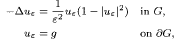
where G is a smooth bounded domain in ℝ2, g ∊ C∞(∂G;ℝ2 / {0}), and ε > 0 is a small parameter. We prove the uniqueness of solutions to this equation under some non-vanishing assumptions on uε, or under conditions on the boundary function g.
Degenerate Lyapunov functionals of a well-known prey–predator model with discrete delays
-
- Journal:
- Proceedings of the Royal Society of Edinburgh. Section A: Mathematics / Volume 129 / Issue 4 / 1999
- Published online by Cambridge University Press:
- 14 November 2011, pp. 755-771
- Print publication:
- 1999
-
- Article
- Export citation
-
It is commonly believed that, as far as stabilities are concerned, ‘small delays are negligible in some modelling processes’. However, to have an affirmative answerfor this common belief is still an open problem for many nonlinear equations. In this paper, the classical Lotka–Volterra prey–predator equation with discrete delays

is considered, and, by using degenerate Lyapunov functionals method, an affirmative answer to this open problem on both local and global stabilities of the prey–predator delay equations is given. It is shown that degenerate Lyapunov functional method is a powerful tool for studying the stability of such nonlinear delay systems. A detailed and explicit procedure of constructing such functionals is provided. Furthermore, some explicit estimates on the allowable sizes of the delays are obtained.
PRM volume 129 issue 1 Cover and Back matter
-
- Journal:
- Proceedings of the Royal Society of Edinburgh. Section A: Mathematics / Volume 129 / Issue 1 / 1999
- Published online by Cambridge University Press:
- 14 November 2011, pp. b1-b2
- Print publication:
- 1999
-
- Article
-
- You have access
- Export citation
Index to Volume 129
-
- Journal:
- Proceedings of the Royal Society of Edinburgh. Section A: Mathematics / Volume 129 / Issue 6 / 1999
- Published online by Cambridge University Press:
- 14 November 2011, pp. 1327-1330
- Print publication:
- 1999
-
- Article
- Export citation
On the existence of bounded Palais–Smale sequences and application to a Landesman–Lazer-type problem set on ℝN
-
- Journal:
- Proceedings of the Royal Society of Edinburgh. Section A: Mathematics / Volume 129 / Issue 4 / 1999
- Published online by Cambridge University Press:
- 14 November 2011, pp. 787-809
- Print publication:
- 1999
-
- Article
-
- You have access
- Export citation
-
Using the ‘monotonicity trick’ introduced by Struwe, we derive a generic theorem. It says that for a wide class of functionals, having a mountain-pass (MP) geometry, almost every functional in this class has a bounded Palais-Smale sequence at the MP level. Then we show how the generic theorem can be used to obtain, for a given functional, a special Palais–Smale sequence possessing extra properties that help to ensure its convergence. Subsequently, these abstract results are applied to prove the existence of a positive solution for a problem of the form

We assume that the functional associated to (P) has an MP geometry. Our results cover the case where the nonlinearity f satisfies (i) f(x, s)s−1 → a ∈)0, ∞) as s →+∞; and (ii) f(x, s)s–1 is non decreasing as a function of s ≥ 0, a.e. x → ℝN.
