Refine search
Actions for selected content:
9084 results in Discrete Mathematics, Information Theory and Coding
Symmetrical sets of constant width and their partitions
- Part of
-
- Journal:
- Mathematika / Volume 18 / Issue 1 / June 1971
- Published online by Cambridge University Press:
- 26 February 2010, pp. 105-111
- Print publication:
- June 1971
-
- Article
- Export citation
On a problem of Gauthier
-
- Journal:
- Mathematika / Volume 18 / Issue 1 / June 1971
- Published online by Cambridge University Press:
- 26 February 2010, pp. 126-129
- Print publication:
- June 1971
-
- Article
- Export citation
-
If ω, ω′ are two points in the extended complex plane then the distance between their stereographic projections on the Riemann sphere is

with an obvious interpretation if ω or ω′ is ∞.
 is called the distance between ω and ω′ in the spherical or in the chordal metric.
 is called the distance between ω and ω′ in the spherical or in the chordal metric.
On the representation of positive integers as sums of three cubes of positive rational numbers
-
- Journal:
- Mathematika / Volume 18 / Issue 1 / June 1971
- Published online by Cambridge University Press:
- 26 February 2010, pp. 98-99
- Print publication:
- June 1971
-
- Article
- Export citation
-
A one parameter solution of th equation

was given by Ryley in 1825. Others were found by Richmond and myself. In the Landau memorial volume [1] recently published, there appears a joint paper, with the above title, of Davenport and Landau dating from 1935. They prove that if n is a positive integer, then positive rational solutions of (1) exist with denominators of order of magnitude O(n2). Their proof depended upon a two parameter solution of (1) due to Richmond and is very complicated.
Fractional powers of a submodule of an algebra
- Part of
-
- Journal:
- Mathematika / Volume 18 / Issue 1 / June 1971
- Published online by Cambridge University Press:
- 26 February 2010, pp. 8-13
- Print publication:
- June 1971
-
- Article
- Export citation
On the minimum points of a positive quadratic form
-
- Journal:
- Mathematika / Volume 18 / Issue 1 / June 1971
- Published online by Cambridge University Press:
- 26 February 2010, pp. 60-70
- Print publication:
- June 1971
-
- Article
- Export citation
-
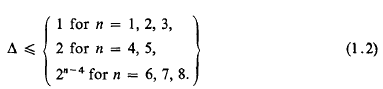
Let fn be a positive-definite n-ary quadratic form, with real coefficients. By the minimum of fn, denoted by min fn, is meant as usual the least value of fn(x1, …, xn) for integers xi not all 0. A minimum point of fn is a point x = (x1, …, xn), with integer coordinates, at which fn takes its minimum value. Let Δ (> 0) be the determinant of a set of n minimum points of fn; then in [1] it was proved that

where γn is the Hermite constant. Enough is known about γn to deduce from (1.1), as in [1], that
On plane coverings with convex domains
-
- Journal:
- Mathematika / Volume 18 / Issue 1 / June 1971
- Published online by Cambridge University Press:
- 26 February 2010, pp. 91-97
- Print publication:
- June 1971
-
- Article
- Export citation
-
The following theorem has been proved by Bambah, Rogers and Zassenhaus [1],
Theorem A. Let K be a closed convex domain with a centre. Let

be points such that:
(i) the polygon A0 A1 … An is a Jordan polygon bounding a closed domain π of area a(π);
(ii) for each r, 0 ≤ r ≤ n, there is a point common to K + An-1 and K + Ar;
(iii) the points An+1, …. An+m are in the interior of π;
(iv) for each point X of π, there exists an Ar, 1 ≤ r ≤ n + m, such that X ∈ K + Ar and the line segment XAr is in π. Then

where t(K) is the area of the largest triangle contained in K.
The existence and uniqueness of a similarity solution of boundary-layer theory
-
- Journal:
- Mathematika / Volume 18 / Issue 1 / June 1971
- Published online by Cambridge University Press:
- 26 February 2010, pp. 14-19
- Print publication:
- June 1971
-
- Article
- Export citation
-
When a viscous incompressible fluid with uniform conditions at upstream infinity flows past a paraboloid of revolution, the boundary-layer equations admit of a similarity solution which leads to the ordinary differential equation (see Miller [1])

with boundary conditions

Homogeneous quadratic equations
-
- Journal:
- Mathematika / Volume 18 / Issue 1 / June 1971
- Published online by Cambridge University Press:
- 26 February 2010, pp. 1-4
- Print publication:
- June 1971
-
- Article
- Export citation
-
Let

be a quadratic form with integral coefficients, and suppose the equation

has a solution in integers x1…, xn, not all 0. It was proved by Cassels [2] that there is such a solution, which satisfies the estimate

where F = max|fij|. It was later observed by Birch and Davenport [1] that the result can be stated in a slightly more general form. Let

be a quadratic form which assumes only integral values at the points (x1 …, x2) of an n-dimensional lattice Λ of determinant Δ. Suppose there is some point of Λ, other than the origin, at which ø = 0. Then there is such a point for which also

where Φ = max |øij|.
The lengths of limbs of random trees
- Part of
-
- Journal:
- Mathematika / Volume 18 / Issue 1 / June 1971
- Published online by Cambridge University Press:
- 26 February 2010, pp. 78-81
- Print publication:
- June 1971
-
- Article
- Export citation
Short surface waves due to an oscillating half-immersed sphere
- Part of
-
- Journal:
- Mathematika / Volume 18 / Issue 1 / June 1971
- Published online by Cambridge University Press:
- 26 February 2010, pp. 20-39
- Print publication:
- June 1971
-
- Article
- Export citation
-
This paper uses systems of image sources to construct suitable generalised Green's functions for considering small amplitude short surface waves due to an oscillating immersed sphere. A sphere of radius a is half-immersed in a fluid under gravity and is making vertical oscillations of small constant amplitude and period 2π/σ about this position. It is required to find the fluid motion, and in particular the virtual mass and wavemaking coefficients. For sufficiently small amplitudes the motion depends non-trivially on only a single dimensionless parameter

where g is the gravitational acceleration. This was shown by Ursell in an unpublished U. S. Navy report in which the methods of an earlier paper (Ursell, 1949) were adapted from cylindrical to spherical symmetry and resolved the conflict between Havelock (1955) and Barakat (1962) in favour of the former. Ursell showed that the virtual mass coefficient is

i.e. infinitely increasing initially so that Barakat's results must be incorrect near N = 0. However, although existence is proved for all N, the same difficulty arises as with the heaving cylinder, namely computation is only practical for values of N up to about 1. In the cylindrical case, Ursell (1953) developed a method for finding the asymptotic solution for large N and here it will be adapted, surprisingly perhaps, to deal with the spherical case. Ursell (1954) then published a formal solution which gave the same virtual mass as the rigorous treatment and if this formal method is applied to the heaving sphere, the virtual mass coefficient obtained is

Some embeddings of Lie groups in Euclidean space
- Part of
-
- Journal:
- Mathematika / Volume 18 / Issue 1 / June 1971
- Published online by Cambridge University Press:
- 26 February 2010, pp. 152-156
- Print publication:
- June 1971
-
- Article
- Export citation
On pseudo-polynomials
-
- Journal:
- Mathematika / Volume 18 / Issue 1 / June 1971
- Published online by Cambridge University Press:
- 26 February 2010, pp. 71-77
- Print publication:
- June 1971
-
- Article
- Export citation
-
In a recent paper [1] I made the following
Definition. The function f: ℤ+ ∪ {0} → ℤ is a pseudo-polynomial if

for all integers n ≥ 0, k ≥ 1.
A determinant of linear forms
-
- Journal:
- Mathematika / Volume 18 / Issue 1 / June 1971
- Published online by Cambridge University Press:
- 26 February 2010, pp. 100-104
- Print publication:
- June 1971
-
- Article
- Export citation
-
Let x1, …, xn be linear forms in u1, …, un with real coefficients, and (for simplicity) determinant 1. Given a form (that is, a homogeneous polynomial) F(x1, …, xn), we can ask the following question: do there exist, for arbitrary real α1, …, αn, integers ul, …, un such that

where C is a suitable number independent of α1, …, αn and of the particular linear forms x1 …, xn? In two well-known cases this is true: namely when

and when

where 1 ≤ r ≤ n − 1.
A compact set of disjoint line segments in E3 whose end set has positive measure
- Part of
-
- Journal:
- Mathematika / Volume 18 / Issue 1 / June 1971
- Published online by Cambridge University Press:
- 26 February 2010, pp. 112-125
- Print publication:
- June 1971
-
- Article
- Export citation
A note on the steady longitudinal motion of an insulating cylinder in a conducting fluid
- Part of
-
- Journal:
- Mathematika / Volume 18 / Issue 1 / June 1971
- Published online by Cambridge University Press:
- 26 February 2010, pp. 130-133
- Print publication:
- June 1971
-
- Article
- Export citation
A convex body with a false centre is an ellipsoid
- Part of
-
- Journal:
- Mathematika / Volume 18 / Issue 1 / June 1971
- Published online by Cambridge University Press:
- 26 February 2010, pp. 50-59
- Print publication:
- June 1971
-
- Article
- Export citation
When is a linear viscoelastic material elastic?
-
- Journal:
- Mathematika / Volume 18 / Issue 1 / June 1971
- Published online by Cambridge University Press:
- 26 February 2010, pp. 134-137
- Print publication:
- June 1971
-
- Article
- Export citation
MTK volume 18 issue 1 Front matter
-
- Journal:
- Mathematika / Volume 18 / Issue 1 / June 1971
- Published online by Cambridge University Press:
- 26 February 2010, pp. f1-f2
- Print publication:
- June 1971
-
- Article
-
- You have access
- Export citation
On uniqueness of flows for a class of second-order fluids
-
- Journal:
- Mathematika / Volume 17 / Issue 2 / December 1970
- Published online by Cambridge University Press:
- 26 February 2010, pp. 333-337
- Print publication:
- December 1970
-
- Article
- Export citation
-
In the present paper we consider the uniqueness of the solutions of the equations governing the motion of an incompressible second-order fluid in a bounded region. For such a fluid model the stress tensor S in a rectangular Cartesian coordinate system xi at a point xi of the fluid is determined from

where I is the unit tensor, p the hydrostatic pressure and μ, β, γ are material constants. The tensors A1 and A2 are the first and second Rivlin-Ericksen tensors which are defined in terms of the velocity field vi by

The distribution of rational points on hypersurfaces defined over a finite field
-
- Journal:
- Mathematika / Volume 17 / Issue 2 / December 1970
- Published online by Cambridge University Press:
- 26 February 2010, pp. 328-332
- Print publication:
- December 1970
-
- Article
- Export citation
-
Let p be an odd prime and denote by [p] the field of p elements. Let C = C(n, p) be the set of points x = (x1 …, xn) of Zn (n ≥ 1) satisfying

