To save content items to your account,
please confirm that you agree to abide by our usage policies.
If this is the first time you use this feature, you will be asked to authorise Cambridge Core to connect with your account.
Find out more about saving content to .
To save content items to your Kindle, first ensure no-reply@cambridge.org
is added to your Approved Personal Document E-mail List under your Personal Document Settings
on the Manage Your Content and Devices page of your Amazon account. Then enter the ‘name’ part
of your Kindle email address below.
Find out more about saving to your Kindle.
Note you can select to save to either the @free.kindle.com or @kindle.com variations.
‘@free.kindle.com’ emails are free but can only be saved to your device when it is connected to wi-fi.
‘@kindle.com’ emails can be delivered even when you are not connected to wi-fi, but note that service fees apply.
First published in 1974, Dr Croxton's book takes the reader from a consideration of the early ways in which the kinetic theory of gases was modified and applied to the liquid state, through a classical thermodynamic approach, to the modern cluster-diagrammatic quantum and statistical mechanical techniques. He includes chapters on the development and numerical solution of the integral equations relating the atomic structure to the pair potential, on the nature of the liquid surface, on the computer simulation schemes and on transport processes and irreversibility in the liquid phase.
Modern experimental developments in condensed matter and ultracold atom physics present formidable challenges to theorists. This book provides a pedagogical introduction to quantum field theory in many-particle physics, emphasizing the applicability of the formalism to concrete problems. This second edition contains two new chapters developing path integral approaches to classical and quantum nonequilibrium phenomena. Other chapters cover a range of topics, from the introduction of many-body techniques and functional integration, to renormalization group methods, the theory of response functions, and topology. Conceptual aspects and formal methodology are emphasized, but the discussion focuses on practical experimental applications drawn largely from condensed matter physics and neighboring fields. Extended and challenging problems with fully worked solutions provide a bridge between formal manipulations and research-oriented thinking. Aimed at elevating graduate students to a level where they can engage in independent research, this book complements graduate level courses on many-particle theory.
Bose-Einstein condensation of excitons is a unique effect in which the electronic states of a solid can self-organize to acquire quantum phase coherence. The phenomenon is closely linked to Bose-Einstein condensation in other systems such as liquid helium and laser-cooled atomic gases. This is the first book to provide a comprehensive survey of this field, covering theoretical aspects as well as recent experimental work. After setting out the relevant basic physics of excitons, the authors discuss exciton-phonon interactions as well as the behaviour of biexcitons. They cover exciton phase transitions and give particular attention to nonlinear optical effects including the optical Stark effect and chaos in excitonic systems. The thermodynamics of equilibrium, quasi-equilibrium, and nonequilibrium systems are examined in detail. The authors interweave theoretical and experimental results throughout the book, and it will be of great interest to graduate students and researchers in semiconductor and superconductor physics, quantum optics, and atomic physics.
The Physics of Metals is an advanced treatise written by a team of experts. It presents an authoritative account of selected topics in a major field of modern physics and will prove indispensable to both experimental and theoretical solid state physicists and metallurgists seeking a clear explanation of the state of knowledge of the physical phenomena occurring in metals, without recourse to elaborate mathematics. The whole work was inspired by the desire to honour Sir Nevill Mott by writing an account of some of the topics treated in Mott and Jones's classic work The Theory of the Properties of Metals and Alloys.
This graduate-level textbook on thermal physics covers classical thermodynamics, statistical mechanics and its applications. It describes theoretical methods to calculate thermodynamic properties, such as the equation of state, specific heat, Helmholtz free energy, magnetic susceptibility and phase transitions of macroscopic systems. In addition to the more standard material covered, this book also describes powerful techniques, which are not found elsewhere, to determine the correlation effects on which the thermodynamic properties are based. Particular emphasis is given to the cluster variation method and a novel formulation is developed for its expression in terms of correlation functions. Although a basic knowledge of quantum mechanics is required, the mathematical formulations are accessible and entirely self-contained. The book will therefore constitute an ideal companion text for graduate students studying courses on the theory of complex analysis, classical mechanics, classical electrodynamics, and quantum mechanics.
Fuelled by rapid growth in communications technology, silicon heterostructures and related high-speed semiconductors are spearheading the drive toward smaller, faster and lower power devices. High-Speed Heterostructure Devices is a textbook on modern high-speed semiconductor devices intended for both graduate students and practising engineers. This book is concerned with the underlying physics of heterostructures as well as some of the most recent techniques for modeling and simulating these devices. Emphasis is placed on heterostructure devices of the immediate future such as the MODFET, HBT and RTD. The principles of operation of other devices such as the Bloch Oscillator, RITD, Gunn diode, quantum cascade laser and SOI and LD MOSFETs are also introduced. Initially developed for a graduate course taught at Ohio State University, the book comes with a complete set of homework problems and a web link to MATLAB programs supporting the lecture material.
Unlike existing texts, this book blends for the first time three topics in physics - symmetry, condensed matter physics and computational methods - into one pedagogical textbook. It includes new concepts in mathematical crystallography; experimental methods capitalizing on symmetry aspects; non-conventional applications such as Fourier crystallography, color groups, quasicrystals and incommensurate systems; as well as concepts and techniques behind the Landau theory of phase transitions. Adopting a computational approach to the application of group theoretical techniques to solving symmetry related problems, it dramatically alleviates the need for intensive calculations usually found in the presentation of symmetry. Writing computer programs helps the student achieve a firm understanding of the underlying concepts, and sample programs, based on Mathematica, are presented throughout the book. Containing over 150 exercises, this textbook is ideal for graduate students in condensed matter physics, materials science, and chemistry. Solutions and computer programs are available online at www.cambridge.org/9780521828451.
This text is a modern treatment of the theory of solids. The core of the book deals with the physics of electron and phonon states in crystals and how they determine the structure and properties of the solid. The discussion uses density functional theory as a starting point and covers electronic and optical phenomena, magnetism and superconductivity. There is also an extensive treatment of defects in solids, including point defects, dislocations, surfaces and interfaces. A number of modern topics where the theory of solids applies are also explored, including quasicrystals, amorphous solids, polymers, metal and semiconductor clusters, carbon nanotubes and biological macromolecules. Numerous examples are presented in detail and each chapter is accompanied by problems and suggested further readings. An extensive set of appendices provides all the necessary background for deriving all the results discussed in the main body of the text.
This book covers the experimental and theoretical understanding of surface and thin film processes. It presents a unique description of surface processes in adsorption and crystal growth, including bonding in metals and semiconductors. Emphasis is placed on the strong link between science and technology in the description of, and research for, new devices based on thin film and surface science. Practical experimental design, sample preparation and analytical techniques are covered, including detailed discussions of Auger electron spectroscopy and microscopy. Thermodynamic and kinetic models of structure are emphasised throughout. The book provides extensive leads into practical and research literature, as well as resources on the World Wide Web (see http://venables.asu.edu/book). Each chapter contains problems which aim to develop awareness of the subject and the methods used. Aimed as a graduate textbook, this book will also be useful as a sourcebook for graduate students, researchers and practitioners in physics, chemistry, materials science and engineering.
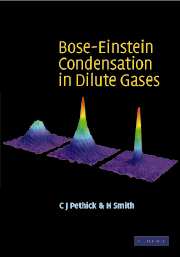
In 1925 Einstein predicted that at low temperatures particles in a gas could all reside in the same quantum state. This gaseous state, a Bose–Einstein condensate, was produced in the laboratory for the first time in 1995 and investigating such condensates has become one of the most active areas in contemporary physics. The study of Bose–Einstein condensates in dilute gases encompasses a number of different subfields of physics, including atomic, condensed matter, and nuclear physics. The authors of this graduate-level textbook explain this exciting new subject in terms of basic physical principles, without assuming detailed knowledge of any of these subfields. Chapters cover the statistical physics of trapped gases, atomic properties, cooling and trapping atoms, interatomic interactions, structure of trapped condensates, collective modes, rotating condensates, superfluidity, interference phenomena, and trapped Fermi gases. Problem sets are also included in each chapter.
Rock Magnetism, first published in 1997, is a comprehensive treatment of fine particle magnetism and the magnetic properties of rocks. Starting from atomic magnetism and magnetostatic principles, the authors explain why domains and micromagnetic structures form in ferromagnetic crystals and how these lead to magnetic memory in the form of thermal, chemical and other remanent magnetizations. The phenomenal stability of these magnetizations, providing a record of plate tectonic motions over millions of years, is explained by thermal activation theory. One chapter is devoted to practical tests of domain state and paleomagnetic stability; another deals with pseudo-single-domain magnetism. The final four chapters place magnetism in the context of igneous, sedimentary, metamorphic, and extraterrestrial rocks. This book will be of great value to graduate students and researchers in geophysics and geology, particularly in paleomagnetism and rock magnetism, as well as physicists and electrical engineers interested in fine-particle magnetism and magnetic recording.
For the first time, this book unites the theory, experimental techniques and computational tools used to describe the diffusion of atoms, molecules and nanoparticles across metal surfaces. Starting with an outline of the formalism that describes diffusion on surfaces, the authors guide the reader through the principles of atomic movement, before moving on to diffusion under special circumstances, such as the presence of defects or foreign species. With an initial focus on the behaviour of single entities on a surface, later chapters address the movement of clusters of atoms and the interactions between adatoms. While there is a special emphasis on experimental work, attention is paid to the increasingly valuable contributions theoretical work has made in this field. This book has wide interdisciplinary appeal and is ideal for researchers in solid state physics, chemistry as well as materials science, and engineering.
In recent years there has been a huge increase in the research and development of nanoscale science and technology. Central to the understanding of the properties of nanoscale structures is the modeling of electronic conduction through these systems. This graduate textbook provides an in-depth description of the transport phenomena relevant to systems of nanoscale dimensions. In this textbook the different theoretical approaches are critically discussed, with emphasis on their basic assumptions and approximations. The book also covers information content in the measurement of currents, the role of initial conditions in establishing a steady state, and the modern use of density-functional theory. Topics are introduced by simple physical arguments, with particular attention to the non-equilibrium statistical nature of electrical conduction, and followed by a detailed formal derivation. This textbook is ideal for graduate students in physics, chemistry, and electrical engineering.
Critical phenomena is one of the most exciting areas of modern physics. This 2007 book provides a thorough but economic introduction into the principles and techniques of the theory of critical phenomena and the renormalization group, from the perspective of modern condensed matter physics. Assuming basic knowledge of quantum and statistical mechanics, the book discusses phase transitions in magnets, superfluids, superconductors, and gauge field theories. Particular attention is given to topics such as gauge field fluctuations in superconductors, the Kosterlitz-Thouless transition, duality transformations, and quantum phase transitions - all of which are at the forefront of physics research. This book contains numerous problems of varying degrees of difficulty, with solutions. These problems provide readers with a wealth of material to test their understanding of the subject. It is ideal for graduate students and more experienced researchers in the fields of condensed matter physics, statistical physics, and many-body physics.
If you are a semiconductor engineer or a magnetics physicist developing magnetic memory, get the information you need with this, the first book on magnetic memory. From magnetics to the engineering design of memory, this practical book explains key magnetic properties and how they are related to memory performance, characterization methods of magnetic films, and tunneling magnetoresistance effect devices. It also covers memory cell options, array architecture, circuit models, and read-write engineering issues. You'll understand the soft fail nature of magnetic memory, which is very different from that of semiconductor memory, as well as methods to deal with the issue. You'll also get invaluable problem-solving insights from real-world memory case studies. This is an essential book for semiconductor engineers who need to understand magnetics, and for magnetics physicists who work with MRAM. It is also a valuable reference for graduate students working in electronic/magnetic device research.
Reflection high-energy electron diffraction (RHEED) is the analytical tool of choice for characterizing thin films during growth by molecular beam epitaxy, since it is very sensitive to surface structure and morphology. This book serves as an introduction to RHEED for beginners and describes detailed experimental and theoretical treatments for experts, explaining how to analyze RHEED patterns. For beginners the principles of electron diffraction are explained and many examples of the interpretation of RHEED patterns are described. The second part of the book contains detailed descriptions of RHEED theory. The third part applies RHEED to the determination of surface structures, gives detailed descriptions of the effects of disorder, and critically reviews the mechanisms contributing to RHEED intensity oscillations. This unified and coherent account will appeal to both graduate students and researchers in the study of molecular beam epitaxial growth.
Low-Dimensional Semiconductor Structures provides a seamless, atoms-to-devices introduction to the latest quantum heterostructures. It covers their fabrication, their electronic, optical and transport properties, their role in exploring physical phenomena, and their utilization in devices. The authors begin with a detailed description of the epitaxial growth of semiconductors. They then deal with the physical behaviour of electrons and phonons in low-dimensional structures. A discussion of localization effects and quantum transport phenomena is followed by coverage of the optical properties of quantum wells. They then go on to discuss non-linear optics in quantum heterostructures. The final chapters deal with semiconductor lasers, mesoscopic devices, and high-speed heterostructure devices. The book contains many exercises and comprehensive references. It is suitable as a textbook for graduate-level courses in electrical engineering and applied physics. It will also be of interest to engineers involved in the development of semiconductor devices.
Starting in the 1970s, considerable work was done on dimers and trimers and their surface diffusion, but there were no experimental studies of larger clusters, containing twenty or more atoms, since they were assumed to be immobile at the surface. This changed in 1984, with the work of Fink using the FIM, in which he assembled a cluster of twenty or more palladium atoms on the (110) plane of tungsten. At 390 K, this large cluster moved over the surface as a unit, as shown in Fig. 9.1, demonstrating its diffusivity. Large clusters turn out to be mobile at relatively low temperatures and their movement needed to be investigated, since it influences the stability of nanostructures and thin film growth kinetics. With the invention of the scanning tunneling microscope, large clusters were rediscovered a few years later, and work began to unravel how diffusion occurred, many of the studies focusing on the dependence of diffusivity on cluster size. This effort will be surveyed, arranged according to the type of the surface. Study of large clusters began with the examination of movement on a bcc surface, on W(110), but this work was not continued later; instead fcc surfaces were investigated in detail.
Large clusters on fcc(100) surfaces
Theoretical investigations of large clusters on fcc(100) surfaces started in 1980 with the work of Binder and Kalos, which initiated a number of discussions of how the cluster diffusivity D was affected by the size and the specific mechanism of diffusion.
Surface diffusion studies on single adsorbed entities, the focus of our presentation, had to await the development of techniques capable of revealing atoms. This was first accomplished by Müller roughly fifty years ago in 1956, with his invention of the field ion microscope (FIM). The natural extension of FIM was the development of the Atom Probe which allowed identification of chemical identities and control of composition for surfaces, but there also were earlier investigative methods, such as field emission microscopy, helium scattering, contact potential measurements and so on, which provided useful information about surface diffusion. Today there are newer techniques that have been shown to have the capability of revealing atoms. The scanning tunneling microscope (STM), devised by Binnig and Rohrer in 1983 is one of them. Less frequently used techniques, such as measurements of work function changes, perturbed angular correlation, or atomic beam scattering will also be mentioned, if only very briefly. Insights into diffusion phenomena on the atomic scale gained with the scanning tunneling microscope are certain to grow in number and importance. Both field ion and scanning tunneling microscopy have been covered extensively in the literature, and will also be described here in reference to diffusion studies. It should be noted that for examination of diffusion phenomena on clean surfaces by any of these techniques, good vacuum conditions are crucial.