To save content items to your account,
please confirm that you agree to abide by our usage policies.
If this is the first time you use this feature, you will be asked to authorise Cambridge Core to connect with your account.
Find out more about saving content to .
To save content items to your Kindle, first ensure no-reply@cambridge.org
is added to your Approved Personal Document E-mail List under your Personal Document Settings
on the Manage Your Content and Devices page of your Amazon account. Then enter the ‘name’ part
of your Kindle email address below.
Find out more about saving to your Kindle.
Note you can select to save to either the @free.kindle.com or @kindle.com variations.
‘@free.kindle.com’ emails are free but can only be saved to your device when it is connected to wi-fi.
‘@kindle.com’ emails can be delivered even when you are not connected to wi-fi, but note that service fees apply.
This book is an attempt to fill a gap that has existed since the dawn of XAFS: to provide a broad and sufficiently deep introduction for graduate students and other researchers, to enable them to quickly learn the disparate things that are needed to do XAFS research in a reliable way. The broad applicability of the XAFS technique draws researchers with a variety of backgrounds who are not specialists in the technique. There needs to be an accessible resource by which they can learn the essentials in a reasonably efficient and comprehensive way.
I have been doing XAFS research for more than 30 years, starting out in the laboratory of Edward Stern at the University of Washington. My work has involved applications and methods development; experiment, theory, computation; synchrotron instrumentation, and construction and operation of synchrotron facilities. I have learned a great deal from Ed Stern, John Rehr, Dale Sayers, Steve Heald, Farrel Lytle, Bruce A. Bunker, Gerd Rosenbaum, and many other colleagues and students too numerous to list, to whom I express my gratitude. I also would like to express my gratitude to my family for their patience and support while I have been occupied nights, weekends, and holidays in writing this book; my brother, Bruce, for originally getting me involved in XAFS; and to my parents, now both deceased, for their unwavering support of the study, appreciation, and preservation of nature.
This book covers basic material, occasionally dipping a toe into deeper waters.
Modern technology depends on materials with precisely controlled properties. Ion beams are a favoured method to achieve controlled modification of surface and near-surface regions. In every integrated circuit production line, for example, there are ion implantation systems. In addition to integrated circuit technology, ion beams are used to modify the mechanical, tribological and chemical properties of metal, intermetallic and ceramic materials without altering their bulk properties. Ion–solid interactions are the foundation that underlies the broad application of ion beams to the modification of materials. This text is designed to cover the fundamentals and applications of ion–solid interactions and is aimed at graduate students and researchers interested in electronic devices, surface engineering, reactor and nuclear engineering and material science issues associated with metastable phase synthesis.
This is a fully revised and expanded edition of a very successful and widely used book. It describes the physical basis of all the principal, and most of the more specialised, techniques currently employed in the study of well-characterised solid surfaces. The coverage of each technique, illustrated with selected examples, is underpinned by discussion of the relevant physical principles, and the complementary aspects of the various methods are also described. Throughout, the emphasis is on understanding the concepts involved, rather than on an exhaustive review of applications. The book will be of great use to final year undergraduate and postgraduate students in physics, chemistry and materials science. It will also be valuable to established researchers in any area of surface science concerned with the acquisition and analysis of experimental data.
This book gives a comprehensive description of the physics and applications of resonant tunnelling diodes. The opening chapters of the book set out the basic principles of coherent tunnelling theory. The effects of impurity scattering, femtosecond dynamics, non-equilibrium distribution and intrinsic bistabilities are then described in detail. The applications of RTDs, such as in high-frequency signal generation and multi-valued data storage, are also reviewed. The book closes with a chapter devoted to the more recent field of resonant tunnelling through laterally confined zero-dimensional structures. Covering all the key theoretical and experimental aspects of this stimulating area of research, the book will be of great value to graduate students of quantum transport physics and device engineering, as well as to researchers in both these fields.
This book, together with its companion volume The Science of Crystallization: Microscopic Interfacial Phenomena, make up a complete course that will teach an advanced student how to understand and analyse scientifically any of the phenomena that are observed during natural or technological crystallization from any medium and via any technique. It is an advanced text that goes into considerable detail concerning the many elements of knowledge needed to understand both quantitatively and qualitatively a crystallization event. Both the present book and its companion volume are sufficiently broad to provide the scientific basis necessary to address any area of application. The book and its companion can be used independently of each other, and together they provide the basis for advanced courses on crystallization in departments of materials science, metallurgy, electrical engineering, geology, chemistry, chemical engineering and physics. In addition the books will be invaluable to scientists and engineers in the solid state electronics, optoelectronics, metallurgical and chemical industries involved in any form of crystallization and thin film formation.
The theory of how metals conduct electronically had for a long time been confined to metals that are crystalline with the constituent atoms in regular arrays. The discovery of how to make solid amorphous alloys led to an explosion of measurements of the electronic properties of these new materials, and the emergence of a range of interesting low temperature phenomena. This 1995 book describes in physical terms the theory of the electrical conductivity, Hall coefficient, magnetoresistance and thermopower of disordered metals and alloys. The author begins by showing how conventional Boltzmann theory can be extended and modified when the mean free path of the conduction electrons becomes comparable with their wavelength and interionic separation. The consequence of this is explored and the theory tested by application to experimental data on metallic glasses. Designed as a self-contained review, the book will appeal to non-specialist physicists, metallurgists and chemists with an interest in disordered metals.
This book is a concise introduction to the experimental technicalities of low and ultralow temperature physics research. The author has made extensive use of diagrams as aids to understanding, and refers the reader to the professional literature at appropriate points in the text. The book begins with an introduction to the thermodynamic principles of refrigeration and thermometry. It covers the properties of fluid 3He/3He mixtures and the most important practical means of achieving low temperatures, including dilution and Pomeranchuk refrigeration and adiabatic nuclear demagnetisation. The basic introduction to the subject will be of value to postgraduate students beginning research in low temperature physics, and to seasoned researchers moving into the field. It could also be used by advanced undergraduates taking low temperature physics courses.
Liquid metals remain of both fundamental and technological interest and the concepts needed to understand their properties are set out in this book, starting from a survey of the basic experimental facts to be explained. The quantitative theory of liquid pair correlation functions, effective ion-ion interactions, thermodynamic properties and electronic and atomic transport is then developed. The book goes on to discuss inelastic neutron scattering, critical behaviour, magnetism, the liquid/metal surface, binary liquid metal alloys, the two component theory of pure liquid metals, shock wave studies, liquid hydrogen plasmas and the constitution of giant planets.
In this book the theories, techniques and applications of reflection electron microscopy (REM), reflection high-energy electron diffraction (RHEED) and reflection electron energy-loss spectroscopy (REELS) are comprehensively reviewed for the first time. The book is divided into three parts: diffraction, imaging and spectroscopy. The text is written to combine basic techniques with special applications, theories with experiments, and the basic physics with materials science, so that a full picture of RHEED and REM emerges. An entirely self-contained study, the book contains much invaluable reference material, including FORTRAN source codes for calculating crystal structures data and electron energy loss spectra in different scattering geometries. This and many other features make the book an important and timely addition to the materials science literature.
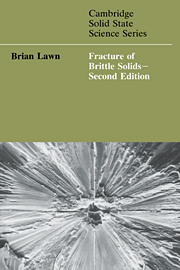
This is an advanced text for higher degree materials science students and researchers concerned with the strength of highly brittle covalent–ionic solids, principally ceramics. It is a reconstructed and greatly expanded edition of a book first published in 1975. The book presents a unified continuum, microstructural and atomistic treatment of modern day fracture mechanics from a materials perspective. Particular attention is directed to the basic elements of bonding and microstructure that govern the intrinsic toughness of ceramics. These elements hold the key to the future of ceramics as high-technology materials - to make brittle solids strong, we must first understand what makes them weak. The underlying theme of the book is the fundamental Griffith energy-balance concept of crack propagation. The early chapters develop fracture mechanics from the traditional continuum perspective, with attention to linear and nonlinear crack-tip fields, equilibrium and non-equilibrium crack states. It then describes the atomic structure of sharp cracks, the topical subject of crack-microstructure interactions in ceramics, with special focus on the concepts of crack-tip shielding and crack-resistance curves, and finally deals with indentation fracture, flaws, and structural reliability.
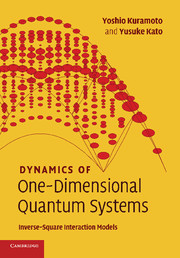
One-dimensional quantum systems show fascinating properties beyond the scope of the mean-field approximation. However, the complicated mathematics involved is a high barrier to non-specialists. Written for graduate students and researchers new to the field, this book is a self-contained account of how to derive the exotic quasi-particle picture from the exact solution of models with inverse-square interparticle interactions. The book provides readers with an intuitive understanding of exact dynamical properties in terms of exotic quasi-particles which are neither bosons nor fermions. Powerful concepts, such as the Yangian symmetry in the Sutherland model and its lattice versions, are explained. A self-contained account of non-symmetric and symmetric Jack polynomials is also given. Derivations of dynamics are made easier, and are more concise than in the original papers, so readers can learn the physics of one-dimensional quantum systems through the simplest model.
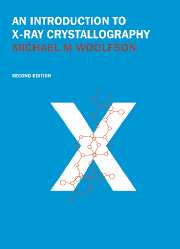
A textbook for the advanced undergraduate or graduate student beginning a serious study of X-ray crystallography. It will be of interest both to those intending to become professional crystallographers and to those physicists, chemists, biologists, geologists, metallurgists and others who will use it as a tool in their research. All major aspects of crystallography are covered - the geometry of crystals and their symmetry, theoretical and practical aspects of diffracting X-rays by crystals and how the data may be analysed to find the symmetry of the crystal and its structure. Recent advances are fully covered, including the synchrotron as a source of X-rays, methods of solving structures from power data and the full range of techniques for solving structures from single-crystal data. A suite of computer programs is provided for carrying out many operations of data-processing and solving crystal structures - including by direct methods. While these are limited to two dimensions they fully illustrate the characteristics of three-dimensional work. These programs are required for many of the examples given at the end of each chapter but may also be used to create new examples by which students can test themselves or each other.
This book provides an introduction to lattice models of polymers. This is an important topic both in the theory of critical phenomena and the modelling of polymers. The first two chapters introduce the basic theory of random, directed and self-avoiding walks. The next two chapters develop and expand this theory to explore the self-avoiding walk in both two and three dimensions. Following chapters describe polymers near a surface, dense polymers, self-interacting polymers and branched polymers. The book closes with discussions of some geometrical and topological properties of polymers, and of self-avoiding surfaces on a lattice. The volume combines results from rigorous analytical and numerical work to give a coherent picture of the properties of lattice models of polymers. This book will be valuable for graduate students and researchers working in statistical mechanics, theoretical physics and polymer physics. It will also be of interest to those working in applied mathematics and theoretical chemistry.
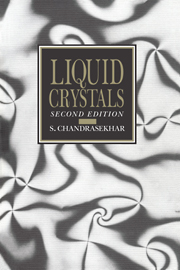
This is a new and greatly revised edition of Professor Chandrasekhar's classic book Liquid Crystals, first published in 1977. The subject of liquid crystals has grown into an exciting interdisciplinary research field with important practical applications. This book presents a systematic and self-contained treatment of the physics of the different types of thermotropic liquid crystals - the three classical types, nematic, cholesteric and smectic, and the newly discovered discotic type. Included is a description of the structures of these four main types and their polymorphic modifications, their thermodynamical, optical and mechanical properties and their behaviour under external fields. The basic principles underlying the major applications of liquid crystals in display technology and in thermography are also discussed. This book will be of great value to advanced students and researchers in condensed matter physics, chemical physics, materials science and technology with an interest in the physics, chemistry and applications of liquid crystals.
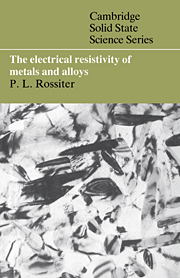
Now in paperback, this comprehensive book is the first text devoted to the problem of understanding the electrical properties of metals and alloys. Dr Rossiter, well-known for his work on the electrical resistivity of alloys, has written a book which blends results and theory, but does not rely on a strong grounding in quantum mechanics. After an introduction to the basic ideas, the concepts of atomic and magnetic correlations and their microstructural consequences are explained. Later chapters then deal with the effects of such correlations on electrical resistivity. Examples and applications of the concepts derived are given in discrete sections, allowing the uninterrupted development of theory for each specific problem, and enhancing the value of the book for a wide range of readers from theoretical and experimental solid state physicists to metallurgists and materials scientists. Anyone with an interest in the electrical conduction process or in the application of resistivity measurements to the study of alloy configuration will find this essential reading.
Written by two leading experts in the field, this book explores the 'many-body' methods that have become the dominant approach in determining molecular structure, properties and interactions. With a tight focus on the highly popular Many-Body Perturbation Theory (MBPT) and Coupled-Cluster theories (CC), the authors present a simple, clear, unified approach to describe the mathematical tools and diagrammatic techniques employed. Using this book the reader will be able to understand, derive and confidently implement relevant algebraic equations for current and even new multi-reference CC methods. Hundreds of diagrams throughout the book enhance reader understanding through visualization of computational procedures and extensive referencing allows further exploration of this evolving area. With an extensive bibliography and detailed index, this book will be suitable for graduates and researchers within quantum chemistry, chemical physics and atomic, molecular and solid-state physics.
Perturbation series expansion methods are sophisticated numerical tools used to provide quantitative calculations in many areas of theoretical physics. This book gives a comprehensive guide to the use of series expansion methods for investigating phase transitions and critical phenomena, and lattice models of quantum magnetism, strongly correlated electron systems and elementary particles. Early chapters cover the classical treatment of critical phenomena through high-temperature expansions, and introduce graph theoretical and combinatorial algorithms. The book then discusses high-order linked-cluster perturbation expansions for quantum lattice models, finite temperature expansions, and lattice gauge models. Also included are numerous detailed examples and case studies, and an accompanying resources website, www.cambridge.org/9780521842426, contains programs for implementing these powerful numerical techniques. A valuable resource for graduate students and postdoctoral researchers working in condensed matter and particle physics, this book will also be useful as a reference for specialized graduate courses on series expansion methods.
This book shows how the concept of geometrical frustration can be used to elucidate the structure and properties of non-periodic materials such as metallic glasses, quasicrystals, amorphous semiconductors and complex liquid crystals. Geometric frustration is introduced through examples and idealized models, leading to a consideration of how the concept can be used to identify ordered and defective regions in real materials. Then it is shown how these principles can also be used to model physical properties of materials, in particular specific volume, melting, the structure factor and the glass transition. Final chapters consider geometric frustration in periodic structures with large cells and quasiperiodic order. Appendices give all necessary background on geometry, symmetry and tilings. The text considers geometrical frustration at different scales in many types of materials and structures, including metals, amorphous solids, liquid crystals, amphiphiles, cholisteric systems, polymers, phospholipid membranes, atomic clusters, and quasicrystals. Of interest to researchers in condensed matter physics, materials science and structural chemistry, as well as mathematics and structural biology.
This book reviews the results of experimental research into mesoscopic devices, and develops a detailed theoretical framework for understanding their behaviour. The authors begin by discussing the key observable phenomena in nanostructures, including phase interference and weak localization. They then describe quantum confined systems, transmission in nanostructures, quantum dots and single electron phenomena. Separate chapters are devoted to interference in diffusive transport and temperature decay of fluctuations, and the book concludes with a chapter on non-equilibrium transport and nanodevices. Throughout, the authors interweave experimental results with the appropriate theoretical formalism. The book will be of great interest to graduate students taking courses in mesoscopic physics or nanoelectronics, as well as to anyone working on semiconductor nanostructures or the development of new ultrasmall devices.