Refine search
Actions for selected content:
238160 results in Physics and Astronomy
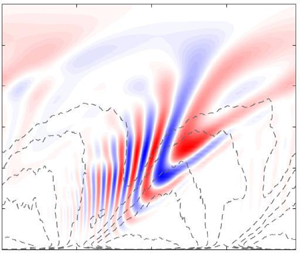
Sparse space–time resolvent analysis for statistically stationary and time-varying flows
-
- Journal:
- Journal of Fluid Mechanics / Volume 999 / 25 November 2024
- Published online by Cambridge University Press:
- 21 November 2024, A87
-
- Article
- Export citation
-
Resolvent analysis provides a framework to predict coherent spatio-temporal structures of the largest linear energy amplification, through a singular value decomposition (SVD) of the resolvent operator, obtained by linearising the Navier–Stokes equations about a known turbulent mean velocity profile. Resolvent analysis utilizes a Fourier decomposition in time, which has thus far limited its application to statistically stationary or time-periodic flows. This work develops a variant of resolvent analysis applicable to time-evolving flows, and proposes a variant that identifies spatio-temporally sparse structures, applicable to either stationary or time-varying mean velocity profiles. Spatio-temporal resolvent analysis is formulated through the incorporation of the temporal dimension to the numerical domain via a discrete time-differentiation operator. Sparsity (which manifests in localisation) is achieved through the addition of an $l_1$-norm penalisation term to the optimisation associated with the SVD. This modified optimisation problem can be formulated as a nonlinear eigenproblem and solved via an inverse power method. We first showcase the implementation of the sparse analysis on a statistically stationary turbulent channel flow, and demonstrate that the sparse variant can identify aspects of the physics not directly evident from standard resolvent analysis. This is followed by applying the sparse space–time formulation on systems that are time varying: a time-periodic turbulent Stokes boundary layer and then a turbulent channel flow with a sudden imposition of a lateral pressure gradient, with the original streamwise pressure gradient unchanged. We present results demonstrating how the sparsity-promoting variant can either change the quantitative structure of the leading space–time modes to increase their sparsity, or identify entirely different linear amplification mechanisms compared with non-sparse resolvent analysis.

27 - Maldacena–Núñez and supergravity no-go theorems; loopholes
- from Part II - Applications
-
- Book:
- Introduction to Supergravity and its Applications
- Published online:
- 14 November 2024
- Print publication:
- 21 November 2024, pp 353-364
-
- Chapter
- Export citation
2 - Formulation of the Population Balance
-
- Book:
- Population Balance of Particles in Flows
- Published online:
- 14 November 2024
- Print publication:
- 21 November 2024, pp 24-58
-
- Chapter
- Export citation
Intermittency of gravity wave turbulence on the surface of an infinitely deep fluid: directional effects
-
- Journal:
- Journal of Fluid Mechanics / Volume 999 / 25 November 2024
- Published online by Cambridge University Press:
- 21 November 2024, A84
-
- Article
-
- You have access
- Open access
- HTML
- Export citation
Epigraph
-
- Book:
- Quantum Models of Cognition and Decision
- Published online:
- 14 November 2024
- Print publication:
- 21 November 2024, pp v-v
-
- Chapter
- Export citation
Appendix C - Derivation of the PDF Transport Equation
-
- Book:
- Population Balance of Particles in Flows
- Published online:
- 14 November 2024
- Print publication:
- 21 November 2024, pp 339-344
-
- Chapter
- Export citation
Appendix A - Coupling of PBE with Fluid Flow, Heat and Mass Transfer
-
- Book:
- Population Balance of Particles in Flows
- Published online:
- 14 November 2024
- Print publication:
- 21 November 2024, pp 320-330
-
- Chapter
- Export citation
3 - Introduction to supersymmetry 1:Wess–Zumino models, on-shell and off-shell supersymmetry
- from Part I - Formalism
-
- Book:
- Introduction to Supergravity and its Applications
- Published online:
- 14 November 2024
- Print publication:
- 21 November 2024, pp 30-42
-
- Chapter
- Export citation
15 - N = 2 sugra in 4 dimensions, general sugra theories, and N = 1 sugra in 11 dimensions
- from Part I - Formalism
-
- Book:
- Introduction to Supergravity and its Applications
- Published online:
- 14 November 2024
- Print publication:
- 21 November 2024, pp 162-174
-
- Chapter
- Export citation
13 - Philosophical Aspects
-
- Book:
- Quantum Models of Cognition and Decision
- Published online:
- 14 November 2024
- Print publication:
- 21 November 2024, pp 363-385
-
- Chapter
- Export citation
Preface
-
- Book:
- Population Balance of Particles in Flows
- Published online:
- 14 November 2024
- Print publication:
- 21 November 2024, pp xiii-xv
-
- Chapter
- Export citation
Dedication
-
- Book:
- Quantum Models of Cognition and Decision
- Published online:
- 14 November 2024
- Print publication:
- 21 November 2024, pp vi-vi
-
- Chapter
- Export citation
Index
-
- Book:
- Introduction to Supergravity and its Applications
- Published online:
- 14 November 2024
- Print publication:
- 21 November 2024, pp 421-426
-
- Chapter
- Export citation
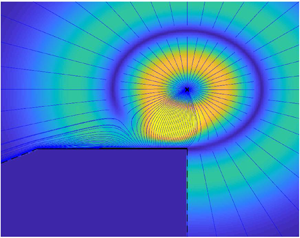
Acoustic interaction of a finite body in a rarefied gas: does sound reciprocity hold at non-continuum conditions?
-
- Journal:
- Journal of Fluid Mechanics / Volume 999 / 25 November 2024
- Published online by Cambridge University Press:
- 21 November 2024, A105
-
- Article
-
- You have access
- Open access
- HTML
- Export citation
9 - Quantum Learning
-
- Book:
- Quantum Models of Cognition and Decision
- Published online:
- 14 November 2024
- Print publication:
- 21 November 2024, pp 272-284
-
- Chapter
- Export citation
13 - Kaluza–Klein (KK)-dimensional reduction and examples
- from Part I - Formalism
-
- Book:
- Introduction to Supergravity and its Applications
- Published online:
- 14 November 2024
- Print publication:
- 21 November 2024, pp 137-147
-
- Chapter
- Export citation
2 - Elementary Quantum Probability
-
- Book:
- Quantum Models of Cognition and Decision
- Published online:
- 14 November 2024
- Print publication:
- 21 November 2024, pp 21-59
-
- Chapter
- Export citation
10 - Contextuality
-
- Book:
- Quantum Models of Cognition and Decision
- Published online:
- 14 November 2024
- Print publication:
- 21 November 2024, pp 285-312
-
- Chapter
- Export citation
11 - N = 1 Four-dimensional supergravity in superspace
- from Part I - Formalism
-
- Book:
- Introduction to Supergravity and its Applications
- Published online:
- 14 November 2024
- Print publication:
- 21 November 2024, pp 121-127
-
- Chapter
- Export citation
Frontmatter
-
- Book:
- Population Balance of Particles in Flows
- Published online:
- 14 November 2024
- Print publication:
- 21 November 2024, pp i-iv
-
- Chapter
- Export citation
