Refine search
Actions for selected content:
238152 results in Physics and Astronomy
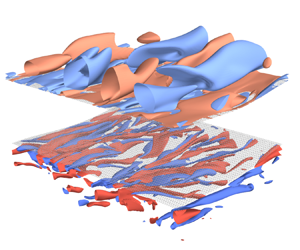
Dynamics of turbulence production by attenuating interfacial gravity waves observed in air–water coupled wave-resolving simulation
-
- Journal:
- Journal of Fluid Mechanics / Volume 999 / 25 November 2024
- Published online by Cambridge University Press:
- 21 November 2024, A97
-
- Article
- Export citation
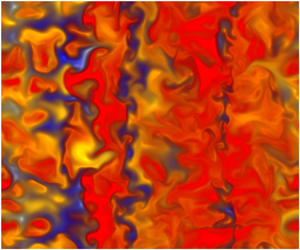
Direct numerical simulations of three-component Rayleigh–Taylor mixing and an improved model for multicomponent reacting mixtures
-
- Journal:
- Journal of Fluid Mechanics / Volume 999 / 25 November 2024
- Published online by Cambridge University Press:
- 21 November 2024, A88
-
- Article
-
- You have access
- Open access
- HTML
- Export citation
14 - Spherical harmonics and the KK expansion on sphere, coset, and group spaces
- from Part I - Formalism
-
- Book:
- Introduction to Supergravity and its Applications
- Published online:
- 14 November 2024
- Print publication:
- 21 November 2024, pp 148-161
-
- Chapter
- Export citation
17 - (Abelian and nonabelian) T-dualities and other solution generatingtechniques: TsT, O(d, d), and null Melvin twist
- from Part II - Applications
-
- Book:
- Introduction to Supergravity and its Applications
- Published online:
- 14 November 2024
- Print publication:
- 21 November 2024, pp 210-222
-
- Chapter
- Export citation

Preferential orientation of small floaters drifting in water waves
-
- Journal:
- Journal of Fluid Mechanics / Volume 999 / 25 November 2024
- Published online by Cambridge University Press:
- 21 November 2024, A92
-
- Article
- Export citation
-
Elongated floaters drifting in propagating water waves slowly rotate towards a preferential orientation with respect to the direction of incidence. In this paper we study this phenomenon in the small floater limit $k L_x < 1$, with $k$ the wavenumber and $L_x$ the floater length. Experiments show that short and heavy floaters tend to align longitudinally, along the direction of wave propagation, whereas longer and lighter floaters align transversely, parallel to the wave crests and troughs. We show that this preferential orientation can be modelled using an inviscid Froude–Krylov model, ignoring diffraction effects. Asymptotic theory, in the double limit of a small wave slope and small floater, suggests that preferential orientation is essentially controlled by the non-dimensional number $F = k L_x^2 / \bar {h}$, with $\bar {h}$ the equilibrium submersion depth. Theory predicts the longitudinal-transverse transition for homogeneous parallelepipeds at the critical value $F_c = 60$, in fair agreement with the experiments that locate $F_c = 50 \pm 15$. Using a simplified model for a thin floater, we elucidate the physical mechanisms that control the preferential orientation. The longitudinal equilibrium for $F< F_c$ originates from a slight asymmetry between the buoyancy torque induced by the wave crests, that favours the longitudinal orientation, and that induced by the wave troughs, that favours the transverse orientation. The transverse equilibrium for $F>F_c$ arises from the variation of the submersion depth along the long axis of the floaters, which significantly increases the torque in the trough positions, when the tips are more submersed.


24 - Supersymmetric string (NS-R, GS, Berkovits) and supergravity on the worldsheet vs. spacetime supergravity
- from Part II - Applications
-
- Book:
- Introduction to Supergravity and its Applications
- Published online:
- 14 November 2024
- Print publication:
- 21 November 2024, pp 309-324
-
- Chapter
- Export citation
Appendix B - Implementation of the Conservative Finite Volume Discretisation Method
-
- Book:
- Population Balance of Particles in Flows
- Published online:
- 14 November 2024
- Print publication:
- 21 November 2024, pp 331-338
-
- Chapter
- Export citation
22 - Supersymmetric AdS/CFT gravity dual pairs and their deformations (susy, marginal, integrable)
- from Part II - Applications
-
- Book:
- Introduction to Supergravity and its Applications
- Published online:
- 14 November 2024
- Print publication:
- 21 November 2024, pp 283-294
-
- Chapter
- Export citation
Index
-
- Book:
- Quantum Models of Cognition and Decision
- Published online:
- 14 November 2024
- Print publication:
- 21 November 2024, pp 433-440
-
- Chapter
- Export citation
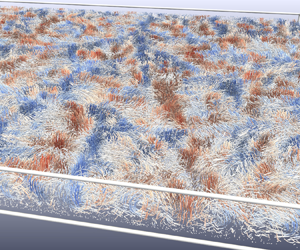
On Lagrangian properties of turbulent Rayleigh–Bénard convection
-
- Journal:
- Journal of Fluid Mechanics / Volume 999 / 25 November 2024
- Published online by Cambridge University Press:
- 21 November 2024, A90
-
- Article
-
- You have access
- Open access
- HTML
- Export citation
-
We report on Lagrangian statistics of turbulent Rayleigh–Bénard convection under very different conditions. For this, we conducted particle tracking experiments in a $H=1.1$-m-high cylinder of aspect ratio $\varGamma =1$ filled with air (Pr = 0.7), as well as in two rectangular cells of heights $H=0.02$ m ( $\varGamma =16$) and $H=0.04$ m ( $\varGamma =8$) filled with water (Pr = 7.0), covering Rayleigh numbers in the range $10^6\le {\textit {Ra}}\le 1.6\times 10^9$. Using the Shake-The-Box algorithm, we have tracked up to 500 000 neutrally buoyant particles over several hundred free-fall times for each set of control parameters. We find the Reynolds number to scale at small Ra (large Pr) as $ {\textit{Re}} \propto {\textit{Ra}}^{0.6}$. Further, the averaged horizontal particle displacement is found to be universal and exhibits a ballistic regime at small times and a diffusive regime at larger times, for sufficiently large $\varGamma$. The diffusive regime occurs for time lags larger than $\tau _{co}$, which is the time scale related to the decay of the velocity autocorrelation. Compensated as $\tau _{co} {\textit {Pr}}^{-0.3}$, this time scale is universal and rather independent of $ {\textit {Ra}}$ and $\varGamma$. We have also investigated the Lagrangian velocity structure function $S^2_i(\tau )$, which is dominated by viscous effects for times smaller than the Kolmogorov time $\tau _\eta$ and hence $S^2_i\propto \tau ^2$. For larger times we find a novel scaling for the different components with exponents smaller than what is expected in the inertial range of homogeneous isotropic turbulence without buoyancy. Studying particle-pair dispersion, we find a Batchelor scaling ( ${\propto }\,t^2$) on small time scales, diffusive scaling ( ${\propto }\,t$) on large time scales and Richardson-like scaling ( ${\propto }\,t^3$) for intermediate time scales.


14 - Contributions and Future Directions
-
- Book:
- Quantum Models of Cognition and Decision
- Published online:
- 14 November 2024
- Print publication:
- 21 November 2024, pp 386-399
-
- Chapter
- Export citation
6 - Introductory Dynamics
-
- Book:
- Quantum Models of Cognition and Decision
- Published online:
- 14 November 2024
- Print publication:
- 21 November 2024, pp 178-209
-
- Chapter
- Export citation
Preface
-
- Book:
- Introduction to Supergravity and its Applications
- Published online:
- 14 November 2024
- Print publication:
- 21 November 2024, pp xv-xv
-
- Chapter
- Export citation
Contents
-
- Book:
- Population Balance of Particles in Flows
- Published online:
- 14 November 2024
- Print publication:
- 21 November 2024, pp vii-xii
-
- Chapter
- Export citation
5 - Population Balance in Turbulent Flow
-
- Book:
- Population Balance of Particles in Flows
- Published online:
- 14 November 2024
- Print publication:
- 21 November 2024, pp 193-234
-
- Chapter
- Export citation
References
-
- Book:
- Quantum Models of Cognition and Decision
- Published online:
- 14 November 2024
- Print publication:
- 21 November 2024, pp 409-432
-
- Chapter
- Export citation
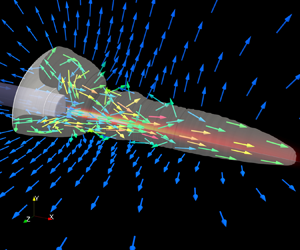
Vapour bubbles produced by long-pulsed laser: a race between advection and phase transition
-
- Journal:
- Journal of Fluid Mechanics / Volume 999 / 25 November 2024
- Published online by Cambridge University Press:
- 21 November 2024, A103
-
- Article
-
- You have access
- Open access
- HTML
- Export citation
-
Vapour bubbles produced by long-pulsed laser often have complex non-spherical shapes that reflect some characteristics of the laser beam. The transition between two commonly observed shapes, namely, a rounded pear-like shape and an elongated conical shape, is studied using a new computational model that combines compressible multiphase fluid dynamics with laser radiation and phase transition. Two laboratory experiments are simulated, in which a holmium:YAG or thulium fibre laser is used to generate bubbles of different shapes. In both cases, the predicted bubble nucleation and morphology agree reasonably well with the experimental observation. The full-field results of laser irradiance, temperature, velocity and pressure are analysed to explain bubble dynamics and energy transmission. It is found that due to the lasting energy input, the vapour bubble's dynamics is driven not only by advection, but also by the continued vaporisation at its surface. Vaporisation lasts less than $1~{\rm \mu}$s in the case of the pear-shaped bubble, compared with over $50~{\rm \mu}$s for the elongated bubble. It is thus hypothesised that the bubble's morphology is determined by competition. When the speed of advection is higher than that of vaporisation, the bubble tends to grow spherically. Otherwise, it elongates along the laser beam direction. To test this hypothesis, the two speeds are defined analytically using a model problem, then estimated for the experiments using simulation results. The results support the hypothesis. They also suggest that when the laser's power is fixed, a higher laser absorption coefficient and a narrower beam facilitate bubble elongation.


23 - Extremal black holes, the attractormechanism, and holography
- from Part II - Applications
-
- Book:
- Introduction to Supergravity and its Applications
- Published online:
- 14 November 2024
- Print publication:
- 21 November 2024, pp 295-308
-
- Chapter
- Export citation
Index
-
- Book:
- Population Balance of Particles in Flows
- Published online:
- 14 November 2024
- Print publication:
- 21 November 2024, pp 379-383
-
- Chapter
- Export citation
1 - Introduction to general relativity 1: Kinematics and Einstein equations
- from Part I - Formalism
-
- Book:
- Introduction to Supergravity and its Applications
- Published online:
- 14 November 2024
- Print publication:
- 21 November 2024, pp 5-17
-
- Chapter
- Export citation
