Refine search
Actions for selected content:
238152 results in Physics and Astronomy
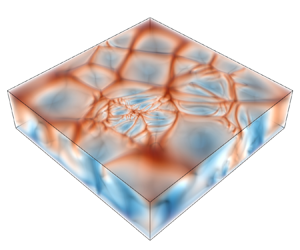
Double-diffusive convection with gravitationally unstable temperature and concentration gradients in homogeneous and heterogeneous porous media
-
- Journal:
- Journal of Fluid Mechanics / Volume 999 / 25 November 2024
- Published online by Cambridge University Press:
- 15 November 2024, A62
-
- Article
- Export citation
-
Geothermal gradients and heterogeneous permeability are commonly observed in natural geological formations for underground CO $_2$ sequestration. In this study, we conduct three-dimensional direct numerical simulations on the double-diffusive convection with both unstable temperature and concentration gradients in homogeneous and heterogeneous porous media. For homogeneous porous media, the root-mean-squared velocity increases linearly with density ratio defined as the buoyancy ratio by temperature and concentration differences. The flow structures show no remarkable changes when temperature Rayleigh number ${Ra}_T$ is less than its critical value, but alter from sheet-like to cellular structures as ${Ra}_T$ surpasses this threshold. The concentration wavenumber scales approximately as $k_{rS}\sim {Ra}_e^{0.47}$ with a defined effective Rayleigh number ${Ra}_e$. By using a scale analysis, the concentration flux exhibits a consistent linear relation with the total driving forces for all simulations. For heterogeneous porous media, where the Dykstra–Parsons coefficient $V_{DP}$ and correlation length $l_{r}$ determine the spatial distribution of the permeability field, the flow is strengthened in places with higher permeability. The velocity and concentration flux are less affected by $l_{r}$ than that by $V_{DP}$. For small correlation length, the flow structures coarsen and their characteristic width generally increases with increasing heterogeneity. For large correlation length, small structures emerge in the regions with large permeability, which can be attributed to the intensified local Rayleigh number triggering more vigorous convection there. The variations of concentration flux with $l_{r}$ and $V_{DP}$ can be explained by the portion of area covered by high concentration with large vertical velocity near the boundaries.


976 nm continuous-wave laser damage of Er:CaF2 crystals
-
- Journal:
- High Power Laser Science and Engineering / Volume 12 / 2024
- Published online by Cambridge University Press:
- 15 November 2024, e65
-
- Article
-
- You have access
- Open access
- HTML
- Export citation
Diode-pumped high-power gigahertz Kerr-lens mode-locked solid-state oscillator enabled by a dual-confocal ring cavity
-
- Journal:
- High Power Laser Science and Engineering / Volume 12 / 2024
- Published online by Cambridge University Press:
- 15 November 2024, e66
-
- Article
-
- You have access
- Open access
- HTML
- Export citation
Self-organization of collisionless shocks: from a laminar profile to a rippled time-dependent structure
-
- Journal:
- Journal of Plasma Physics / Volume 90 / Issue 6 / December 2024
- Published online by Cambridge University Press:
- 15 November 2024, 905900606
-
- Article
-
- You have access
- Open access
- HTML
- Export citation
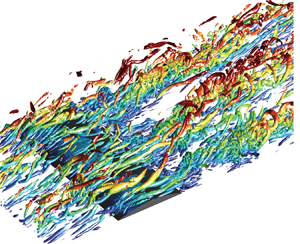
Impact of spanwise rotation on flow separation and recovery behind a bulge in channel flows
-
- Journal:
- Journal of Fluid Mechanics / Volume 999 / 25 November 2024
- Published online by Cambridge University Press:
- 15 November 2024, A51
-
- Article
-
- You have access
- Open access
- HTML
- Export citation
-
Direct numerical simulations of spanwise-rotating turbulent channel flow with a parabolic bump on the bottom wall are employed to investigate the effects of rotation on flow separation. Four rotation rates, $Ro_b := 2\varOmega H/U_b = \pm 0.42$, $\pm$1.0, are compared with the non-rotating scenario. The mild adverse pressure gradient induced by the lee side of the bump allows for a variable pressure-induced separation. The separation region is reduced (increased) when the bump is on the anti-cyclonic (cyclonic) side of the channel, compared with the non-rotating separation. The total drag is reduced in all rotating cases. Through several mechanisms, rotation alters the onset of separation, reattachment and wake recovery. The mean momentum deficit is found to be the key. A physical interpretation of the ratio between the system rotation and mean shear vorticity, $S:=\varOmega /\varOmega _s$, provides the mechanisms regarding stability thresholds $S=-0.5$ and $-$1. The rotation effects are explained accordingly, with reference to the dynamics of several flow structures. For anti-cyclonic separation, particularly, the interaction between the Taylor–Görtler vortices and hairpin vortices of wall-bounded turbulence is proven to be responsible for the breakdown of the separating shear layer. A generalized argument is made regarding the essential role of near-wall deceleration and resultant ejection of enhanced hairpin vortices in destabilizing an anti-cyclonic flow. This mechanism is anticipated to have broad impacts on other applications in analogy to rotating shear flows, such as thermal convection and boundary layers over concave walls.


On the importance of slow ions in the kinetic Bohm criterion
-
- Journal:
- Journal of Plasma Physics / Volume 90 / Issue 6 / December 2024
- Published online by Cambridge University Press:
- 15 November 2024, 905900604
-
- Article
-
- You have access
- Open access
- HTML
- Export citation
-
Between a plasma and a solid target lies a positively charged sheath of several Debye lengths $\lambda _{D}$
 width, typically much smaller than the characteristic length scale $L$
 of the main plasma. This scale separation implies that the asymptotic limit $\epsilon = \lambda _{D} / L \rightarrow 0$
 is useful to solve for the plasma-sheath system. In this limit, the Bohm criterion must be satisfied at the sheath entrance. A new derivation of the kinetic criterion, admitting a general ion velocity distribution, is presented. It is proven that, for $\epsilon \rightarrow 0$
 , the distribution of the velocity component normal to the target, $v_x$
 , and its first derivative must vanish for $|v_x| \rightarrow 0$
 at the sheath entrance. These two conditions can be subsumed into a third integral one after it is integrated by parts twice. A subsequent interchange of the limits $\epsilon \rightarrow 0$
 and $|v_x| \rightarrow 0$
 is invalid, leading to a divergence which underlies the misconception that the criterion gives undue importance to slow ions.


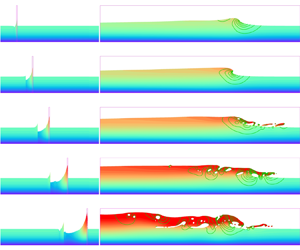
Roll waves on laminar sheet flow of Newtonian fluid with negligible surface tension
-
- Journal:
- Journal of Fluid Mechanics / Volume 999 / 25 November 2024
- Published online by Cambridge University Press:
- 15 November 2024, A49
-
- Article
-
- You have access
- Open access
- HTML
- Export citation
A 7-kW narrow-linewidth fiber amplifier assisted by optimizing the refractive index of the large-mode-area active fiber
-
- Journal:
- High Power Laser Science and Engineering / Volume 12 / 2024
- Published online by Cambridge University Press:
- 15 November 2024, e67
-
- Article
-
- You have access
- Open access
- HTML
- Export citation

Quantum Models of Cognition and Decision
- Principles and Applications
-
- Published online:
- 14 November 2024
- Print publication:
- 21 November 2024

Population Balance of Particles in Flows
- From Aerosols to Crystallisation
-
- Published online:
- 14 November 2024
- Print publication:
- 21 November 2024

The Einstein Paradox
- The Debate on Nonlocality and Incompleteness in 1935
-
- Published online:
- 14 November 2024
- Print publication:
- 28 November 2024

Introduction to Supergravity and its Applications
-
- Published online:
- 14 November 2024
- Print publication:
- 21 November 2024
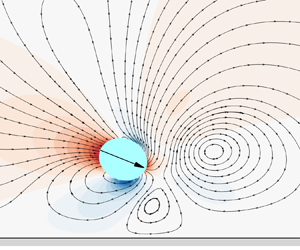
Effect of the shape of microswimmers and slip boundary conditions on the dynamic characteristics of near-wall microswimmers
-
- Journal:
- Journal of Fluid Mechanics / Volume 999 / 25 November 2024
- Published online by Cambridge University Press:
- 14 November 2024, A42
-
- Article
- Export citation
Internal tides and the inviscid dynamics of an oscillating ellipsoid in a stratified fluid
-
- Journal:
- Journal of Fluid Mechanics / Volume 999 / 25 November 2024
- Published online by Cambridge University Press:
- 14 November 2024, A59
-
- Article
- Export citation
Guided-jet waves
-
- Journal:
- Journal of Fluid Mechanics / Volume 999 / 25 November 2024
- Published online by Cambridge University Press:
- 14 November 2024, A47
-
- Article
-
- You have access
- Open access
- HTML
- Export citation
The global properties of nocturnal stable atmospheric boundary layers
-
- Journal:
- Journal of Fluid Mechanics / Volume 999 / 25 November 2024
- Published online by Cambridge University Press:
- 14 November 2024, A60
-
- Article
- Export citation
-
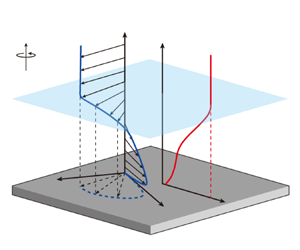
Accurate prediction of the global properties of wall-bounded turbulence holds significant importance for both fundamental research and engineering applications. In atmospheric boundary layers, the relationship between friction drag and geostrophic wind is described by the geostrophic drag law (GDL). We use carefully designed large-eddy simulations to study nocturnal stable atmospheric boundary layers (NSBLs), which are characterized by a negative potential temperature flux at the surface and neutral stratification higher up. Our simulations explore a wider range of the Kazanski–Monin parameter, $\mu = L_f / L_s = [16.7, 193.3]$, with $L_f$ the Ekman length scale and $L_s$ the surface Obukhov length. We show collapse of the GDL coefficients onto single curves as functions of $\mu$, thereby validating the GDL's applicability to NSBLs over a very wide $\mu$ range. We show that the boundary-layer height $h$ scales with $\sqrt {L_f L_s}$, while both the streamwise and spanwise wind gradients scale with $u_*^2 / (h^2 f)$, where $u_*$ represents the friction velocity and $f$ the Coriolis parameter. Leveraging these insights, we developed new analytical expressions for the GDL coefficients, significantly enhancing our understanding of the GDL for turbulent boundary layers. These formulations facilitate the analytical prediction of the geostrophic drag coefficient and cross-isobaric angle.


Dynamic large-eddy simulation of hypersonic transition delay over broadband wall impedance
-
- Journal:
- Journal of Fluid Mechanics / Volume 999 / 25 November 2024
- Published online by Cambridge University Press:
- 14 November 2024, A41
-
- Article
- Export citation
-
Three-dimensional numerical simulations of hypersonic boundary layer transition delay due to porosity representative of carbon-fibre-reinforced carbon-matrix ceramics (C/C) were carried out on a 7 $^{\circ {}}$ half-angle cone for unit Reynolds numbers $Re_m=2.43 \times 10^6$– $6.40\times 10^6\ \text {m}^{-1}$, at the free-stream Mach number $M_\infty =7.4$, for both sharp and 2.5 mm nose tip radii. A broadband time-domain impedance boundary condition was used to model the acoustic effects of the porous surface on the flow field. A quasi-spectral sub-filter-scale dynamic closure was adopted to stabilize the computations upon turbulent breakdown under extreme cooling conditions, with wall-to-adiabatic temperature ratio of $T_{w}/ T_{ad} \simeq 0.08 $, while accurately recovering the growth rates of the unstable modes present in the early transition stages. Good agreement is observed with the reference experimental data, both in terms of the predicted extent of the transition delay and the measured second-mode frequency spectrum. The latter is strongly modulated by the formation of near-wall low-temperature three-dimensional streaks. Pressure disturbances concentrate in corridors of locally thickened boundary layer, with frequencies lower than what predicted by linear theory. Here, trapped wavetrains are formed, which can persist long into the turbulent region. Finally, it is shown that the presence of a porous wall simply shifts the onset of turbulence downstream, without affecting its structure.


The confined stresslet for suspensions in a spherical cavity. Part 1. Traceless elements
-
- Journal:
- Journal of Fluid Mechanics / Volume 999 / 25 November 2024
- Published online by Cambridge University Press:
- 14 November 2024, A38
-
- Article
- Export citation
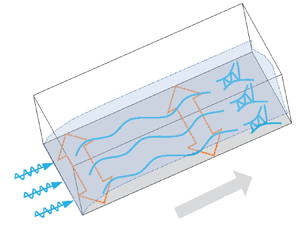
Influence of spanwise wall vibration on non-modal perturbations subject to freestream vortical disturbances in hypersonic boundary layers
-
- Journal:
- Journal of Fluid Mechanics / Volume 999 / 25 November 2024
- Published online by Cambridge University Press:
- 14 November 2024, A57
-
- Article
- Export citation

Bubble dissolution in Taylor–Couette flow
-
- Journal:
- Journal of Fluid Mechanics / Volume 999 / 25 November 2024
- Published online by Cambridge University Press:
- 14 November 2024, A39
-
- Article
-
- You have access
- Open access
- HTML
- Export citation
-
We perform direct numerical simulations of soluble bubbles dissolving in a Taylor–Couette (TC) flow reactor with a radius ratio of $\eta =0.5$ and Reynolds number in the range $0 \leq Re \leq 5000$, which covers the main regimes of this flow configuration, up to fully turbulent Taylor vortex flow. The numerical method is based on a geometric volume-of-fluid framework for incompressible flows coupled with a phase-change solver that ensures mass conservation of the soluble species, whilst boundary conditions on solid walls are enforced through an embedded boundary approach. The numerical framework is validated extensively against single-phase TC flows and competing mass transfer in multicomponent mixtures for an idealised infinite cylinder and for a bubble rising in a quiescent liquid. Our results show that when bubbles in a TC flow are mainly driven by buoyancy, theoretical formulae derived for spherical interfaces on a vertical trajectory still provide the right fundamental relationship between the bubble Reynolds and Sherwood numbers, which reduces to $Sh \propto \sqrt {Pe}$ for large Péclet values. For bubbles mainly transported by TC flows, the dissolution of bubbles depend on the TC Reynolds number and, for the turbulent configurations, we show that the smallest characteristic turbulent scales control mass transfer, in agreement with the small-eddy model of Lamont & Scott (AIChE J., vol. 16, 1970, pp. 513–519). Finally, the interaction between two aligned bubbles is investigated and we show that a significant increase in mass transfer can be obtained when the rotor of the apparatus is operated at larger speeds.


