Refine search
Actions for selected content:
238152 results in Physics and Astronomy
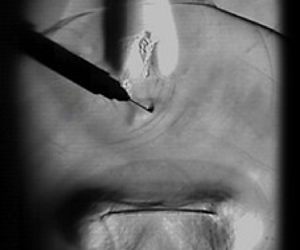
Insights into spatio-temporal dynamics during shock–droplet flame interaction
-
- Journal:
- Journal of Fluid Mechanics / Volume 999 / 25 November 2024
- Published online by Cambridge University Press:
- 12 November 2024, A22
-
- Article
- Export citation

A Reynolds analogy model for compressible wall turbulence
-
- Journal:
- Journal of Fluid Mechanics / Volume 999 / 25 November 2024
- Published online by Cambridge University Press:
- 12 November 2024, A20
-
- Article
-
- You have access
- Open access
- HTML
- Export citation

Transition of the thermal boundary layer and plume over an isothermal section-triangular roof: an experimental study
-
- Journal:
- Journal of Fluid Mechanics / Volume 998 / 10 November 2024
- Published online by Cambridge University Press:
- 12 November 2024, A7
-
- Article
-
- You have access
- Open access
- HTML
- Export citation
New radio continuum study of the large magellanic cloud supernova remnant N49
-
- Journal:
- Publications of the Astronomical Society of Australia / Volume 41 / 2024
- Published online by Cambridge University Press:
- 11 November 2024, e089
-
- Article
-
- You have access
- Open access
- HTML
- Export citation
-
We present new Australia Telescope Compact Array (ATCA) radio observations towards N 49, one of the brightest extragalactic supernova remnants (SNRs) located in the Large Magellanic Cloud (LMC). Our new and archival ATCA radio observations were analysed along with Chandra X-ray data. These observations show a prominent ‘bullet’ shaped feature beyond the southwestern boundary of the SNR. Both X-ray morphology and radio polarisation analysis support a physical connection of this feature to the SNR. The ‘bullet’ feature’s apparent velocity is estimated at $\sim$1 300 km s $^{-1}$, based on its distance ( $\sim$10 pc) from the remnant’s geometric centre and estimated age ( $\sim$7 600 yr). we estimated the radio spectral index, $\alpha= -0.55 \pm 0.03$ which is typical of middle-age SNRs. Polarisation maps created for N 49 show low to moderate levels of mean fractional polarisation estimated at 7 $\pm$1% and 10 $\pm$1% for 5.5 and 9 GHz, respectively. These values are noticeably larger than found in previous studies. Moreover, the mean value for the Faraday rotation of SNR N 49 from combining CABB data is 212 $\pm$65 rad m $^{-2}$ and the maximum value of RM is 591 $\pm$103 rad m $^{-2}$.


Nonlinear waves in a sheared liquid film on a horizontal plane at small Reynolds numbers
-
- Journal:
- Journal of Fluid Mechanics / Volume 999 / 25 November 2024
- Published online by Cambridge University Press:
- 11 November 2024, A14
-
- Article
- Export citation

Flagellum pumping efficiency in shear-thinning viscoelastic fluids
-
- Journal:
- Journal of Fluid Mechanics / Volume 999 / 25 November 2024
- Published online by Cambridge University Press:
- 11 November 2024, A2
-
- Article
-
- You have access
- Open access
- HTML
- Export citation
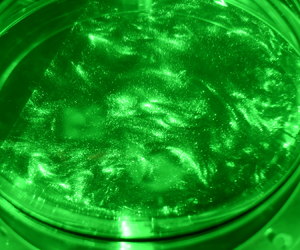
Precessing non-axisymmetric ellipsoids: bi-stability and fluid instabilities
- Part of
-
- Journal:
- Journal of Fluid Mechanics / Volume 997 / 25 October 2024
- Published online by Cambridge University Press:
- 11 November 2024, A52
-
- Article
-
- You have access
- Open access
- HTML
- Export citation
WALLABY Pilot Survey: Public data release of ∼ 1800 H i sources and high-resolution cut-outs from Pilot Survey Phase 2
-
- Journal:
- Publications of the Astronomical Society of Australia / Volume 41 / 2024
- Published online by Cambridge University Press:
- 11 November 2024, e088
-
- Article
-
- You have access
- Open access
- HTML
- Export citation
-
We present the Pilot Survey Phase 2 data release for the Wide-field ASKAP L-band Legacy All-sky Blind surveY (WALLABY), carried-out using the Australian SKA Pathfinder (ASKAP). We present 1760 H i detections (with a default spatial resolution of 30′′) from three pilot fields including the NGC 5044 and NGC 4808 groups as well as the Vela field, covering a total of $\sim 180$ deg $^2$ of the sky and spanning a redshift up to $z \simeq 0.09$. This release also includes kinematic models for over 126 spatially resolved galaxies. The observed median rms noise in the image cubes is 1.7 mJy per 30′′ beam and 18.5 kHz channel. This corresponds to a 5 $\sigma$ H i column density sensitivity of $\sim 9.1\times10^{19}(1 + z)^4$ cm $^{-2}$ per 30′′ beam and $\sim 20$ km s $^{-1}$ channel and a 5 $\sigma$ H i mass sensitivity of $\sim 5.5\times10^8 (D/100$ Mpc) $^{2}$ M $_{\odot}$ for point sources. Furthermore, we also present for the first time 12′′ high-resolution images (“cut-outs”) and catalogues for a sub-sample of 80 sources from the Pilot Survey Phase 2 fields. While we are able to recover sources with lower signal-to-noise ratio compared to sources in the Public Data Release 1, we do note that some data quality issues still persist, notably, flux discrepancies that are linked to the impact of side lobes associated with the dirty beams due to inadequate deconvolution. However, in spite of these limitations, the WALLABY Pilot Survey Phase 2 has already produced roughly a third of the number of HIPASS sources, making this the largest spatially resolved H i sample from a single survey to date.



Introduction to Elementary Particle Physics
-
- Published online:
- 08 November 2024
- Print publication:
- 27 June 2024
-
- Textbook
-
- You have access
- Open access
- Export citation
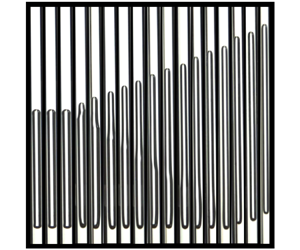
Releasing long bubbles trapped in thin capillaries via tube centrifugation and inclination
-
- Journal:
- Journal of Fluid Mechanics / Volume 999 / 25 November 2024
- Published online by Cambridge University Press:
- 08 November 2024, A9
-
- Article
-
- You have access
- Open access
- HTML
- Export citation
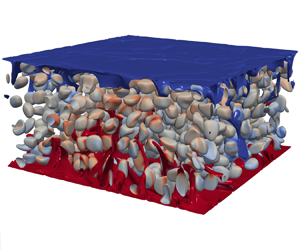
Turbulent convection in emulsions: the Rayleigh–Bénard configuration
-
- Journal:
- Journal of Fluid Mechanics / Volume 999 / 25 November 2024
- Published online by Cambridge University Press:
- 08 November 2024, A4
-
- Article
-
- You have access
- Open access
- HTML
- Export citation
-
This study explores heat and turbulent modulation in three-dimensional multiphase Rayleigh–Bénard convection using direct numerical simulations. Two immiscible fluids with identical reference density undergo systematic variations in dispersed-phase volume fractions, $0.0 \leq \varPhi \leq 0.5$, and ratios of dynamic viscosity, $\lambda _{\mu }$, and thermal diffusivity, $\lambda _{\alpha }$, within the range $[0.1\unicode{x2013}10]$. The Rayleigh, Prandtl, Weber and Froude numbers are held constant at $10^8$, $4$,
$4$,  $6000$ and $1$, respectively. Initially, when both fluids share the same properties, a 10 % Nusselt number increase is observed at the highest volume fractions. In this case, despite a reduction in turbulent kinetic energy, droplets enhance energy transfer to smaller scales, smaller than those of single-phase flow, promoting local mixing. By varying viscosity ratios, while maintaining a constant Rayleigh number based on the average mixture properties, the global heat transfer rises by approximately 25 % at $\varPhi =0.2$ and $\lambda _{\mu }=10$. This is attributed to increased small-scale mixing and turbulence in the less viscous carrier phase. In addition, a dispersed phase with higher thermal diffusivity results in a 50 % reduction in the Nusselt number compared with the single-phase counterpart, owing to faster heat conduction and reduced droplet presence near walls. The study also addresses droplet-size distributions, confirming two distinct ranges dominated by coalescence and breakup with different scaling laws.


Direct numerical simulation of bubble rising in turbulence
-
- Journal:
- Journal of Fluid Mechanics / Volume 999 / 25 November 2024
- Published online by Cambridge University Press:
- 08 November 2024, A11
-
- Article
-
- You have access
- Open access
- HTML
- Export citation
-
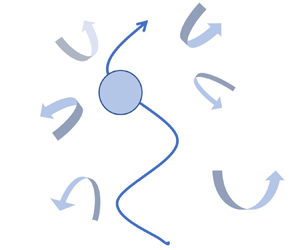
We describe the rising trajectory of bubbles in isotropic turbulence and quantify the slowdown of the mean rise velocity of bubbles with sizes within the inertial subrange. We perform direct numerical simulations of bubbles, for a wide range of turbulence intensity, bubble inertia and deformability, with systematic comparison with the corresponding quiescent case, with Reynolds number at the Taylor microscale from 38 to 77. Turbulent fluctuations randomise the rising trajectory and cause a reduction of the mean rise velocity $\tilde {w}_b$ compared with the rise velocity in quiescent flow $w_b$. The decrease in mean rise velocity of bubbles $\tilde {w}_b/w_b$ is shown to be primarily a function of the ratio of the turbulence intensity and the buoyancy forces, described by the Froude number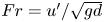 $Fr=u'/\sqrt {gd}$, where $u'$ is the root-mean-square velocity fluctuations, $g$ is gravity and $d$ is the bubble diameter. The bubble inertia, characterised by the ratio of inertial to viscous forces (Galileo number), and the bubble deformability, characterised by the ratio of buoyancy forces to surface tension (Bond number), modulate the rise trajectory and velocity in quiescent fluid. The slowdown of these bubbles in the inertial subrange is not due to preferential sampling, as is the case with sub-Kolmogorov bubbles. Instead, it is caused by the nonlinear drag–velocity relationship, where velocity fluctuations lead to an increased average drag. For $Fr > 0.5$, we confirm the scaling $\tilde {w}_b / w_b \propto 1 / Fr$, as proposed previously by Ruth et al. (J. Fluid Mech., vol. 924, 2021, p. A2), over a wide range of bubble inertia and deformability.


Particle transport and deposition in wall-sheared thermal turbulence
-
- Journal:
- Journal of Fluid Mechanics / Volume 999 / 25 November 2024
- Published online by Cambridge University Press:
- 08 November 2024, A15
-
- Article
- Export citation
-
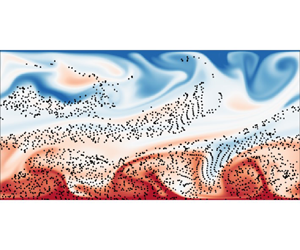
We studied the transport and deposition behaviour of point particles in Rayleigh–Bénard convection cells subjected to Couette-type wall shear. Direct numerical simulations (DNSs) are performed for Rayleigh number ( $Ra$) in the range $10^{7} \leq Ra \leq ~10^9$ with a fixed Prandtl number $Pr = 0.71$, while the wall-shear Reynolds number ( $Re_w$) is in the range $0 \leq Re_w \leq ~12\,000$. With the increase of $Re_w$, the large-scale rolls expanded horizontally, evolving into zonal flow in two-dimensional simulations or streamwise-oriented rolls in three-dimensional simulations. We observed that, for particles with a small Stokes number ( $St$), they either circulated within the large-scale rolls when buoyancy dominated or drifted near the walls when shear dominated. For medium $St$ particles, pronounced spatial inhomogeneity and preferential concentration were observed regardless of the prevailing flow state. For large $St$ particles, the turbulent flow structure had a minor influence on the particles’ motion; although clustering still occurred, wall shear had a negligible influence compared with that for medium $St$ particles. We then presented the settling curves to quantify the particle deposition ratio on the walls. Our DNS results aligned well with previous theoretical predictions, which state that small $St$ particles settle with an exponential deposition ratio and large $St$ particles settle with a linear deposition ratio. For medium $St$ particles, where complex particle–turbulence interaction emerges, we developed a new model describing the settling process with an initial linear stage followed by a nonlinear stage. Unknown parameters in our model can be determined either by fitting the settling curves or using empirical relations. Compared with DNS results, our model also accurately predicts the average residence time across a wide range of $St$ for various $Re_w$.


Diffusion-driven flows in a nonlinear stratified fluid layer
-
- Journal:
- Journal of Fluid Mechanics / Volume 999 / 25 November 2024
- Published online by Cambridge University Press:
- 08 November 2024, A12
-
- Article
- Export citation
-
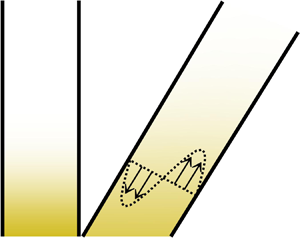
Diffusion-driven flow is a boundary layer flow arising from the interplay of gravity and diffusion in density-stratified fluids when a gravitational field is non-parallel to an impermeable solid boundary. This study investigates diffusion-driven flow within a nonlinearly density-stratified fluid confined between two tilted parallel walls. We introduce an asymptotic expansion inspired by the centre manifold theory, where quantities are expanded in terms of derivatives of the cross-sectional averaged stratified scalar (such as salinity or temperature). This technique provides accurate approximations for velocity, density and pressure fields. Furthermore, we derive an evolution equation describing the cross-sectional averaged stratified scalar. This equation takes the form of the traditional diffusion equation but replaces the constant diffusion coefficient with a positive-definite function dependent on the solution's derivative. Numerical simulations validate the accuracy of our approximations. Our investigation of the effective equation reveals that the density profile depends on a non-dimensional parameter denoted as $\gamma$ representing the flow strength. In the large $\gamma$ limit, the system is approximated by a diffusion process with an augmented diffusion coefficient of $1+\cot ^{2}\theta$, where $\theta$ signifies the inclination angle of the channel domain. This parameter regime is where diffusion-driven flow exhibits its strongest mixing ability. Conversely, in the small $\gamma$ regime, the density field behaves like pure diffusion with distorted isopycnals. Lastly, we show that the classical thin film equation aligns with the results obtained using the proposed expansion in the small $\gamma$ regime but fails to accurately describe the dynamics of the density field for large $\gamma$.


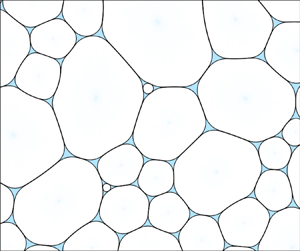
Effects of liquid fraction and contact angle on structure and coarsening in two-dimensional foams
-
- Journal:
- Journal of Fluid Mechanics / Volume 999 / 25 November 2024
- Published online by Cambridge University Press:
- 08 November 2024, A10
-
- Article
-
- You have access
- Open access
- HTML
- Export citation
-
Aqueous foams coarsen with time due to gas diffusion through the liquid between the bubbles. The mean bubble size grows, and small bubbles vanish. However, coarsening is little understood for foams with an intermediate liquid content, particularly in the presence of surfactant-induced attractive forces between the bubbles, measured by the interface contact angle where thin films meet the bulk liquid. Rigorous bubble growth laws have yet to be developed, and the evolution of bulk foam properties is unclear. We present a quasistatic numerical model for coarsening in two-dimensional wet foams, focusing on growth laws and related bubble properties. The deformation of bubble interfaces is modelled using a finite-element approach, and the gas flow through both films and Plateau borders is approximated. We give results for disordered two-dimensional wet foams with $256$ to $1024$ bubbles, at liquid fractions from $2\,\%$ to $25\,\%$, beyond the zero-contact-angle unjamming transition, and with contact angles up to $10^\circ$. Simple analytical models for the bubble pressures, film lengths and coarsening growth rates are developed to aid interpretation. If the contact angle is non-zero, we find that a prediction of the coarsening rate approaches a non-zero value as the liquid fraction is increased. We also find that an individual bubble's effective number of neighbours determines whether it grows or shrinks to a good approximation.


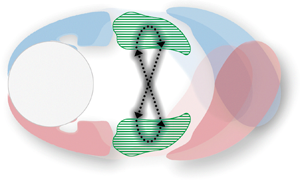
On the short-wavelength three-dimensional instability in the cylinder wake
-
- Journal:
- Journal of Fluid Mechanics / Volume 999 / 25 November 2024
- Published online by Cambridge University Press:
- 08 November 2024, A13
-
- Article
-
- You have access
- Open access
- HTML
- Export citation
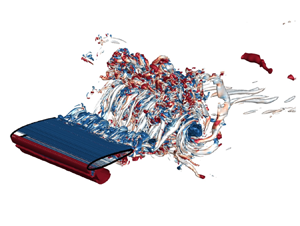
Hydrodynamic performance and scaling laws for a modelled wave-induced flapping-foil propulsor
-
- Journal:
- Journal of Fluid Mechanics / Volume 999 / 25 November 2024
- Published online by Cambridge University Press:
- 07 November 2024, A1
-
- Article
-
- You have access
- Open access
- HTML
- Export citation
Multi-model workload specifications and their application to cyber-physical systems – ERRATUM
-
- Journal:
- Research Directions: Cyber-Physical Systems / Volume 2 / 2024
- Published online by Cambridge University Press:
- 07 November 2024, e6
-
- Article
-
- You have access
- Open access
- HTML
- Export citation
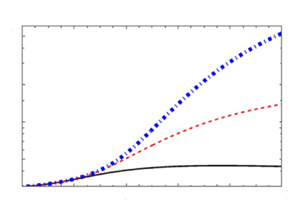
Pressure-driven viscoelastic flow in axisymmetric geometries with application to the hyperbolic pipe
-
- Journal:
- Journal of Fluid Mechanics / Volume 999 / 25 November 2024
- Published online by Cambridge University Press:
- 07 November 2024, A7
-
- Article
-
- You have access
- Open access
- HTML
- Export citation
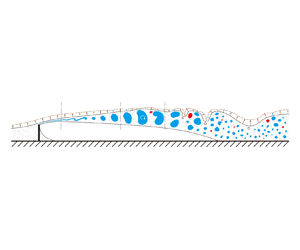
Entrainment of the shear layer separated from a wall-mounted fence
-
- Journal:
- Journal of Fluid Mechanics / Volume 999 / 25 November 2024
- Published online by Cambridge University Press:
- 07 November 2024, A6
-
- Article
- Export citation
