Refine search
Actions for selected content:
238152 results in Physics and Astronomy
PSP volume 177 issue 3 Cover and Front matter
-
- Journal:
- Mathematical Proceedings of the Cambridge Philosophical Society / Volume 177 / Issue 3 / November 2024
- Published online by Cambridge University Press:
- 03 January 2025, pp. f1-f2
- Print publication:
- November 2024
-
- Article
-
- You have access
- Export citation
5 - Light Sources, Displays, and Detectors
- from Theme I - Introducing Light
-
- Book:
- Pedrottis' Introduction to Optics
- Published online:
- 15 April 2025
- Print publication:
- 31 October 2024, pp 192-236
-
- Chapter
- Export citation
E. Integrated Testlet Lookup Table
-
- Book:
- Pedrottis' Introduction to Optics
- Published online:
- 15 April 2025
- Print publication:
- 31 October 2024, pp 942-943
-
- Chapter
- Export citation
Theme V - Advanced Topics
-
- Book:
- Pedrottis' Introduction to Optics
- Published online:
- 15 April 2025
- Print publication:
- 31 October 2024, pp 683-684
-
- Chapter
- Export citation
Effects of surface roughness on the drag coefficient of finite-span cylinders freely rolling on an inclined plane
-
- Journal:
- Journal of Fluid Mechanics / Volume 998 / 10 November 2024
- Published online by Cambridge University Press:
- 31 October 2024, A39
-
- Article
-
- You have access
- Open access
- HTML
- Export citation
-
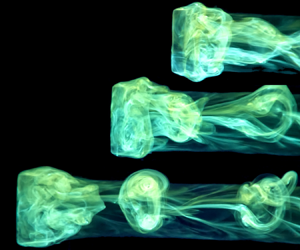
We present an experimental investigation aimed at understanding the effects of surface roughness on the time-mean drag coefficient ( $\bar {C}_{D}$) of finite-span cylinders ( $\text {span/diameter} = \text {aspect ratio}$, $0.51 \le AR \le 6.02$) freely rolling without slip on an inclined plane. While lubrication theory predicts an infinite drag force for ideally smooth cylinders in contact with a smooth surface, experiments yield finite drag coefficients. We propose that surface roughness introduces an effective gap ( $G_{eff}$) resulting in a finite drag force while allowing physical contact between the cylinder and the plane. This study combines measurements of surface roughness for both the cylinder and the plane panel to determine a total relative roughness ( $\xi$) that can effectively describe $G_{eff}$ at the point of contact. It is observed that the measured $\bar {C}_{D}$ increases as $\xi$ decreases, aligning with predictions of lubrication theory. Furthermore, the measured $\bar {C}_{D}$ approximately matches combined analytical and numerical predictions for a smooth cylinder and plane when the imposed gap is approximately equal to the mean peak roughness ( $R_p$) for rough cylinders, and one standard deviation peak roughness ( $R_{p, 1\sigma }$) for relatively smooth cylinders. As the time-mean Reynolds number ( $\overline {Re}$) increases, the influence of surface roughness on $\bar {C}_{D}$ decreases, indicating that wake drag becomes dominant at higher $\overline {Re}$. The cylinder aspect ratio ( $AR$) is found to have only a minor effect on $\bar {C}_{D}$. Flow visualisations are also conducted to identify critical flow transitions and these are compared with visualisations previously obtained numerically. Variations in $\xi$ have little effect on the cylinder wake. Instead, $AR$ was observed to have a more pronounced effect on the flow structures observed. The Strouhal number ( $St$) associated with the cylinder wake shedding was observed to increase with $\overline {Re}$, while demonstrating little dependence on $AR$.
$AR$.


Influence of porous material on the flow behind a backward-facing step: experimental study
-
- Journal:
- Journal of Fluid Mechanics / Volume 998 / 10 November 2024
- Published online by Cambridge University Press:
- 31 October 2024, A31
-
- Article
-
- You have access
- Open access
- HTML
- Export citation
4 - Waves
- from Theme I - Introducing Light
-
- Book:
- Pedrottis' Introduction to Optics
- Published online:
- 15 April 2025
- Print publication:
- 31 October 2024, pp 164-191
-
- Chapter
- Export citation
B. Mathematical Formulas
-
- Book:
- Pedrottis' Introduction to Optics
- Published online:
- 15 April 2025
- Print publication:
- 31 October 2024, pp 913-915
-
- Chapter
- Export citation
12 - Reflection and Transmission at Surfaces
- from Theme III - A Vector Field Approach to Light
-
- Book:
- Pedrottis' Introduction to Optics
- Published online:
- 15 April 2025
- Print publication:
- 31 October 2024, pp 447-472
-
- Chapter
- Export citation
26 - Optics of the Eye
- from Theme V - Advanced Topics
-
- Book:
- Pedrottis' Introduction to Optics
- Published online:
- 15 April 2025
- Print publication:
- 31 October 2024, pp 886-910
-
- Chapter
- Export citation
Regular reflection to Mach reflection (RR–MR) transition in short wedges
-
- Journal:
- Journal of Fluid Mechanics / Volume 998 / 10 November 2024
- Published online by Cambridge University Press:
- 31 October 2024, A38
-
- Article
-
- You have access
- Open access
- HTML
- Export citation
-
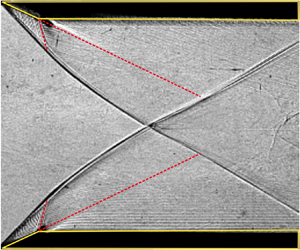
Regular reflection (RR) to Mach reflection (MR) transitions ( ${\rm RR}\leftrightarrow {\rm MR}$) on long wedges in steady supersonic flows have been well studied and documented. However, in a short wedge where the wedge length is small, the transition prediction becomes really challenging owing to the interaction of the expansion fan emanating from the trailing edge of the wedge with the incident shock and the triple/reflection point. The extent of this interaction depends on the distance between the wedge trailing edge and the symmetry line (Ht). This distance is a geometric combination of the distance of the wedge leading edge from the symmetry line $(H)$, the wedge angle ( $\theta$) and the wedge length $(w)$. In the present study, we used the method of characteristics to model the complete wave interactions which accurately predicted shock curvatures and the reflection configurations for all ranges of the incoming flow Mach number. In the case of short wedges, the transition criterion strongly depends on the wedge length, which can be so adjusted even to eliminate the ${\rm RR}\rightarrow {\rm MR}$ transitions till the wedge angle reaches the no-reflection domain. Transition lines for both the detachment criterion and von Neumann criterion are also drawn to investigate the dual solution domain, and the reflection configurations were verified experimentally for the first time on short wedges. By using proper input configuration parameter ( $w/H$), various types of shifts in the dual solution domain for short wedges are studied and categorised into three types, namely Type I, Type II and Type III.


3 - Understanding Optical Instruments
- from Theme I - Introducing Light
-
- Book:
- Pedrottis' Introduction to Optics
- Published online:
- 15 April 2025
- Print publication:
- 31 October 2024, pp 103-163
-
- Chapter
- Export citation
15 - Polarization in Practice
- from Theme III - A Vector Field Approach to Light
-
- Book:
- Pedrottis' Introduction to Optics
- Published online:
- 15 April 2025
- Print publication:
- 31 October 2024, pp 544-572
-
- Chapter
- Export citation
25 - Laser Technology and Applications
- from Theme V - Advanced Topics
-
- Book:
- Pedrottis' Introduction to Optics
- Published online:
- 15 April 2025
- Print publication:
- 31 October 2024, pp 857-885
-
- Chapter
- Export citation

A three-layer Hele-Shaw problem driven by a sink
-
- Journal:
- Journal of Fluid Mechanics / Volume 998 / 10 November 2024
- Published online by Cambridge University Press:
- 31 October 2024, A35
-
- Article
- Export citation
19 - Aberrations
- from Theme V - Advanced Topics
-
- Book:
- Pedrottis' Introduction to Optics
- Published online:
- 15 April 2025
- Print publication:
- 31 October 2024, pp 685-718
-
- Chapter
- Export citation
Comparison between shear-driven and pressure-driven oscillatory flows over ripples
-
- Journal:
- Journal of Fluid Mechanics / Volume 998 / 10 November 2024
- Published online by Cambridge University Press:
- 31 October 2024, A42
-
- Article
- Export citation
Theme II - A Scalar Field Approach to Light
-
- Book:
- Pedrottis' Introduction to Optics
- Published online:
- 15 April 2025
- Print publication:
- 31 October 2024, pp 237-238
-
- Chapter
- Export citation
Direct calculation of the eddy viscosity operator in turbulent channel flow at Reτ = 180
-
- Journal:
- Journal of Fluid Mechanics / Volume 998 / 10 November 2024
- Published online by Cambridge University Press:
- 31 October 2024, A33
-
- Article
-
- You have access
- Open access
- HTML
- Export citation
-
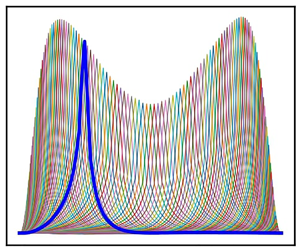
This study aims to quantify how turbulence in a channel flow mixes momentum in the mean sense. We applied the macroscopic forcing method (Mani & Park, Phys. Rev. Fluids, 2021, 054607) to direct numerical simulation (DNS) of a turbulent channel flow at $Re_\tau =180$ using two different forcing strategies that are designed to separately assess the anisotropy and non-locality of momentum mixing. In the first strategy, the leading term of the Kramers–Moyal expansion of the eddy viscosity is quantified, revealing all 81 tensorial coefficients that essentially characterise the local-limit eddy viscosity. The results indicate the following: (1) the eddy viscosity has significant anisotropy, (2) Reynolds stresses are generated by both the mean strain rate and mean rotation rate tensors associated with the momentum field and (3) the local-limit eddy viscosity generates asymmetric Reynolds stress tensors. In the second strategy, the eddy viscosity is quantified as an integration kernel revealing the non-local influence of the mean momentum gradient at each wall-normal coordinate on all nine components of the Reynolds stresses over the channel width. Our results indicate that while the shear component of the Reynolds stress is reasonably reproduced by the local mean gradients, other components of the Reynolds stress are highly non-local. These results provide an understanding of anisotropy and non-locality requirements for closure modelling of momentum transport in attached wall-bounded turbulent flows.

The global flow state in a precessing cylinder
-
- Journal:
- Journal of Fluid Mechanics / Volume 998 / 10 November 2024
- Published online by Cambridge University Press:
- 31 October 2024, A30
-
- Article
-
- You have access
- Open access
- HTML
- Export citation
-
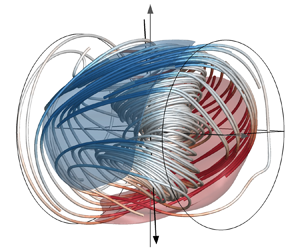
We examine the fluid flow forced by precession of a rotating cylindrical container using numerical simulations and experimental flow measurements with ultrasonic Doppler velocimetry. The analysis is based on the decomposition of the flow field into contributions with distinct azimuthal symmetry or analytically known inertial modes and the corresponding calculation of their amplitudes. We show that the predominant fraction of the kinetic energy of the precession-driven fluid flow is contained only within a few large-scale modes. The most striking observation shown by simulations and experiments is the transition from a flow dominated by large-scale structures to a more turbulent behaviour with the small-scale fluctuations becoming increasingly important. At a fixed rotation frequency (parametrized by the Reynolds number, $Re$) this transition occurs when a critical precession ratio is exceeded and consists of a two-stage collapse of the directly driven flow going along with a massive modification of the azimuthal circulation (the zonal flow) and the appearance of an axisymmetric double-roll mode limited to a narrow range of precession ratios. A similar behaviour is found in experiments which make it possible to follow the transition up to Reynolds numbers of $Re\approx 2\times 10^6$. We find that the critical precession ratio decreases with rotation, initially showing a particular scaling ${\propto }Re^{-({1}/{5})}$ but developing an asymptotic behaviour for $Re\gtrsim 10^5$ which might be explained by the onset of turbulence in boundary layers.


