Refine search
Actions for selected content:
238152 results in Physics and Astronomy
Impact of axial strain on linear, transitional and self-similar turbulent mixing layers
-
- Journal:
- Journal of Fluid Mechanics / Volume 999 / 25 November 2024
- Published online by Cambridge University Press:
- 07 November 2024, A5
-
- Article
-
- You have access
- Open access
- HTML
- Export citation
-
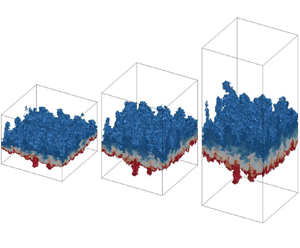
In convergent geometry, the effect of convergence and compression on the Rayleigh–Taylor instability (RTI) and Richtmyer–Meshkov instability (RMI) modifies the growth rate and behaviour of the instabilities. In order to better understand how compression/expansion caused by axial strain rates (i.e. strain rates normal to the interface) change the instability dynamics, axial strain rates are applied to RMI in planar geometry, isolated from the effects of convergence. Potential flow theory for the linear regime shows the growth rate of the instability is modified to include the background velocity difference of the instability's width. Resolved two-dimensional simulations of single-mode RMI showed the potential flow model is accurate whilst the amplitude is small compared with the wavelength. The application of strain rate to an RMI-induced mixing layer was investigated using three-dimensional implicit large eddy simulations (ILES) of the quarter-scale $\theta$-group case by Thornber et al. (Phys. Fluids, vol. 29, 2017, 105107). Whilst the background strain rate contributed to the mixing layer's growth, it was to a smaller extent than expected. The shear production of axial turbulent kinetic energy from the strain rate modified the rate of bulk entrainment, affecting the mixing layer's growth and mixedness, such that the strained simulations no longer attained the same self-similar state. The capability of the buoyancy-drag model by Youngs & Thornber (Physica D, vol. 410, 2020, 132517) to predict the mixing layer width was investigated, using a model calibrated to the unstrained case. New terms were introduced into the buoyancy-drag model, which correspond to the shear production of turbulent kinetic energy.

On the mean structure and unsteadiness of dual shock wave–turbulent boundary layer interactions
-
- Journal:
- Journal of Fluid Mechanics / Volume 999 / 25 November 2024
- Published online by Cambridge University Press:
- 07 November 2024, A3
-
- Article
- Export citation
Weakly nonlinear behaviour of transonic buffet on airfoils
-
- Journal:
- Journal of Fluid Mechanics / Volume 999 / 25 November 2024
- Published online by Cambridge University Press:
- 07 November 2024, A8
-
- Article
- Export citation
Bayesian recalibration of Planck galaxy cluster scaling relations including relativistic Sunyaev-Zel’dovich corrections
-
- Journal:
- Publications of the Astronomical Society of Australia / Volume 41 / 2024
- Published online by Cambridge University Press:
- 06 November 2024, e087
-
- Article
-
- You have access
- Open access
- HTML
- Export citation
-
We investigate the impact of relativistic SZ corrections on Planck measurements of massive galaxy clusters, finding that they have a significant impact at the $\approx$5–15% and up to $\approx$ 3 $\sigma$ level. We investigate the possibility of constraining temperature directly from these SZ measurements but find that only weak constraints are possible for the most significant detections; for most clusters, an external temperature measurement is required to correctly measure integrated Compton-y. We also investigate the impact of profile shape assumptions and find that these have a small but non-negligible impact on measured Compton-y, at the $\approx$ 5% level. Informed by the results of these investigations, we recalibrate the Planck SZ observable-mass scaling relation, using the updated NPIPE data release and a larger sample of X-ray mass estimates. Along with the expected change in the high-mass end of the scaling relation, which does not impact Planck mass estimation, we also find hints of a low-mass deviation, but this requires better understanding of the selection function in order to confirm.


A sky survey of ultraviolet sources observed through AstroSat’s UVIT: A point source catalogue
-
- Journal:
- Publications of the Astronomical Society of Australia / Volume 41 / 2024
- Published online by Cambridge University Press:
- 06 November 2024, e086
-
- Article
- Export citation
-
The Ultra Violet Imaging Telescope (UVIT) onboard India’s first dedicated multiwavelength satellite AstroSat observed a significant fraction of the sky in the ultraviolet with a spatial resolution of 1.4 $^{\prime\prime}$. We present a catalogue of the point sources observed by UVIT in the far ultraviolet (FUV; 1 300–1 800 Å) and near ultraviolet (NUV; 2 000–3 000 Å). We carried out astrometry and photometry of 428 field pointings in the FUV and 54 field pointings in the NUV band, observed in 5 filter bands in each channel, respectively, covering an area of about 63 square degrees. The final catalogue contains about 102 773 sources. The limiting magnitude(AB) of the F148W band filter, that has the largest number of detections is $\sim$ $21.3$. For the NUV channel, we find the limiting magnitude at around $\sim$23. We describe the final catalogue and present the results of the statistical analysis.


Template-based piecewise affine regression
-
- Journal:
- Research Directions: Cyber-Physical Systems / Volume 2 / 2024
- Published online by Cambridge University Press:
- 06 November 2024, e5
-
- Article
-
- You have access
- Open access
- HTML
- Export citation
Comparative study of the W UMa type binaries S Ant and ε CrA
-
- Journal:
- Publications of the Astronomical Society of Australia / Volume 41 / 2024
- Published online by Cambridge University Press:
- 06 November 2024, e083
-
- Article
-
- You have access
- Open access
- HTML
- Export citation
-
Contact binaries challenge contemporary stellar astrophysics with respect to their incidence, structure, and evolution. We explore these issues through a detailed study of two bright examples: S Ant and $\varepsilon$ CrA, that permit high-resolution spectroscopy at a relatively good S/N ratio. The availability of high-quality photometry, including data from the TESS satellite as well as Gaia parallaxes, allows us to apply the Russell paradigm to produce reliable up-to-date information on the physical properties of these binaries. As a result, models of their interactive evolution, such as the thermal relaxation oscillator scenario, can be examined. Mass transfer between the components is clearly evidenced, but the variability of the O’Connell effect over relatively short-time scales points to irregularities in the mass transfer or accretion processes. Our findings indicate that S Ant may evolve into an R CMa type Algol, while the low mass ratio of $\varepsilon$ CrA suggests a likely merger of its components in the not-too-distant future.


Scraping of a viscoplastic fluid to model mountain building
-
- Journal:
- Journal of Fluid Mechanics / Volume 998 / 10 November 2024
- Published online by Cambridge University Press:
- 05 November 2024, A58
-
- Article
-
- You have access
- Open access
- HTML
- Export citation
Regimes of stratified turbulence at low Prandtl number
-
- Journal:
- Journal of Fluid Mechanics / Volume 998 / 10 November 2024
- Published online by Cambridge University Press:
- 05 November 2024, A60
-
- Article
-
- You have access
- Open access
- HTML
- Export citation
-
Quantifying transport by strongly stratified turbulence in low Prandtl number ( $Pr$) fluids is critically important for the development of better models for the structure and evolution of stellar and planetary interiors. Motivated by recent numerical simulations showing strongly anisotropic flows suggestive of a scale-separated dynamics, we perform a multiscale asymptotic analysis of the governing equations. We find that, in all cases, the resulting slow–fast systems take a quasilinear form. Our analysis also reveals the existence of several distinct dynamical regimes depending on the emergent buoyancy Reynolds and Péclet numbers, $Re_b = \alpha ^2 Re$ and $Pe_b = Pr Re_b$, respectively, where $\alpha$ is the aspect ratio of the large-scale turbulent flow structures, and $Re$ is the outer-scale Reynolds number. Scaling relationships relating the aspect ratio, the characteristic vertical velocity and the strength of the stratification (measured by the Froude number $Fr$) naturally emerge from the analysis. When $Pe_b \ll \alpha$, the dynamics at all scales is dominated by buoyancy diffusion, and our results recover the scaling laws empirically obtained from direct numerical simulations by Cope et al. (J. Fluid Mech., vol. 903, 2020, A1). For $Pe_b \ge O(1)$, diffusion is negligible (or at least subdominant) at all scales and our results are consistent with those of Chini et al. (J. Fluid Mech., vol. 933, 2022) for strongly stratified geophysical turbulence at $Pr =O(1)$. Finally, we have identified a new regime for $\alpha \ll Pe_b \ll 1$, in which slow, large scales are diffusive while fast, small scales are not. We conclude by presenting a map of parameter space that clearly indicates the transitions between isotropic turbulence, non-diffusive stratified turbulence, diffusive stratified turbulence and viscously dominated flows, and by proposing parameterisations of the buoyancy flux, mixing efficiency and turbulent diffusion coefficient for each regime.


Self-supervised contrastive learning of radio data for source detection, classification and peculiar object discovery
-
- Journal:
- Publications of the Astronomical Society of Australia / Volume 41 / 2024
- Published online by Cambridge University Press:
- 05 November 2024, e085
-
- Article
- Export citation
Exact planetary waves and jet streams
-
- Journal:
- Journal of Fluid Mechanics / Volume 998 / 10 November 2024
- Published online by Cambridge University Press:
- 05 November 2024, A43
-
- Article
-
- You have access
- Open access
- HTML
- Export citation
-
We investigate exact nonlinear waves on surfaces locally approximating the rotating sphere for two-dimensional inviscid incompressible flow. Our first system corresponds to a $\beta$-plane approximation at the equator, and the second to a $\gamma$ approximation, with the latter describing flow near the poles. We find exact wave solutions in the Lagrangian reference frame that cannot be written down in closed form in the Eulerian reference frame. The wave particle trajectories, contours of potential vorticity and Lagrangian mean velocity take relatively simple forms. The waves possess a non-trivial Lagrangian mean flow that depends on the amplitude of the waves and on a particle label that characterizes values of constant potential vorticity. The mean flow arises due to potential vorticity conservation on fluid particles. Solutions over the entire space are generated by assuming that the flow far from the origin is zonal and there is a region of uniform potential vorticity between this zonal flow and the waves. In the $\gamma$ approximation, a class of waves is found that, based on analogous solutions on the plane, we call Ptolemaic vortex waves. The mean flow of some of these waves, which we can describe in highly nonlinear scenarios due to the exact nature of the solutions, resembles polar jet streams. Several illustrative solutions are used as initial conditions in the fully spherical rotating Navier–Stokes equations, where integration is performed via the numerical scheme presented in Salmon & Pizzo (Atmosphere, vol. 14, issue 4, 2023, 747). The potential vorticity contours found from these numerical experiments vary between stable permanent progressive form and fully turbulent flows generated by wave breaking.


Bacteria Acidithiobacillus ferrooxidans, terrestrial analogue of extraterrestrial microorganisms?
-
- Journal:
- International Journal of Astrobiology / Volume 23 / 2024
- Published online by Cambridge University Press:
- 05 November 2024, e22
-
- Article
-
- You have access
- Open access
- HTML
- Export citation

The structure and dynamics of the laminar separation bubble
-
- Journal:
- Journal of Fluid Mechanics / Volume 998 / 10 November 2024
- Published online by Cambridge University Press:
- 05 November 2024, A56
-
- Article
- Export citation
-
A novel selective mode decomposition, proper orthogonal decomposition and dynamic mode decomposition methods are used to analyse large-eddy simulation data of the flow field about a NACA0012 airfoil at low Reynolds numbers of $5\times 10^4$ and $9\times 10^4$, and at near-stall conditions. The objective of the analysis is to investigate the structure of the laminar separation bubble (LSB) and its associated low-frequency flow oscillation (LFO). It is shown that the flow field can be decomposed into three dominant flow modes: two low-frequency modes (LFO-Mode-1 and LFO-Mode-2) that govern an interplay of a triad of vortices and sustain the LFO phenomenon, and a high-frequency oscillating (HFO) mode featuring travelling Kelvin–Helmholtz waves along the wake of the airfoil. The structure and dynamics of the LSB depend on the energy content of these three dominant flow modes. At angles of attack lower than the stall angle of attack and above the angle of a full stall, the flow is dominated by the HFO mode. At angles of attack above the stall angle of attack the LFO-Mode-2 overtakes the HFO mode, triggers instability in the LSB and initiates the LFO phenomenon. Previous studies peg the structure, stability and bursting conditions of the separation bubble to local flow parameters. However, the amplitude of these local flow parameters is dependent on the energy content of the three dominant flow modes. Thus, the present work proposes a more robust bursting criterion that is based on global eigenmodes.


The Sydney Radio Star Catalogue: Properties of radio stars at megahertz to gigahertz frequencies
-
- Journal:
- Publications of the Astronomical Society of Australia / Volume 41 / 2024
- Published online by Cambridge University Press:
- 05 November 2024, e084
-
- Article
-
- You have access
- Open access
- HTML
- Export citation
On the existence of ‘Maia variables’
-
- Journal:
- Publications of the Astronomical Society of Australia / Volume 41 / 2024
- Published online by Cambridge University Press:
- 05 November 2024, e082
-
- Article
- Export citation
-
There are different classes of pulsating stars in the H-R diagram. While many of those classes are undisputed, some remain a mystery such as the objects historically called ‘Maia variables’. Whereas the presence of such a class was suggested seven decades ago, no pulsational driving mechanism is known that could excite short-period oscillations in these late B to early A-type stars. Alternative hypotheses that would render the reports of variability of those stars erroneous have been proposed such as incorrect effective temperatures, binarity or rapid rotation, but no certain conclusions have been reached yet. Therefore, the existence of these variables as a homogeneous class of pulsating star is still under discussion. Meanwhile, many new candidates of these variables have been claimed especially by using photometric observations of space telescopes. In this study, we examined 31 objects that are alleged members of this hypothetical group and carried out detailed spectroscopic and photometric analyses to test the proposed hypotheses for their cause of variability. The $T_\textrm{eff}$, $\log g$, $v \sin i$, and chemical abundances of the targets were determined and the TESS photometric data were examined. As a result, we found that most of these targets are located inside the $\delta$ Scuti, $\beta$ Cephei, or SPB star instability strips, a few show evidence for binarity and others for rapid rotation. We give arguments that none of the apparently rapid pulsations in our targets is caused by a star outside any known instability strip. By extrapolation, we argue that most stars proposed as pulsators outside well-established instability domains are misclassified. Hence there is no sufficient evidence justifying the existence of a class of pulsating stars formerly known as the ‘Maia variables’.


Clustering and chaotic motion of heavy inertial particles in an isolated non-axisymmetric vortex
-
- Journal:
- Journal of Fluid Mechanics / Volume 998 / 10 November 2024
- Published online by Cambridge University Press:
- 05 November 2024, A62
-
- Article
-
- You have access
- Open access
- HTML
- Export citation

A meso–micro atmospheric perturbation model for wind farm blockage
-
- Journal:
- Journal of Fluid Mechanics / Volume 998 / 10 November 2024
- Published online by Cambridge University Press:
- 05 November 2024, A63
-
- Article
- Export citation
WISE J152614.95-111326.4, an unusual variable star
-
- Journal:
- Publications of the Astronomical Society of Australia / Volume 41 / 2024
- Published online by Cambridge University Press:
- 05 November 2024, e108
-
- Article
-
- You have access
- Open access
- HTML
- Export citation
-
New time series photometry of WISE J152614.95-111326.4, an eclipsing binary candidate, has been obtained. Full cycles of variation were covered in five filters, ranging from B to z. Archival time series photometry is also available from several sources. The phased light curve shape changes from a double wave form in the red, to a single wave at shorter wavelengths. Analysis of the spectral energy distribution and SALT spectra shows the presence of a cool ( $\sim$7 250–7 900 K) white dwarf and an M6 star. The light curves can be explained by a hot spot on the opposing hemisphere of the white dwarf. The star may be in a pre-cataclysmic variable phase with a very low rate of mass flow from the red dwarf to the white dwarf, such that no flickering is evident. Evidence in favour of this hypothesis is that the period of the system (2.25 h) is in the cataclysmic variable period gap. It is speculated that a weak magnetic field associated with the white dwarf funnels accreted material onto a magnetic pole. Amplitudes of the W1 and W2 WISE light curves are anomalously large. The possibility is discussed that variability in this spectral region is primarily driven by electron cyclotron radiation.

A mathematical model for wind-generated particle–fluid flow fields with an application to the helicopter cloud problem
-
- Journal:
- Journal of Fluid Mechanics / Volume 998 / 10 November 2024
- Published online by Cambridge University Press:
- 05 November 2024, A61
-
- Article
-
- You have access
- Open access
- HTML
- Export citation
Tunable X-ray frequency comb generation at the Shanghai soft X-ray Free-Electron Laser facility
-
- Journal:
- High Power Laser Science and Engineering / Volume 12 / 2024
- Published online by Cambridge University Press:
- 04 November 2024, e60
-
- Article
-
- You have access
- Open access
- HTML
- Export citation
