Refine search
Actions for selected content:
238152 results in Physics and Astronomy
Impacts of inflow turbulence on the flow past a permeable disk
-
- Journal:
- Journal of Fluid Mechanics / Volume 999 / 25 November 2024
- Published online by Cambridge University Press:
- 13 November 2024, A30
-
- Article
- Export citation
-
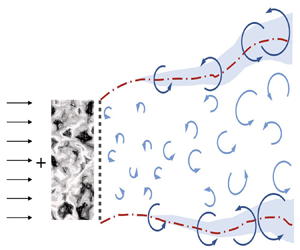
A permeable disk serves as a simplified model for the conversion of wind energy by a horizontal axis wind turbine. In this study, we investigate how inflow turbulence intensity (TI), $I_\infty$, and inflow turbulence integral length scale, $L_\infty$, influence the flow recovery in the wake, the capability of a permeable disk in extracting turbulence kinetic energy (TKE) of the incoming flow, and the statistics of wake-added turbulence using large-eddy simulation. The simulated inflows include various TIs (i.e. $I_\infty =2.5\,\%$– $25\,\%$) and integral length scales (i.e. $L_\infty / D =0.5$– $2.0$) for two thrust coefficients. Simulation results show that both inflow TI and integral length scale influence flow recovery via enhanced ejections and sweeps across the wake boundary, with the former strongly affecting the position where the wake starts to recover and the latter mainly on the recovery rate. Moreover, it is shown that increasing $I_\infty$ and $L_\infty$ increases the TKE extraction by the disk, occurring mainly at scales ( $s$) greater than $0.5D$ and frequencies depending on the inflow integral length scale. As for the wake-added TKE, the inflow TI mainly affects its intensity, while the inflow integral length scale affects both its intensity and the sensitive frequencies, with the spectral distributions in scale space ( $s$) being similar and the peak located around $s/D=1.0$ for the considered inflows.


Self-organization in collisionless, high-β turbulence
- Part of
-
- Journal:
- Journal of Plasma Physics / Volume 90 / Issue 6 / December 2024
- Published online by Cambridge University Press:
- 12 November 2024, 535900601
-
- Article
-
- You have access
- Open access
- HTML
- Export citation
-
The magnetohydrodynamic (MHD) equations, as a collisional fluid model that remains in local thermodynamic equilibrium (LTE), have long been used to describe turbulence in myriad space and astrophysical plasmas. Yet, the vast majority of these plasmas, from the solar wind to the intracluster medium (ICM) of galaxy clusters, are only weakly collisional at best, meaning that significant deviations from LTE are not only possible but common. Recent studies have demonstrated that the kinetic physics inherent to this weakly collisional regime can fundamentally transform the evolution of such plasmas across a wide range of scales. Here, we explore the consequences of pressure anisotropy and Larmor-scale instabilities for collisionless, $\beta \gg 1$
 , turbulence, focusing on the role of a self-organizational effect known as ‘magneto-immutability’. We describe this self-organization analytically through a high-$\beta$
 , reduced ordering of the Chew–Goldberger–Low-MHD (CGL-MHD) equations, finding that it is a robust inertial-range effect that dynamically suppresses magnetic-field-strength fluctuations, anisotropic-pressure stresses and dissipation due to heat fluxes. As a result, the turbulent cascade of Alfvénic fluctuations continues below the putative viscous scale to form a robust, nearly conservative, MHD-like inertial range. These findings are confirmed numerically via Landau-fluid CGL-MHD turbulence simulations that employ a collisional closure to mimic the effects of microinstabilities. We find that microinstabilities occupy a small (${\sim }5\,\%$
 ) volume-filling fraction of the plasma, even when the pressure anisotropy is driven strongly towards its instability thresholds. We discuss these results in the context of recent predictions for ion-vs-electron heating in low-luminosity accretion flows and observations implying suppressed viscosity in ICM turbulence.


Exact boundary-value solution for an electromagnetic wave propagating in a linearly varying index of refraction
- Part of
-
- Journal:
- Journal of Plasma Physics / Volume 90 / Issue 6 / December 2024
- Published online by Cambridge University Press:
- 12 November 2024, 995900602
-
- Article
-
- You have access
- Open access
- HTML
- Export citation
-
The propagation of electromagnetic waves in a linearly varying index of refraction is a fundamental problem in wave physics, being relevant in fusion science for describing certain wave-based heating and diagnostic schemes. Here, an exact solution is obtained for a given incoming wavefield specified on the boundary transverse to the direction of inhomogeneity by performing a spectral, rather than asymptotic, matching. Two case studies are then presented: a Gaussian beam at oblique incidence and a speckled wavefield at normal incidence. For the Gaussian beam, it is shown that when the waist $W$
 is sufficiently large, oblique incidence manifests simply as rigid translation and focal shift of the corresponding diffraction pattern at normal incidence. The destruction of the hyperbolic umbilic caustic (corresponding to a critically focused beam) as $W$
 is reduced is then demonstrated. The caustic disappears once $W \lesssim \delta _a \sqrt {L}$
 ($L$
($L$ being the medium length scale normalized by the Airy skin depth $\delta _a$
 ), at which point the wave behaviour is increasingly described by Airy functions, but experiences less focusing as a result. To maximize the intensity of a launched Gaussian beam at a turning point, one should therefore minimize the imaginary part of the launched complex beam parameter while having the real part satisfy critical focusing. For the speckled wavefield, it is shown that the transverse speckle pattern only couples to the Airy longitudinal pattern when the coupling parameter $\eta = \sqrt {L}/f_{\#}$
 is large, with $f_{\#}$
 being the f-number of the launching aperture. When $\eta \ll 1$
 , a reduced description of the total wavefield can be obtained by simply multiplying the incoming speckle pattern with the Airy swelling.


Classical-quantum simulation of non-equilibrium Marshak waves
- Part of
-
- Journal:
- Journal of Plasma Physics / Volume 90 / Issue 6 / December 2024
- Published online by Cambridge University Press:
- 12 November 2024, 805900601
-
- Article
-
- You have access
- Open access
- HTML
- Export citation
Control of roughness-induced transition in supersonic flows by local wall heating strips
-
- Journal:
- Journal of Fluid Mechanics / Volume 999 / 25 November 2024
- Published online by Cambridge University Press:
- 12 November 2024, A16
-
- Article
- Export citation

Mass transport modelling of two partially miscible, multicomponent fluids in nanoporous media
-
- Journal:
- Journal of Fluid Mechanics / Volume 999 / 25 November 2024
- Published online by Cambridge University Press:
- 12 November 2024, A21
-
- Article
- Export citation

Towards a new roughness parametrization through the effective distribution function
-
- Journal:
- Journal of Fluid Mechanics / Volume 999 / 25 November 2024
- Published online by Cambridge University Press:
- 12 November 2024, A26
-
- Article
-
- You have access
- Open access
- HTML
- Export citation
-
Turbulent flows over rough surfaces can be encountered in a wide range of engineering applications. Despite the progress made after several decades of studies, the prediction of drag and roughness function from the surface geometrical parameters remains an open question. Several methods have shown encouraging results. However, they lack generality and present some scatter in the data. In this paper we propose a new parameter, the effective distribution ( $ED$), which lays foundation on the effective slope with some changes to take into account the sheltering effect of large roughness elements and the drag induced by pinnacles higher than the average roughness elements. To develop this new correlation between geometrical features of the wall and the drag, we performed a set of simulations of the turbulent flow over a rough surface made of triangular elements varying their height and spatial distribution. The $ED$ correlates quite well both with the drag and the roughness function for a wide range of cases having different mean roughness height, skewness and kurtosis. To further validate the $ED$, and assessing how it can be generalized to real rough wall, an irregular wall made from the superposition of random sinusoidal function was considered. Results were consistent with the correlation here presented.


Enhancing tip vortices to improve the lift production through shear layers in flapping-wing flow control
-
- Journal:
- Journal of Fluid Mechanics / Volume 999 / 25 November 2024
- Published online by Cambridge University Press:
- 12 November 2024, A25
-
- Article
- Export citation
-
Flow control of a low-aspect-ratio flat-plate heaving wing at an average angle of attack of $10^{\circ }$ by a steady-blowing jet is numerically studied by using a feedback immersed boundary–lattice Boltzmann method. Blowing jets at the leading edge, mid-chord and trailing edge are considered. The wing enjoys the highest lift production with the trailing-edge downstream blowing jet, which improves the average lift by 50.0 % at $Re = 1000$ and 22.9 % at $Re = 5000$ through the enhancement of the tip vortex circulation caused by the increase in the mass flux of the shear layer at the wing tips. This increase in mass flux decreases as $Re$ increases from 1000 to 5000 due to its self-limiting mechanism. A mid-chord vertical blowing jet induces a middle vortex which enhances the lift production but the enhancement is smaller than that of trailing-edge downstream blowing jet. Other jet arrangements do not significantly increase the lift coefficient, but the mid-chord upstream blowing jet experiences a significant reduction in the drag coefficient, leading to an increase of 50.6 % in the average lift-to-drag ratio. The effectiveness of the flow control is not significantly affected by the aspect ratio.


A momentum-conserving wake superposition method for wind-farm flows under pressure gradient
-
- Journal:
- Journal of Fluid Mechanics / Volume 999 / 25 November 2024
- Published online by Cambridge University Press:
- 12 November 2024, A27
-
- Article
- Export citation
Response of a relativistically streaming pulsar plasma
-
- Journal:
- Journal of Plasma Physics / Volume 90 / Issue 6 / December 2024
- Published online by Cambridge University Press:
- 12 November 2024, 905900601
-
- Article
-
- You have access
- Open access
- HTML
- Export citation

Internal gravity waves in flow past a bluff body under different levels of stratification
-
- Journal:
- Journal of Fluid Mechanics / Volume 999 / 25 November 2024
- Published online by Cambridge University Press:
- 12 November 2024, A23
-
- Article
-
- You have access
- Open access
- HTML
- Export citation
-
The flow field of a bluff body, a circular disk, that moves horizontally in a stratified environment is studied using large-eddy simulations. Five levels of stratification (body Froude numbers of ${{Fr}} = 0.5, 1, 1.5, 2$ and $5$) are simulated at Reynolds number of ${{Re}} = 5000$ and Prandtl number of $Pr =1$. A higher ${{Re}} = 50\,000$ database at ${{Fr}} = 2, 10$ and $Pr =1$ is also examined for comparison. The wavelengths and amplitudes of steady lee waves are compared with a linear-theory analysis. Excellent agreement is found over the entire range of ${{Fr}}$ if an ‘equivalent body’ that includes the separation region is employed for the linear theory. For asymptotically large distances, the velocity amplitude varies theoretically as ${{Fr}}^{-1}$ but a correction owing to the dependence of the separation zone on ${{Fr}}$ is needed. The wake waves propagate in a narrow band of angles with the vertical, and have a wavelength that increases with increasing ${{Fr}}$. The envelope of wake waves, demarcated using buoyancy variance, exhibits self-similar behaviour. The higher ${{Re}}$ results are consistent with the buoyancy effects exhibited at the lower ${{Re}}$. The wake wave energy is larger at ${{Re}} = 50\,000$. Nevertheless, independent of ${{Fr}}$ and ${{Re}}$, the ratio of the wake wave potential energy to the wake turbulent energy increases to approximately 0.6–0.7 in the non-equilibrium stage showing their energetic importance besides suggesting universality in this statistic. There is a crossover of energetic dominance of lee waves at ${{Fr}} <2$ to wake-wave dominance at ${{Fr}} \approx 5$.


Temperature anisotropy instabilities driven by intermittent velocity shears in the solar wind
- Part of
-
- Journal:
- Journal of Plasma Physics / Volume 90 / Issue 6 / December 2024
- Published online by Cambridge University Press:
- 12 November 2024, 905900602
-
- Article
-
- You have access
- Open access
- HTML
- Export citation
Interplay of the magnetic and current density field topologies in axisymmetric devices for magnetic confinement fusion
-
- Journal:
- Journal of Plasma Physics / Volume 90 / Issue 6 / December 2024
- Published online by Cambridge University Press:
- 12 November 2024, 175900601
-
- Article
-
- You have access
- Open access
- HTML
- Export citation
-
In magnetic confinement fusion devices close to axisymmetry, such as tokamaks, a key element is the winding profile of the magnetic field lines, or its inverse, the safety profile $q=q_{\boldsymbol {B}}$
 . A corresponding profile, $q_{\boldsymbol {J}}$
 , can be defined for the current density field lines. Ampère's law relates any mode of current perturbation $\delta \boldsymbol {J}_{m,n}$
 with a mode of magnetic perturbation $\delta \boldsymbol {B}_{m,n}$
 . It is shown that the knowledge of the pair $(q_{\boldsymbol {B}},q_{\boldsymbol {J}})$
 allows us then to characterize the resonant, or non-resonant, nature of the modes for both the magnetic and current density field lines. The expression of $q_{\boldsymbol {J}}$
 in the flux coordinate is derived. Including this calculation in real-time Grad–Shafranov equilibrium reconstruction codes would yield a comprehensive view of the magnetics. The monitoring of the pair $(q_{\boldsymbol {B}},q_{\boldsymbol {J}})$
 would then allow us to investigate the role played by the resonant modes for the current density, that are current filamentary modes, in the plasma small-scale turbulence. By driving the magnetic and current density profiles apart so that the images of $q_{\boldsymbol {B}}$
 and $q_{\boldsymbol {J}}$
 are disjoint, these filamentary modes would not impact the magnetic field topology, being not associated with magnetic islands but with non-resonant magnetic modes. It remains to be explored to what extent such a configuration, where the spectrum of tiny current density filaments produces a spectrum of magnetic modes that has practically no effect on heat transport, is beneficial.


On the interaction between a rising bubble and a settling particle
-
- Journal:
- Journal of Fluid Mechanics / Volume 999 / 25 November 2024
- Published online by Cambridge University Press:
- 12 November 2024, A18
-
- Article
-
- You have access
- Open access
- HTML
- Export citation

Dynamic characteristic of transonic aeroelasticity affected by fluid mode in pre-buffet flow
-
- Journal:
- Journal of Fluid Mechanics / Volume 999 / 25 November 2024
- Published online by Cambridge University Press:
- 12 November 2024, A24
-
- Article
- Export citation
Penetration of a spherical vortex into turbulence
-
- Journal:
- Journal of Fluid Mechanics / Volume 999 / 25 November 2024
- Published online by Cambridge University Press:
- 12 November 2024, A17
-
- Article
-
- You have access
- Open access
- HTML
- Export citation
-
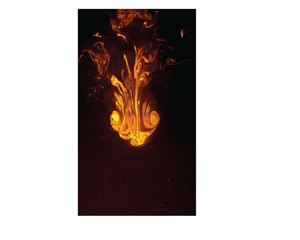
The penetration of a spherical vortex into turbulence is studied theoretically and experimentally. The characteristics of the vortex are first analysed from an integral perspective that reconciles the far-field dipolar flow with the near-field source flow. The influence of entrainment on the vortex drag force is elucidated, extending the Maxworthy (J. Fluid Mech., vol. 81, 1977, pp. 465–495) model to account for turbulent entrainment into the vortex movement and vortex penetration into an evolving turbulent field. The physics are explored numerically using a spherical vortex (initial radius $R_0$, speed $U_{v0}$), characterised by a Reynolds number $Re_0(=2R_0U_{v0}/\nu$, where $\nu$ is the kinematic viscosity) of 2000, moving into decaying homogeneous turbulence (root-mean-square $u_0$, integral scale $L$) with turbulent intensity $I_t=u_0/U_{v0}$. When the turbulence is absent ( $I_t=0$), a wake volume flux leads to a reduction of vortex impulse that causes the vortex to slow down. In the presence of turbulence ( $I_t> 0$), the loss of vortical material is enhanced and the vortex speed decreases until it is comparable to the local turbulent intensity and quickly fragments, penetrating a distance that scales as $I_t^{-1}$. In the experimental study, a vortex ( $Re_0\sim 1490\unicode{x2013}5660$) propagating into a statistically steady, spatially varying turbulent field ( $I_{ve}=0.02$ to 0.98). The penetration distance is observed to scale with the inverse of the turbulent intensity. Incorporating the spatially and temporally varying turbulent fields into the integral model gives a good agreement with the predicted trend of the vortex penetration distance with turbulent intensity and insight into its dependence on the structure of the turbulence.


Impact of a free normal velocity boundary on the modelling of external MHD modes
- Part of
-
- Journal:
- Journal of Plasma Physics / Volume 90 / Issue 6 / December 2024
- Published online by Cambridge University Press:
- 12 November 2024, 995900601
-
- Article
-
- You have access
- Open access
- HTML
- Export citation
High-repetition-rate strong-field terahertz source by optical rectification in DSTMS crystals
-
- Journal:
- High Power Laser Science and Engineering / Volume 12 / 2024
- Published online by Cambridge University Press:
- 12 November 2024, e61
-
- Article
-
- You have access
- Open access
- HTML
- Export citation
Revisiting the mysterious origin of FRB 20121102A with machine-learning classification
-
- Journal:
- Publications of the Astronomical Society of Australia / Volume 41 / 2024
- Published online by Cambridge University Press:
- 12 November 2024, e090
-
- Article
- Export citation
Cavitation dynamics in creeping flow
-
- Journal:
- Journal of Fluid Mechanics / Volume 999 / 25 November 2024
- Published online by Cambridge University Press:
- 12 November 2024, A19
-
- Article
-
- You have access
- Open access
- HTML
- Export citation
-
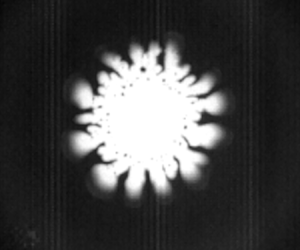
We investigate the heterogeneous cavitation phenomenon in water when a spherical surface is abruptly separated from a nearby flat substrate, at a distance of approximately 10 nm. By tracking the surface separation using Newton ring positions, and capturing the bubble evolution with a high-speed camera on a microscope, we compare our experimental findings with hydrodynamic predictions at low Reynolds numbers. Upon upward movement of the spherical surface, the resulting bubble develops branched fingers through the Saffman–Taylor instability. Simultaneously, negative liquid pressures in the range $\sim$10 atm are observed. These large tension values occasionally lead to secondary nucleation events. The bubble sizes satisfy a predicted Family–Vicsek scaling law where the bubble area is proportional to the inverse bubble lifetime. The fact that creeping flow cavitation bubbles are more short-lived the larger they are separates them from bubbles that are governed by inertial dynamics.

