Refine search
Actions for selected content:
238160 results in Physics and Astronomy
Dynamic hysteresis of an oscillatory contact line
-
- Journal:
- Journal of Fluid Mechanics / Volume 1000 / 10 December 2024
- Published online by Cambridge University Press:
- 25 November 2024, A34
-
- Article
-
- You have access
- Open access
- HTML
- Export citation
Turbulence distortion and blockage in the induction zone of a horizontal axis turbine
-
- Journal:
- Journal of Fluid Mechanics / Volume 1000 / 10 December 2024
- Published online by Cambridge University Press:
- 25 November 2024, A25
-
- Article
-
- You have access
- Open access
- HTML
- Export citation
A universal scaling for the length scales of shock-induced separation
-
- Journal:
- Journal of Fluid Mechanics / Volume 1000 / 10 December 2024
- Published online by Cambridge University Press:
- 25 November 2024, A5
-
- Article
- Export citation
-
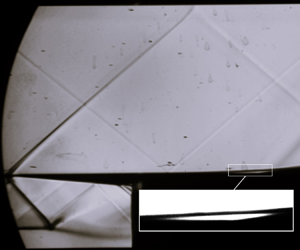
Experiments of transitional shock wave–boundary layer interactions (SBLIs) over 6 $^\circ$ and 10 $^\circ$ compression ramps were performed at Mach number 1.65. The unit Reynolds number was varied by a factor of two between 5.6 million per metre and 11 million per metre. Schlieren flow visualization was performed, and mean flow measurements were made using Pitot probes. Free interaction theory was verified from pressure measurements for all operating conditions. A new non-dimensional parameter was developed for scaling the strength of the imposed shock, which was based on the pressure required to separate a boundary layer. The validity of this new scaling was supported by the reconciliation of large discrepancies in a diverse collection of experimental results on the length scales of transitional interactions. This non-dimensional scaling was also applied to turbulent interactions, where different models were used to determine the pressure required to separate a turbulent boundary layer. Finally, a direct comparison between transitional and turbulent SBLIs was made, which revealed new insights into the evolution of length scales based on the state of the boundary layer.


Swirling instability of viscous liquid jets with axial shear effect in gas surroundings
-
- Journal:
- Journal of Fluid Mechanics / Volume 1000 / 10 December 2024
- Published online by Cambridge University Press:
- 25 November 2024, A32
-
- Article
- Export citation
Active wake-flow control for a notchback Ahmed body driven by a genetically inspired optimization
-
- Journal:
- Journal of Fluid Mechanics / Volume 1000 / 10 December 2024
- Published online by Cambridge University Press:
- 25 November 2024, A20
-
- Article
-
- You have access
- Open access
- HTML
- Export citation
A search for 3-mm molecular absorption line transitions in the magellanic stream
-
- Journal:
- Publications of the Astronomical Society of Australia / Volume 41 / 2024
- Published online by Cambridge University Press:
- 25 November 2024, e094
-
- Article
-
- You have access
- Open access
- HTML
- Export citation
-
The Magellanic Stream (MS), a tail of diffuse gas formed from tidal and ram pressure interactions between the Small and Large Magellanic Clouds (SMC and LMC) and the Halo of the Milky Way, is primarily composed of neutral atomic hydrogen (HI). The deficiency of dust and the diffuse nature of the present gas make molecular formation rare and difficult, but if present, could lead to regions potentially suitable for star formation, thereby allowing us to probe conditions of star formation similar to those at high redshifts. We search for $\text{HCO}^{+}$, HCN, HNC, and C $_2$H using the highest sensitivity observations of molecular absorption data from the Atacama Large Millimeter Array (ALMA) to trace these regions, comparing with HI archival data from the Galactic Arecibo L-Band Feed Array (GALFA) HI Survey and the Galactic All Sky Survey (GASS) to compare these environments in the MS to the HI column density threshold for molecular formation in the Milky Way. We also compare the line of sight locations with confirmed locations of stars, molecular hydrogen, and OI detections, though at higher sensitivities than the observations presented here.
We find no detections to a 3 $\sigma$ significance, despite four sightlines having column densities surpassing the threshold for molecular formation in the diffuse regions of the Milky Way. Here we present our calculations for the upper limits of the column densities of each of these molecular absorption lines, ranging from $3 \times 10^{10}$ to $1 \times 10^{13}$ cm $^{-2}$. The non-detection of $\text{HCO}^{+}$ suggests that at least one of the following is true: (i) $X_{\text{HCO}^{+}{}, \mathrm{MS}}$ is significantly lower than the Milky Way value; (ii) that the widespread diffuse molecular gas observed by Rybarczyk (2022b, ApJ, 928, 79) in the Milky Way’s diffuse interstellar medium (ISM) does not have a direct analogue in the MS; (iii) the HI-to- $\text{H}_{2}$ transition occurs in the MS at a higher surface density in the MS than in the LMC or SMC; or (iv) molecular gas exists in the MS, but only in small, dense clumps.


Microbial growth within porous gravity currents
-
- Journal:
- Journal of Fluid Mechanics / Volume 1000 / 10 December 2024
- Published online by Cambridge University Press:
- 25 November 2024, A24
-
- Article
-
- You have access
- Open access
- HTML
- Export citation
Tunable drag drop via flow-induced snap-through in origami
-
- Journal:
- Journal of Fluid Mechanics / Volume 1000 / 10 December 2024
- Published online by Cambridge University Press:
- 25 November 2024, A8
-
- Article
- Export citation

From Stars to Life
- A Quantitative Approach to Astrobiology
-
- Published online:
- 22 November 2024
- Print publication:
- 05 December 2024

Steven Weinberg: A Life in Physics
-
- Published online:
- 22 November 2024
- Print publication:
- 12 December 2024

Active Particles Methods in Economics
- New Perspectives in the Interaction between Mathematics and Economics
-
- Published online:
- 22 November 2024
- Print publication:
- 02 January 2025
-
- Element
- Export citation

These things take time: the first 1000 volumes of the Journal of Fluid Mechanics
-
- Journal:
- Journal of Fluid Mechanics / Volume 1000 / 10 December 2024
- Published online by Cambridge University Press:
- 22 November 2024, E1
-
- Article
-
- You have access
- Open access
- HTML
- Export citation

The establishment of JFM Perspectives
-
- Journal:
- Journal of Fluid Mechanics / Volume 1000 / 10 December 2024
- Published online by Cambridge University Press:
- 22 November 2024, E5
-
- Article
-
- You have access
- Open access
- HTML
- Export citation
Modelling of the electron cyclotron emission burst from a laboratory tokamak plasma with loss-cone maser instability
- Part of
-
- Journal:
- Journal of Plasma Physics / Volume 90 / Issue 6 / December 2024
- Published online by Cambridge University Press:
- 22 November 2024, 985900601
-
- Article
-
- You have access
- Open access
- HTML
- Export citation
-
The maser instability associated with the loss-cone distribution has been widely invoked to explain the radio bursts observed in the astrophysical plasma environment, such as aurora and corona. In the laboratory plasma of a tokamak, events reminiscent of these radio bursts have also been frequently observed as an electron cyclotron emission (ECE) burst in the microwave range ($\mathrm{\sim }2{f_{\textrm{ce}}}$
 near the last closed flux surface) during transient magnetohydrodynamic events. These bursts have a short duration of ~10 μs and display a radiation spectrum corresponding to a radiation temperature ${T_{e,\textrm{rad}}}$
 of over $30\ \textrm{keV}$
 while the edge thermal electron temperature ${T_e}$
 is only in the range of $1\ \textrm{keV}$
 . Suprathermal electrons can be generated through magnetic reconnection, and a loss-cone distribution can be generated through open stochastic field lines in the magnetic mirror of the near-edge region of a tokamak plasma. Radiation modelling shows that a sharp distribution gradient $\partial f/\partial {v_ \bot } > 0$
 at the loss-cone boundary can cause a negative absorption of ECE radiation through the maser instability. The negative absorption then amplifies the radiation so that the microwave intensity is significantly stronger than the thermal value. The significant ${T_{e,\textrm{rad}}}$
 from the simulations suggests the potential role of the loss-cone maser instability in generating the ECE burst in a tokamak.


Experimental investigation of velocity and temperature distribution inside single droplet impingement on a heated substrate
-
- Journal:
- Journal of Fluid Mechanics / Volume 999 / 25 November 2024
- Published online by Cambridge University Press:
- 22 November 2024, A93
-
- Article
- Export citation
Forward ion acceleration by laser-driven collisionless filamentary shocks in underdense plasmas
-
- Journal:
- Laser and Particle Beams / Volume 42 / 2024
- Published online by Cambridge University Press:
- 22 November 2024, e4
-
- Article
-
- You have access
- Open access
- HTML
- Export citation
Asking the right questions on Rayleigh–Bénard turbulence
-
- Journal:
- Journal of Fluid Mechanics / Volume 1000 / 10 December 2024
- Published online by Cambridge University Press:
- 22 November 2024, F3
-
- Article
-
- You have access
- Open access
- HTML
- Export citation
-
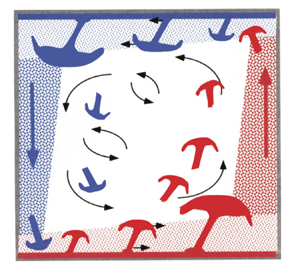
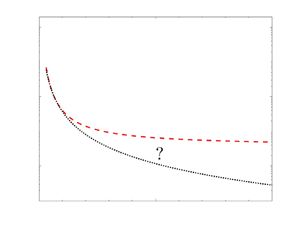
The paper by Castaing et al. (J. Fluid Mech., vol. 204, 1989, pp. 1–30) on turbulent Rayleigh–Bénard convection has been one of the most impactful papers on the subject – not by giving the right and complete answers but by developing versatile concepts and by asking the right questions, namely: (i) What is the overall flow organization? (ii) What is the dependence of the Nusselt number ${\textit {Nu}}$ (the dimensionless heat transport) on the Rayleigh number ${\textit {Ra}}$ (the thermal driving strength)? (iii) What is the ultimate state of turbulence for extremely large ${\textit {Ra}}$? Thanks to Castaing et al. having asked the right questions, the field has made tremendous progress over the last 35 years.


Log at first sight
-
- Journal:
- Journal of Fluid Mechanics / Volume 1000 / 10 December 2024
- Published online by Cambridge University Press:
- 22 November 2024, F6
-
- Article
-
- You have access
- HTML
- Export citation
Ultra-fast imaging reveals
-
- Journal:
- Journal of Fluid Mechanics / Volume 1000 / 10 December 2024
- Published online by Cambridge University Press:
- 22 November 2024, F8
-
- Article
-
- You have access
- Open access
- HTML
- Export citation
Wave scattering by an isolated cyclogeostrophic vortex
-
- Journal:
- Journal of Fluid Mechanics / Volume 999 / 25 November 2024
- Published online by Cambridge University Press:
- 22 November 2024, A100
-
- Article
-
- You have access
- Open access
- HTML
- Export citation
-
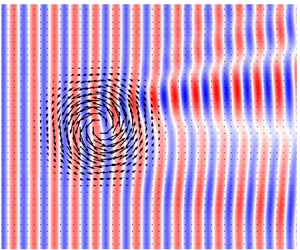
The propagation paths of oceanic internal tides are influenced by their interactions with vortices. We examine the scattering effect that an isolated vortex in (cyclo)geostrophic balance has on a rotating shallow-water plane wave. We run a suite of simulations in which we vary the non-dimensional vorticity of the vortex, $Ro$, the relative scale of the vortex size to the Rossby radius of deformation, $Bu$, and the size of the vortex compared with the plane wave wavelength, $K$. We compare the scattered wave flux pattern with ray-tracing predictions. Ray-tracing predictions are relatively insensitive to $K$ in the $1< K<4$ range we investigate; however, they generally underestimate the broad angles of the shallow-water wave scattering patterns, especially for the lower end of the $K$ range. We then measure the ratio of the scattered wave energy flux to the incoming wave energy flux, denoted by $S$, for each simulation. We find that $S$ follows a power law $S \propto (FrK)^2$ when $S < 0.2$, where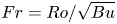 $Fr = Ro/\sqrt {Bu}$ is the Froude number. When $S>0.2$, it starts plateauing.


