Refine search
Actions for selected content:
238141 results in Physics and Astronomy
Fluid-mediated impact of soft solids
-
- Journal:
- Journal of Fluid Mechanics / Volume 997 / 25 October 2024
- Published online by Cambridge University Press:
- 14 October 2024, A35
-
- Article
-
- You have access
- Open access
- HTML
- Export citation
Free-surface-induced ground effect for flapping swimmers
-
- Journal:
- Journal of Fluid Mechanics / Volume 997 / 25 October 2024
- Published online by Cambridge University Press:
- 14 October 2024, A36
-
- Article
-
- You have access
- Open access
- HTML
- Export citation
-
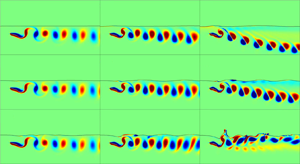
Numerous flying and swimming creatures use the ground effect to boost their propulsive performance, with the ‘ground’ referring to either a solid boundary or a free surface. While our knowledge of how a solid boundary affects biolocomotion is relatively comprehensive, the ground effect of a free surface is not fully understood. To address this limitation, we conduct a numerical investigation on the propulsion performance of a flapping plate under a free surface, subject to a range of control parameters. When the Froude number ( $Fr$) is very low (i.e. little surface deformation), the effects of a free surface are similar to those of a solid boundary, with enhanced thrust and input power but little change in efficiency. However, as $Fr$ increases (i.e. more surface deformation), our results reveal an optimal $Fr$ of approximately 0.6, where the free surface induces a more streamlined flow around the flapping plate, effectively reducing the added mass. This results in a significant decrease in input power and greatly enhanced efficiency.


On the linear response theory of vortex meandering and its statistical verification in experiments
-
- Journal:
- Journal of Fluid Mechanics / Volume 997 / 25 October 2024
- Published online by Cambridge University Press:
- 14 October 2024, A38
-
- Article
-
- You have access
- Open access
- HTML
- Export citation

A singularly altered streamline topology allows faster transport from deformed drops
-
- Journal:
- Journal of Fluid Mechanics / Volume 997 / 25 October 2024
- Published online by Cambridge University Press:
- 14 October 2024, A39
-
- Article
- Export citation
-
We analyse the effect of drop-deformation-induced change in streamline topology on the scalar transport rate (the Nusselt number $Nu$) in an ambient planar linear flow. The drop-phase resistance is assumed dominant, and the drop deformation is characterised by the capillary number ( $Ca$). For a spherical drop ( $Ca = 0$) in an ambient planar extension, closed streamlines lead to $Nu$ increasing with the Péclet number ( $Pe$), from $Nu_0$, corresponding to purely diffusive transport, to $4.1Nu_0$, corresponding to a large- $Pe$ diffusion-limited plateau. For non-zero $Ca$, we show that the flow field consists of spiralling streamlines densely wound around nested tori foliating the deformed drop interior. Now $Nu$ increases beyond the aforementioned primary plateau, saturating in a secondary one that approaches $22.3Nu_0$ for $Ca \rightarrow 0$, $Pe\,Ca \rightarrow \infty$. The enhancement appears independent of the drop-to-medium viscosity ratio. We further show that this singular dependence, of the transport rate on drop deformation, is generic across planar linear flows; chaotically wandering streamlines in some of these cases may even lead to a tertiary enhancement regime.


Elasto-inertial focusing and rotating characteristics of ellipsoidal particles in a square channel flow of Oldroyd-B viscoelastic fluids
-
- Journal:
- Journal of Fluid Mechanics / Volume 997 / 25 October 2024
- Published online by Cambridge University Press:
- 14 October 2024, A32
-
- Article
- Export citation
Graph theoretic methods for assessing the effects of a background shear current on internal solitary waves
-
- Journal:
- Journal of Fluid Mechanics / Volume 997 / 25 October 2024
- Published online by Cambridge University Press:
- 14 October 2024, A37
-
- Article
-
- You have access
- Open access
- HTML
- Export citation
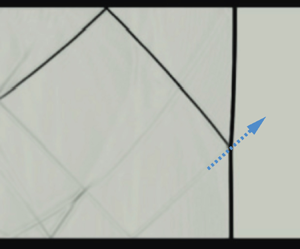
The dynamics of shock wave propagation far downstream of an abrupt area expansion
-
- Journal:
- Journal of Fluid Mechanics / Volume 997 / 25 October 2024
- Published online by Cambridge University Press:
- 14 October 2024, A30
-
- Article
-
- You have access
- Open access
- HTML
- Export citation
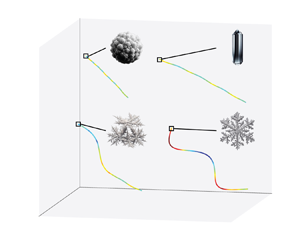
Field investigation of 3-D snow settling dynamics under weak atmospheric turbulence
-
- Journal:
- Journal of Fluid Mechanics / Volume 997 / 25 October 2024
- Published online by Cambridge University Press:
- 11 October 2024, A33
-
- Article
-
- You have access
- Open access
- HTML
- Export citation
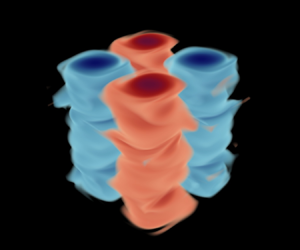
Zigzag instability of columnar Taylor–Green vortices in a strongly stratified fluid
-
- Journal:
- Journal of Fluid Mechanics / Volume 997 / 25 October 2024
- Published online by Cambridge University Press:
- 11 October 2024, A34
-
- Article
-
- You have access
- Open access
- HTML
- Export citation
-
We investigate the dynamics of a columnar Taylor–Green vortex array under strong stratification, focusing on Froude numbers $0.125\leq Fr \leq 1.0$, with the aim of identifying and understanding the primary instabilities that lead to the vortices’ breakdown. Linear stability analysis reveals that the fastest-growing vertical wavenumber scales with $Fr^{-1}$, while the dimensionless growth rate remains approximately constant. The most unstable eigenmode, identified as the mixed hyperbolic mode by Hattori et al. (J. Fluid Mech., vol. 909, 2021, A4), bears significant similarities to the zigzag instability, first discovered by Billant & Chomaz (J. Fluid Mech., vol. 418, 2000, pp. 167–188). Direct numerical simulations further confirm that the zigzag instability is crucial in amplifying initial random perturbations to finite amplitude, with the flow structure and modal growth rate consistent with the linear stability analysis. In particular, the characteristic vertical length scale of turbulence matches that of the fastest-growing linear mode. These findings underscore the broader relevance of the zigzag instability mechanism beyond its initial discovery in vortex pairs, demonstrating its role in facilitating direct energy transfer from vertically uniform vortical motions to a characteristic vertical length scale proportional to $Fr$ in strongly stratified flows.


FLM volume 993 Cover and Front matter
-
- Journal:
- Journal of Fluid Mechanics / Volume 993 / 25 August 2024
- Published online by Cambridge University Press:
- 10 October 2024, p. f1
-
- Article
-
- You have access
- Export citation
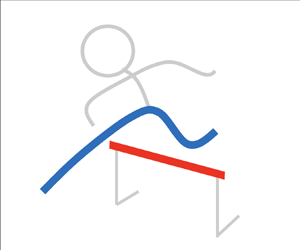
A sufficient condition for inviscid shear instability: hurdle theorem and its application to alternating jets
-
- Journal:
- Journal of Fluid Mechanics / Volume 997 / 25 October 2024
- Published online by Cambridge University Press:
- 10 October 2024, A25
-
- Article
-
- You have access
- Open access
- HTML
- Export citation
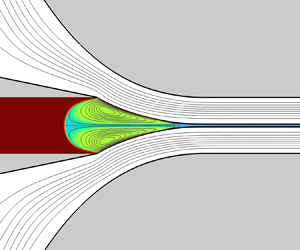
Global stability analysis of hydrodynamic focusing in the presence of a soluble surfactant
-
- Journal:
- Journal of Fluid Mechanics / Volume 997 / 25 October 2024
- Published online by Cambridge University Press:
- 10 October 2024, A23
-
- Article
-
- You have access
- Open access
- HTML
- Export citation
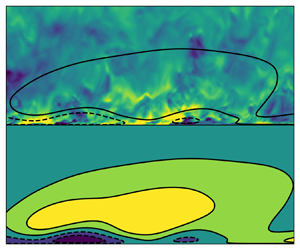
Large-scale coherent structures in turbulent channel flow: a detuned instability of wall streaks
-
- Journal:
- Journal of Fluid Mechanics / Volume 997 / 25 October 2024
- Published online by Cambridge University Press:
- 10 October 2024, A18
-
- Article
- Export citation
-
In this paper it is shown that a modal detuned instability of periodic near-wall streaks originates a large-scale structure in the bulk of the turbulent channel flow. The effect of incoherent turbulent fluctuations is included in the linear operator by means of an eddy viscosity. The base flow is an array of periodic two-dimensional streaks, extracted from numerical simulations in small domains, superposed to the turbulent mean profile. The stability problem for a large number of periodic units is efficiently solved using the block-circulant matrix method proposed by Schmid et al. (Phys. Rev. Fluids, vol. 2, 2017, 113902). For friction Reynolds numbers equal or higher than $590$, it is shown that an unstable branch is present in the eigenspectra. The most unstable eigenmodes display large-scale modulations whose characteristic wavelengths are compatible with the large-scale end of the premultiplied velocity fluctuation spectra reported in previous computational studies. The wall-normal location of the large-wavelength near-wall peak in the spanwise spectrum of the eigenmode exhibits a power-law dependence on the friction Reynolds number, similarly to that found in experiments of pipes and boundary layers. Lastly, the shape of the eigenmode in the streamwise-wall-normal plane is reminiscent of the superstructures reported in the recent experiments of Deshpande et al. (J. Fluid Mech., vol. 969, 2023, A10). Therefore, there is evidence that such large-wavelength instabilities generate large-scale motions in wall-bounded turbulent flows.

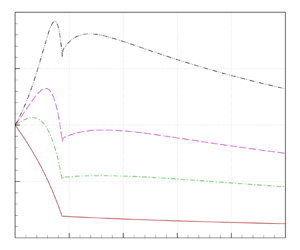
Hypersonic boundary layer theory in the symmetry plane of blunt bodies
-
- Journal:
- Journal of Fluid Mechanics / Volume 997 / 25 October 2024
- Published online by Cambridge University Press:
- 10 October 2024, A21
-
- Article
-
- You have access
- Open access
- HTML
- Export citation
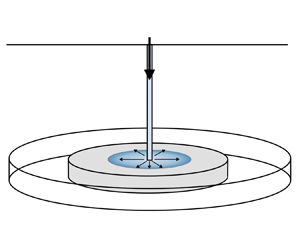
Transient Joule–Thomson cooling during CO2 injection in depleted reservoirs
-
- Journal:
- Journal of Fluid Mechanics / Volume 997 / 25 October 2024
- Published online by Cambridge University Press:
- 10 October 2024, A31
-
- Article
-
- You have access
- Open access
- HTML
- Export citation
-
The injection of ${\rm CO}_2$ into depleted reservoirs carries the potential for significant Joule–Thomson cooling, when dense, supercritical ${\rm CO}_2$ is injected into a strongly under-pressured reservoir. The resulting low temperatures around the wellbore risk causing thermal fracturing of the well/near-well region or causing freezing of pore waters or formation of gas hydrates which would reduce injectivity and jeopardise well and reservoir integrity. These risks are particularly acute during injection start-up when ${\rm CO}_2$ is in the gas stability field. In this paper we present a model of non-isothermal single-phase flow in the near-wellbore region. We show that during radial injection, with fixed mass injection rate, transient Joule–Thomson cooling can be described by similarity solutions at early times. The positions of the ${\rm CO}_2$ and thermal fronts are described by self-similar scaling relations. We show that, in contrast to steady-state flow, transient flow causes slight heating of ${\rm CO}_2$ and reservoir gas either side of the thermal front, as pressure diffuses into the reservoir. The scaling analysis here identifies the parametric dependence of Joule–Thomson cooling. We present a sensitivity analysis which demonstrates that the primary controls on the degree of cooling are reservoir permeability, reservoir thickness, injection rate and Joule–Thomson coefficient. The analysis presented provides a computationally efficient approach for assessing the degree of Joule–Thomson cooling expected during injection start-up, providing a complement to complex, fully resolved numerical simulations.


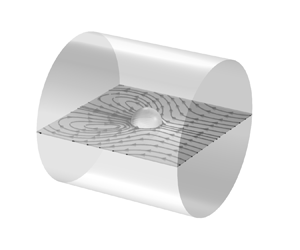
Net flow of charge-asymmetric electrolytes through uncharged channels and over uncharged spheres due to direct-current electroosmosis
-
- Journal:
- Journal of Fluid Mechanics / Volume 997 / 25 October 2024
- Published online by Cambridge University Press:
- 10 October 2024, A28
-
- Article
-
- You have access
- Open access
- HTML
- Export citation
FLM volume 994 Cover and Front matter
-
- Journal:
- Journal of Fluid Mechanics / Volume 994 / 10 September 2024
- Published online by Cambridge University Press:
- 10 October 2024, p. f1
-
- Article
-
- You have access
- Export citation
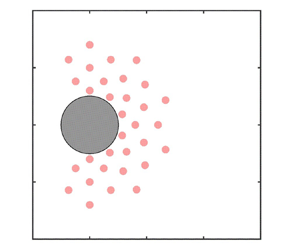
Active control of the flow past a circular cylinder using online dynamic mode decomposition
-
- Journal:
- Journal of Fluid Mechanics / Volume 997 / 25 October 2024
- Published online by Cambridge University Press:
- 10 October 2024, A26
-
- Article
- Export citation
-
This study explores the implementation of an online control strategy based on dynamic mode decomposition in the context of flow control. The investigation is conducted mainly with a fixed Reynolds number of $Re = 100$, focusing on the flow past a circular cylinder constrained between two walls to mitigate vortex shedding. The control approach involves the activation of two synthetic jets on the cylinder through blowing and suction. Velocity fluctuations in the wake, specifically in the $x$-direction, are harnessed to ascertain the mass flow rate of the jets using the linear quadratic regulator and online dynamic mode decomposition. The study systematically assesses the control performance across various configurations, including different values of the input penalty factor ${\boldsymbol {R}}$, varying numbers of probes and distinct probe arrangement methods. The synthetic jets prove effective in stabilising the separation bubble, and their interaction with the unsteady wake leads to a notable reduction in drag force, its fluctuations and the amplitude of the lift force. Specifically, the mean and standard deviation of the drag coefficient witness reductions of $7.44\,\%$ and $96.67\,\%$, respectively, and the standard deviation of the lift coefficient experiences an impressive reduction of $85.18\,\%$. The robustness of the proposed control method has also been tested on two more complicated cases, involving unsteady incoming flows with multiple frequency components. Comparatively, the methodology employed in this paper yields results akin to those obtained through deep reinforcement learning in terms of control effectiveness. However, a noteworthy advantage lies in the substantial reduction of computational resource consumption, highlighting the efficiency of the proposed approach.


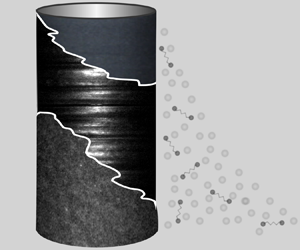
Elasto-inertial dissipation in particle-laden viscoelastic Taylor–Couette flow
-
- Journal:
- Journal of Fluid Mechanics / Volume 997 / 25 October 2024
- Published online by Cambridge University Press:
- 10 October 2024, A19
-
- Article
- Export citation
-
Many natural and industrial processes involve the flow of fluids made of solid particles suspended in non-Newtonian liquid matrices, which are challenging to control due to the fluid's nonlinear rheology. In the present work, a Taylor–Couette canonical system is used to investigate the flow of dilute to semi-dilute suspensions of neutrally buoyant spherical particles in highly elastic base polymer solutions. Friction measurement synchronized with direct flow visualization are combined to characterize the critical conditions for the onset of elasto-inertial instabilities, expected here as a direct transition to elasto-inertial turbulence (EIT). Adding a low particle volume fraction ( ${\leq }2\,\%$, dilute regime) does not affect the nature of the primary transition and reduces the critical Weissenberg number for the onset of EIT, despite a significant decrease in the apparent fluid elasticity. However, for particle volume fractions ${\geq }6\,\%$ (semi-dilute regime), EIT is no longer observed in the explored Reynolds range, suggesting an apparent relaminarization with yet not further decrease in fluid elasticity. Instead, a new regime, termed here elasto-inertial dissipative (EID), was uncovered. It originates from particle–particle interactions altering particle–polymer interactions and occurring under elasto-inertial conditions comparable to those of EIT. Increasing particle volume fraction in the semi-dilute regime and, in so, the particle contribution to the overall viscosity, delays the onset of EID similarly to what was observed previously for EIT in lower elasticity fluids. After this onset, a decrease in the pseudo-Nusselt number observed with increasing inertia and particle-to-polymer concentration ratio confirms a particle-induced alteration of energy transfer in the flow.


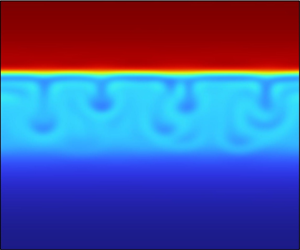
Phase segregation of a partially miscible binary mixture subjected to an external force field
-
- Journal:
- Journal of Fluid Mechanics / Volume 997 / 25 October 2024
- Published online by Cambridge University Press:
- 10 October 2024, A29
-
- Article
-
- You have access
- Open access
- HTML
- Export citation
