Refine search
Actions for selected content:
238141 results in Physics and Astronomy

The impact of finite span and wing-tip vortices on a turbulent NACA0012 wing
-
- Journal:
- Journal of Fluid Mechanics / Volume 997 / 25 October 2024
- Published online by Cambridge University Press:
- 22 October 2024, A68
-
- Article
-
- You have access
- Open access
- HTML
- Export citation
-
High-fidelity simulations are conducted to investigate the turbulent boundary layers around a finite-span NACA0012 wing with a rounded wing-tip geometry at a chord-based Reynolds number of $Re_c=200\,000$ and at various angles of attack up to $10^\circ$. The study aims to discern the differences between the boundary layers on the finite-span wing and those on infinite-span wings at equivalent angles of attack. The finite-span boundary layers exhibit: (i) an altered streamwise and a non-zero spanwise pressure gradient as a result of the variable downwash induced by the wing-tip vortices (an inviscid effect typical of finite-span wings); (ii) differences in the flow history at different wall-normal distances, caused by the variable flow angle in the wall-normal direction (due to constant pressure gradients and variable momentum normal to the wall); (iii) laminar flow entrainment into the turbulent boundary layers near the wing tip (due to a laminar–turbulent interface); and (iv) variations in boundary layer thickness across the span, attributed to the variable wall-normal velocity in that direction (a primarily inviscid effect). These physical effects are then used to explain the differences in the Reynolds stress profiles and other boundary layer quantities, including the reduced near-wall peak of the streamwise Reynolds stress and the elevated Reynolds stress levels near the boundary layer edge, both observed in the finite-span wings. Other aspects of the flow, such as the downstream development of wing-tip vortices and their interactions with the surrounding flow, are reserved for future investigations.


Stellarator optimization with constraints
- Part of
-
- Journal:
- Journal of Plasma Physics / Volume 90 / Issue 5 / October 2024
- Published online by Cambridge University Press:
- 22 October 2024, 905900501
-
- Article
-
- You have access
- Open access
- HTML
- Export citation
A necessary condition for breakeven in dipole-confined plasmas
-
- Journal:
- Journal of Plasma Physics / Volume 90 / Issue 5 / October 2024
- Published online by Cambridge University Press:
- 22 October 2024, 905900502
-
- Article
- Export citation
-
We have derived a necessary condition for the achievement of breakeven in axisymmetric plasmas with zero toroidal field and confined by a dipole magnetic field (B. Lehnert, Nature, vol. 181, 1958, p. 4605; A. Hasegawa, Comments Plasma Phys. Control. Fusion, vol. 11, no. 3, 1987). Excellent MHD stability, high values of $\beta$
 (up to $26$
 %) and good confinement properties awaken the interest of private investors after years of neglect due to lack of public funding and competing alternative lines of research like the tokamak. Starting from a requirement of self-consistency between the balances of momentum and energy in a dipole-confined, two-species plasma and assuming a Maxwellian distribution function for ions and electrons, we derive a necessary condition for breakeven. This condition is more stringent than the Lawson criterion because of the lack of a stabilizing toroidal field. For a given current flowing across the toroidal coil internal to the plasma, the crucial factor at stake is the ratio between the radius of the main toroidal coil and the radius of the vacuum chamber.


Limiting regimes of turbulent horizontal convection. Part 1. Intermediate and low Prandtl numbers
-
- Journal:
- Journal of Fluid Mechanics / Volume 997 / 25 October 2024
- Published online by Cambridge University Press:
- 21 October 2024, A5
-
- Article
-
- You have access
- Open access
- HTML
- Export citation
-
We report the existence of two new limiting turbulent regimes in horizontal convection (HC) using direct numerical simulations at intermediate to low Prandtl numbers. In our simulations, the flow is driven by a step-wise buoyancy profile imposed at the surface, with free-slip, no-flux conditions along all other boundaries, except along the spanwise direction, where periodicity is assumed. The flow is shown to transition to turbulence in the plume and the core, modifying the rate of heat and momentum transport. These transitions set a sequence of scaling laws that combine theoretical arguments from Shishkina, Grossmann and Lohse (SGL) and Hughes, Griffiths, Mullarney and Peterson (HGMP). The parameter range extends through Rayleigh numbers in the range [ $6.4\times 10^5, 1.92\times 10^{15}$] and Prandtl numbers in the range [ $2\times 10^{-3},2$]. At low Prandtl numbers and intermediate Rayleigh numbers, a core-driven regime is shown to follow a Nusselt-number scaling with $Ra^{1/6}Pr^{7/24}$. For Rayleigh numbers larger than $10^{14}$, the Nusselt number scales with $Ra^{0.225}Pr^{0.417}$. For these particular regimes, the Reynolds number is found to scale as $Ra^{2/5}Pr^{-3/5}$ for the low-Prandtl-number regime and $Ra^{1/3}Pr^{1}$ for Rayleigh numbers larger than $10^{14}$. These results embed the HGMP model in the SGL theory and extend the known regime diagram of HC at high Rayleigh numbers. In particular, we show that HC and Rayleigh–Bénard share similar turbulent characteristics at low Prandtl numbers, where HC is shown to be ruled by its core dynamics and turbulent boundary layers. This new scenario confirms that fully turbulent HC enhances the transport of heat and momentum with respect to previously reported regimes at high Rayleigh numbers. This work provides new insights into the applicability of HC for geophysical flows such as overturning circulations found in the atmosphere, the oceans, and flows near the Earth's inner core.


Representing turbulent statistics with partitions of state space. Part 1. Theory and methodology
-
- Journal:
- Journal of Fluid Mechanics / Volume 997 / 25 October 2024
- Published online by Cambridge University Press:
- 21 October 2024, A1
-
- Article
-
- You have access
- Open access
- HTML
- Export citation

Representing turbulent statistics with partitions of state space. Part 2. The compressible Euler equations
-
- Journal:
- Journal of Fluid Mechanics / Volume 997 / 25 October 2024
- Published online by Cambridge University Press:
- 21 October 2024, A2
-
- Article
-
- You have access
- Open access
- HTML
- Export citation

Limiting regimes of turbulent horizontal convection. Part 2. Large Prandtl numbers
-
- Journal:
- Journal of Fluid Mechanics / Volume 997 / 25 October 2024
- Published online by Cambridge University Press:
- 21 October 2024, A6
-
- Article
-
- You have access
- Open access
- HTML
- Export citation
-
Horizontal convection at large Rayleigh and Prandtl numbers is studied experimentally in a regime up to seven orders of magnitude larger in terms of Rayleigh numbers than previously achieved. To reach Rayleigh numbers up to $10^{17}$, the horizontal density gradient is generated using differential solutal convection by a differential input of salt and fresh water controlled by diffusion in a novel experiment in which the zero-net mass flux of water is ensured through permeable membranes. This set-up allows us to accurately measure the Nusselt number in solutal convection by carefully controlling the amount of salt water exchanged through the membranes. Combined measurements of density and velocity across more than five orders of magnitude in Rayleigh numbers show that the flow transitions from the Beardsley & Festa (J. Phys. Oceanogr., vol. 2, issue 4, 1972, pp. 444–455), Shishkina & Wagner (Phys. Rev. Lett., vol. 116, issue 2, 2016, 024302) regime to the Chiu-Webster et al. (J. Fluid Mech., vol. 611, 2008, pp. 395–426) regime and frames the present results within the scope of Shishkina et al. (Geophys. Res. Lett., vol. 43, issue 3, 2016, pp. 1219–1225), and the theory of Part 1 (Passaggia & Scotti, vol. 997, 2024, J. Fluid Mech., A5). In particular, we show that, even for large Prandtl numbers, the circulation eventually clusters underneath the forcing horizontal boundary, leaving a stratified core without motion. Finally, the previous regime diagrams (Hughes & Griffiths, Annu. Rev. Fluid Mech., vol. 40, 2008, pp. 185–208; Shishkina et al., Geophys. Res. Lett., vol. 43, issue 3, 2016, pp. 1219–1225) are extended by combining the present results at high Prandtl numbers, the results at low Prandtl numbers of Part 1, together with previous results from the literature. This work sets a new picture of the transition landscape of horizontal convection over six orders of magnitude in Prandtl number and sixteen orders of magnitude in Rayleigh number.

Reset controller synthesis: a correct-by-construction way to the design of CPS
-
- Journal:
- Research Directions: Cyber-Physical Systems / Volume 2 / 2024
- Published online by Cambridge University Press:
- 18 October 2024, e7
-
- Article
-
- You have access
- Open access
- HTML
- Export citation

Influence of large-scale free-stream turbulence on bypass transition in air and organic vapour flows
-
- Journal:
- Journal of Fluid Mechanics / Volume 997 / 25 October 2024
- Published online by Cambridge University Press:
- 18 October 2024, A56
-
- Article
- Export citation
-
The free-stream turbulence (FST) induced transition in perfect and non-ideal gas zero-pressure-gradient flat-plate boundary layers is investigated by means of large-eddy simulations. The study focuses on the influence of large incoming disturbances over the laminar-to-turbulent transition, by comparing two different integral length scales $L_f$, which differ by a factor of seven, at different FST intensities $T_u$. High-subsonic dense-gas boundary layers of the organic vapour Novec649, representative of organic Rankine cycle applications, are compared with air flows at Mach numbers 0.1 and 0.9. Compressibility and non-ideal gas effects are shown to be of minor importance in comparison to the influence of the FST integral length scale $L_f$. An increase of the inlet turbulent intensity always promotes transition, whereas an increase of $L_f$ has a double effect on the transition onset. At $T_u=2.5\,\%$, increasing $L_f$ promotes the transition, while it tends to delay transition for an FST intensity of 4 %. Larger FST integral scales tend to increase the spanwise distance between laminar streaks generated in the boundary layer. Two competing transition scenarios are observed. When the incoming turbulence intensity and length scale are moderate, the classical bypass route consists in the linear non-modal growth of streaks, which then experience secondary instabilities (sinuous or varicose) and lead to the generation of turbulent spots. The second scenario is characterized by the appearance of $\Lambda$-shaped structures near the inlet, which are further stretched to hairpin vortices before breaking down to turbulence. Spot inceptions can therefore occur at earlier locations than the streak growth. We are then faced with a competition between the classical bypass transition and nonlinear response mechanisms that ‘bypass’ this route. The present case at high $L_f$ and low $T_u$ is an example of a competing scenario, but even for the higher $T_u$ and $L_f$ conditions, only approximately one-third of turbulent spots are due to the $\Lambda$-shaped events. The nonlinear alternative route has strong similarities with scenarios described previously in the literature in the presence of leading edge effects or due to passing wakes. Such a path is governed by the turbulence intensity, but also by the integral length scale, with both parameters playing a critical role in the generation of the $\Lambda$-shaped structures near the inlet. This alternative mechanism is found to be robust under varying flow and thermodynamic conditions.


21-cm Epoch of reionisation power spectrum with closure phase using the Murchison Widefield Array
-
- Journal:
- Publications of the Astronomical Society of Australia / Volume 41 / 2024
- Published online by Cambridge University Press:
- 18 October 2024, e069
-
- Article
-
- You have access
- Open access
- HTML
- Export citation
-
The radio interferometric closure phases can be a valuable tool for studying cosmological HI from the early Universe. Closure phases have the advantage of being immune to element-based gains and associated calibration errors. Thus, calibration and errors therein, which are often sources of systematics limiting standard visibility-based approaches, can be avoided altogether in closure phase analysis. In this work, we present the first results of the closure phase power spectrum of HI 21-cm fluctuations using the Murchison Widefield Array (MWA), with $\sim12$ h of MWA phase II observations centred around redshift, $z\approx 6.79$, during the Epoch of Reionisation. On analysing three redundant classes of baselines – 14, 24, and 28 m equilateral triads, our estimates of the $2\sigma$ (95% confidence interval) 21-cm power spectra are $\lesssim(184)^2 pseudo\,\mathrm{mK}^2$ at ${k}_{||} = 0.36 pseudo\ h \mathrm{Mpc}^{-1}$ in the EoR1 field for the 14 m baseline triads, and $\lesssim(188)^2 pseudo\,\mathrm{mK}^2$ at $k_{||} = 0.18 \,pseudo\ h \mathrm{Mpc}^{-1}$ in the EoR0 field for the 24 m baseline triads. The ‘pseudo’ units denote that the length scale and brightness temperature should be interpreted as close approximations. Our best estimates are still 3-4 orders high compared to the fiducial 21-cm power spectrum; however, our approach provides promising estimates of the power spectra even with a small amount of data. These data-limited estimates can be further improved if more datasets are included into the analysis. The evidence for excess noise has a possible origin in baseline-dependent systematics in the MWA data that will require careful baseline-based strategies to mitigate, even in standard visibility-based approaches.


The collisional particle-in-cell method for the Vlasov–Maxwell–Landau equations
-
- Journal:
- Journal of Plasma Physics / Volume 90 / Issue 4 / August 2024
- Published online by Cambridge University Press:
- 18 October 2024, 905900415
-
- Article
-
- You have access
- Open access
- HTML
- Export citation
Protonation constants of endo- and exogenous L-amino acids and their derivatives in aqueous and mixed solution: Unraveling molecular secrets
-
- Journal:
- Quarterly Reviews of Biophysics / Volume 57 / 2024
- Published online by Cambridge University Press:
- 18 October 2024, e10
-
- Article
- Export citation
A reciprocal theorem for biphasic poro-viscoelastic materials
-
- Journal:
- Journal of Fluid Mechanics / Volume 997 / 25 October 2024
- Published online by Cambridge University Press:
- 17 October 2024, A62
-
- Article
- Export citation

Oscillation migration of a neutrally buoyant oblate spheroid in the elasto-inertial duct flow
-
- Journal:
- Journal of Fluid Mechanics / Volume 997 / 25 October 2024
- Published online by Cambridge University Press:
- 17 October 2024, A57
-
- Article
-
- You have access
- Open access
- HTML
- Export citation
-
The peculiar migration and rotational dynamics of non-spherical particles in non-Newtonian flows stem from the interplay between fluid rheology and fluid inertial effects. In this paper, the cross-flow migration of a neutrally buoyant oblate spheroid (aspect ratio $AR = 0.5$) immersed in the elasto-inertial duct flow is investigated by particle-resolved simulations with the immersed boundary method. Different from spherical particles, due to the orientation-dependent lift force, the oblate spheroid migrates in an oscillating manner in the duct. The travelling period for particles reaching the duct centreline undergoes a non-monotonic change with elastic number, revealing the existence of a critical elastic number governing the migrating efficiency of oblate particles within the present flow system. For the particle rotation and orientation, the present results indicate that the particle rotation rate and orbit drifting rate are both hindered by the fluid elasticity. With increasing the fluid elasticity, three different orientation modes – log-rolling mode, kayaking-like mode and longside-flow alignment mode – are observed successively during the elasto-inertial migration of the oblate spheroid. Potentially, the present results could be used to design the rheology-based controlling strategy for guiding particles to achieve optimal focusing and orientation in microfluidic applications without the need for external forcing fields.


The flow within the head of a gravity current
-
- Journal:
- Journal of Fluid Mechanics / Volume 997 / 25 October 2024
- Published online by Cambridge University Press:
- 17 October 2024, A42
-
- Article
-
- You have access
- Open access
- HTML
- Export citation
Mixing in a strongly stratified turbulent wake quantified by bulk and conditional statistics
-
- Journal:
- Journal of Fluid Mechanics / Volume 997 / 25 October 2024
- Published online by Cambridge University Press:
- 17 October 2024, A41
-
- Article
-
- You have access
- Open access
- HTML
- Export citation
-
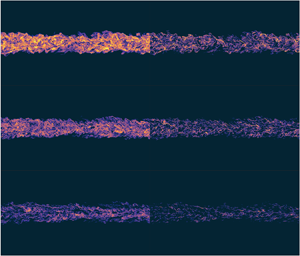
We analyze a dataset from a numerically simulated, temporally evolving turbulent wake (Zhou, Phys. Rev. Fluids, vol. 7, 2022, 104802) that exhibits spontaneous anisotropic layering under strong stratification, alongside significant spatiotemporal variability within the flow. This analysis focuses on the irreversible flux coefficient, $\varGamma$, defined as the ratio between turbulent potential and kinetic energy dissipation rates. We find that the volume-averaged $\varGamma$ initially rises, reaches a plateau between 0.45 and 0.49 when the layering dynamics become dominant, and then decreases as viscosity plays a larger role. These peak $\varGamma$ values are consistent with those from prior simulations under strongly stratified conditions. Such efficient mixing occurs when the Ozmidov to Thorpe length scale ratio is between 0.37 and 0.52, consistent with numerical and field data reported by Mashayek et al. (J. Fluid Mech., vol. 826, 2017, pp. 522–552). To account for the coexistence of dynamically distinct regions within the flow, we perform conditional sampling of $\varGamma$ against a locally defined gradient Richardson number, ${\textit {Ri}}$. This reveals a flux-gradient relation between $\varGamma$ and ${\textit {Ri}}$ that remains largely consistent over time. This relation features a large, approximately constant value of $\varGamma$ for ${\textit {Ri}}$ values greater than one, echoing the ‘constant-power’ scenario postulated by Balmforth et al. (J. Fluid Mech., vol. 355, 1998, pp. 329–358).


Harnessing wall slip towards tunable microswimming in Poiseuille flow
-
- Journal:
- Journal of Fluid Mechanics / Volume 997 / 25 October 2024
- Published online by Cambridge University Press:
- 17 October 2024, A59
-
- Article
- Export citation
Fossil and present-day stromatolite ooids contain a meteoritic polymer of glycine and iron
-
- Journal:
- International Journal of Astrobiology / Volume 23 / 2024
- Published online by Cambridge University Press:
- 17 October 2024, e20
-
- Article
-
- You have access
- Open access
- HTML
- Export citation
Identifying optimal decision-making strategies and determining effective messaging to maximize the expected outcomes of potential human–extraterrestrial encounters
-
- Journal:
- International Journal of Astrobiology / Volume 23 / 2024
- Published online by Cambridge University Press:
- 17 October 2024, e21
-
- Article
-
- You have access
- Open access
- HTML
- Export citation

Equilibrium of fluid fluxes in the wake of a three-dimensional flat-back bluff body
-
- Journal:
- Journal of Fluid Mechanics / Volume 997 / 25 October 2024
- Published online by Cambridge University Press:
- 17 October 2024, A60
-
- Article
-
- You have access
- Open access
- HTML
- Export citation
-
The turbulent wake behind a flat-back Ahmed body is investigated using stacked stereoscopic particle image velocimetry. The wake is disturbed by a steady jet from the centre of the base and the effects are quantified for key blowing rates. The unactuated wake exhibits bistable dynamics in the horizontal plane that are completely subdued for the optimal blowing case, yielding a base drag reduction of 9 %. The three-dimensional mean wake is reconstructed and used to evaluate the wake mass fluxes whose equilibrium determines the recirculation length. The results for the unactuated wake show that up to 80 % of replenishment fluid flux entering the recirculation bubble from the free-stream flow is provided through the low-pressure side of the base, where the symmetry-breaking shear layer roll-up occurs near the base. For the optimal blowing configuration, where the wake becomes symmetric, the flux of wake replenishment is severely reduced. This flow configuration results in elongated shear layers on all sides, which terminate the bubble with a roll-up of reduced intensity at a further downstream location. The dominant cause of bubble growth and the accompanying drag reduction is attributed to the momentum of the base blowing, and the new regime is referred to as the ‘favourable momentum regime’. Similar trends are observed when the model is at $5^{\circ }$ yaw where a reduction of drag and yaw-induced asymmetry are obtained. Proper orthogonal decomposition of the wake reveals the coherent structures related to the bistable flow and the symmetric wake under optimal blowing coefficient.

