To save content items to your account,
please confirm that you agree to abide by our usage policies.
If this is the first time you use this feature, you will be asked to authorise Cambridge Core to connect with your account.
Find out more about saving content to .
To save content items to your Kindle, first ensure no-reply@cambridge.org
is added to your Approved Personal Document E-mail List under your Personal Document Settings
on the Manage Your Content and Devices page of your Amazon account. Then enter the ‘name’ part
of your Kindle email address below.
Find out more about saving to your Kindle.
Note you can select to save to either the @free.kindle.com or @kindle.com variations.
‘@free.kindle.com’ emails are free but can only be saved to your device when it is connected to wi-fi.
‘@kindle.com’ emails can be delivered even when you are not connected to wi-fi, but note that service fees apply.
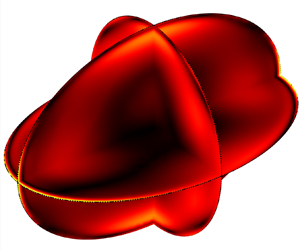
Motivated by modelling rotating turbulence in planetary fluid layers, we investigate precession-driven flows in ellipsoids subject to stress-free boundary conditions (SF-BC). The SF-BC could indeed unlock numerical constraints associated with the no-slip boundary conditions (NS-BC), but are also relevant for some astrophysical applications. Although SF-BC have been employed in the pioneering work of Lorenzani & Tilgner (J. Fluid Mech., vol. 492, 2003, pp. 363–379), they have scarcely been used due to the discovery of some specific mathematical issues associated with angular momentum conservation. We revisit the problem using asymptotic analysis in the low-viscosity regime, which is validated with numerical simulations. First, we extend the reduced model of uniform-vorticity flows in ellipsoids to account for SF-BC. We show that the long-term evolution of angular momentum is affected by viscosity in triaxial geometries, but also in axisymmetric ellipsoids when the mean rotation axis of the fluid is not the symmetry axis. In a regime relevant to planets, we analytically obtain the primary forced flow in triaxial geometries, which exhibits a second inviscid resonance. Then, we investigate the bulk instabilities existing in precessing ellipsoids. We show that using SF-BC would be useful to explore the non-viscous instabilities (e.g. Kerswell, Geophys. Astrophys. Fluid Dyn., vol. 72, 1993, pp. 107–144), which are presumably relevant for planetary applications but are often hampered in experiments or simulations with NS-BC.
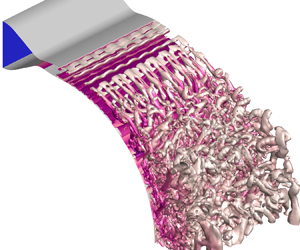
The supersonic jet over a convex wall is numerically investigated using the delayed detached-eddy simulation method based on the two-equation shear-stress transport model. The current study focuses on instabilities, turbulent statistics and the influence of compressibility effects. A widely applicable data-driven modal decomposition approach, called dynamic mode decomposition is used to gain further insight into the dynamical behaviours of the flow. The results demonstrate that streamwise vortices caused by the centrifugal force play significant roles in shear layer instabilities. The spanwise modulation of the streamwise vortices induces inflection points in the flow, resulting in secondary shear layer instability. This instability, which is sustained by the side-to-side sway of the streamwise vortices to obtain energy from the mean flow, dominates the rapid growth of the shear layer and turbulent stresses in the growth region. In the self-similar region, there is not only self-similarity of velocity profiles, but also self-similarity of normalized turbulent stresses. The compressibility effect significantly inhibits the growth of the shear layer and the formation of large-scale streamwise vortices. The investigation of turbulent stresses in the self-similar region with increasing convective Mach number indicates that the compressibility effect enhances turbulence anisotropy.
Written for a two-semester graduate course in Quantum Mechanics, this comprehensive text helps develop the tools and formalism of Quantum Mechanics and its applications to physical systems. It suits students who have taken some introductory Quantum Mechanics and Modern Physics courses at undergraduate level, but it is self-contained and does not assume any specific background knowledge beyond appropriate fluency in mathematics. The text takes a modern logical approach rather than a historical one and it covers standard material, such as the hydrogen atom and the harmonic oscillator, the WKB approximations and Bohr-Sommerfeld quantization. Important modern topics and examples are also described, including Berry phase, quantum information, complexity and chaos, decoherence and thermalization, nonstandard statistics, as well as more advanced material such as path integrals, scattering theory, multiparticles and Fock space. Readers will gain a broad overview of Quantum Mechanics, as solid preparation for further study or research.
An easy-to-understand course book, based on the authentic lectures and detailed research, conducted by the authors themselves, on information optics, holography and MATLAB. This book is the first to highlight the incoherent optical system, provide up-to-date, novel digital holography techniques, and demonstrate MATLAB codes to accomplish tasks such as optical image processing and pattern recognition. This title is a comprehensive introduction to the basics of Fourier optics as well as optical image processing and digital holography. A step-by-step guide which details the vast majority of the derivations, without omitting essential steps, to facilitate a clear mathematical understanding. This book also features exercises at the end of each chapter, providing hands-on experience and consolidating understanding. An ideal companion for graduates and researchers involved in engineering and applied physics, as well as interested in the growing field of information optics.
Progress in astronomy is associated with the construction of new telescopes
and new instruments. This chapter only mentions a few selected initiatives of interest,
to give a flavor of the tools that astronomers are considering for optical observations from the ground and from space. Similarly, on the side of science, this chapter examines only one major set of observations from space, the so-called Hubble Deep Fields, and then proceeds to outline a landmark discovery made at the turn of the century, that is the observations of distant supernovae that have led to convincing evidence that the universe is not only expanding, but, at the present epoch, is actually accelerating. A large investment, not only in the field of optical astronomy, is being made in placing telescopes at special locations very far from Earth. These special sites correspond to Lagrangian points, that is, equilibrium points of the restricted three-body problem for the Sun-Earth system. At the end of this chapter, a digression is made on these concepts, which also allows us to introduce the tidal radius, one concept frequently used in dynamical astronomy.
Electromagnetic radiation is the primary source of astronomical information.
In particular, until the early 1930s astronomy was all based on the use of telescopes
that extended the power of the human eye, but were restricted to the
collection of visible light. In general, the sources of astronomical electromagnetic radiation and other sources of astronomical information are what we call visible matter. This chapter introduces some key concepts and notation that characterize light and the collection of light for astronomical purposes. It addresses the main types of information that we may extract from the observations, by means of imaging and spectroscopy, recalling the difference between apparent and intrinsic properties of the astronomical sources and the fact that the light from distant sources is often a mixture of photons from different stars or different
components. This serves as an excuse for a quick introduction to important
concepts, such as stellar populations, mass-to-light ratios, mean motions, and
velocity dispersions. In closing the chapter, a method is described to measure the distance to a stellar system based on the application of a very simple dynamical model to a suitable set of observations.
The tracking of the orbit of a star around SgrA* is one of the most beautiful achievements of astronomy. It is the focus of this chapter. This measurement has led to the most convincing evidence for the existence of a supermassive black hole and to an accurate measurement of its mass. In addition, this is also a simple example of the general dynamical paradigm used to determine whether a system contains some form of invisible matter coexisting with the visible matter. Here, the invisible matter (a black hole) has nothing to do with the concept of dark matter as is commonly envisaged in modern astrophysics. After a section on the dynamical paradigm that leads to declare a discrepancy between mass present and visible mass, some observations are recalled that for decades have suggested that our Galaxy should host a central supermassive black hole. Then the main characteristics of the more recent study of star orbits close to the source SgrA* are described, with additional comments on the detection of supermassive central black holes in other galaxies. The final dynamical section is devoted to some general concepts about orbits; it also includes a short description of quasi-circular star orbits in spherical or axisymmetric time-independent potentials.
In regular, normal spiral galaxies the overall kinematics of the disk can be described in terms of a mean axisymmetric rotation around the center, following a fluid model presented earlier in the book. Making reliable measurements of galaxy rotation curves is an art that requires great expertise. This chapter explains how the study of the rotation curves of spiral galaxies led to the discovery of dark matter halos: decisive evidence was eventually obtained in the mid-1980s, by referring to radially extended radio rotation curves. The decomposition of a rotation curve in the relative contributions of dark and visible matter to the total gravitational field is a step that still remains largely ambiguous. In a conservative approach, the role of dark matter is often thought to be minimal and to become dominant only in the outer parts of the galaxy, but there remain several unexplained aspects and unresolved questions. Touching upon a nontrivial dynamical issue, the problem of making self-consistent decompositions is briefly addressed. Finally, two dynamical arguments are examined that go beyond the direct inspection of the properties that characterize the observed basic state of spiral galaxies and call for the presence of a dark halo as a solution to otherwise unexplained stability properties of galaxy disks.