Refine search
Actions for selected content:
238160 results in Physics and Astronomy
Second-order inertial forces and torques on a sphere in a viscous steady linear flow
-
- Journal:
- Journal of Fluid Mechanics / Volume 954 / 10 January 2023
- Published online by Cambridge University Press:
- 03 January 2023, A25
-
- Article
-
- You have access
- Open access
- HTML
- Export citation
Theoretical analysis for bedload particle deposition and hop statistics
-
- Journal:
- Journal of Fluid Mechanics / Volume 954 / 10 January 2023
- Published online by Cambridge University Press:
- 03 January 2023, A11
-
- Article
-
- You have access
- Open access
- HTML
- Export citation
Mechanisms of mass transfer to small spheres sinking in turbulence
-
- Journal:
- Journal of Fluid Mechanics / Volume 954 / 10 January 2023
- Published online by Cambridge University Press:
- 03 January 2023, A15
-
- Article
-
- You have access
- Open access
- HTML
- Export citation
-
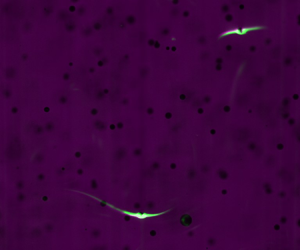
Using laboratory experiments and numerical simulations, we examine the transfer of soluble material from small, spherical particles sinking in homogeneous turbulence at large Péclet number. A theoretical analysis predicts two distinct mechanisms of convective mass transfer: strain due to turbulence and slip due to gravitational settling. Their relative strength is parametrised by the sinking ratio,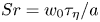 ${Sr} = w_0 \tau _\eta /a$, where $w_0$ is the quiescent settling velocity, $a$ is the particle radius and $\tau _\eta$ is the Kolmogorov time scale. This analysis predicts that the topology of the concentration wake changes from a symmetric topology at ${Sr} \ll 1$ to an asymmetric topology at ${Sr} \gg 1$ as the dominant mechanism of mass transfer changes. Particle tracking flow visualisations of small spheres releasing dye in turbulence confirm the existence of this change in mechanism at ${Sr} = O(1)$. We complement these experiments with numerical simulations of the mass transfer from sinking particles. The transfer rate predicted by the simulation is found to be in good agreement with literature data for mass transfer to turbulent suspensions of solid particles and is consistent with asymptotic expressions for mass transfer in uniform flow when ${Sr} \gg 1$. A decomposition of the convective fluxes confirms the transition in the transfer mechanism. At ${Sr} = O(1)$, both mechanisms provide comparable contributions to the transfer rate. Cross-correlation analysis reveals that particle-scale knowledge of both the recent strain and velocity history is required to predict the instantaneous transfer rate. Turbulence-induced particle rotation has a modest suppression effect upon convective transfer by sinking.


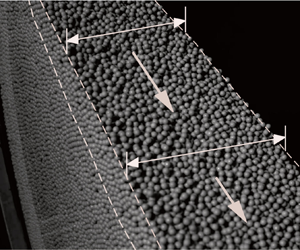
Granular flows in drums of non-uniform widths
-
- Journal:
- Journal of Fluid Mechanics / Volume 954 / 10 January 2023
- Published online by Cambridge University Press:
- 03 January 2023, A18
-
- Article
-
- You have access
- Open access
- HTML
- Export citation
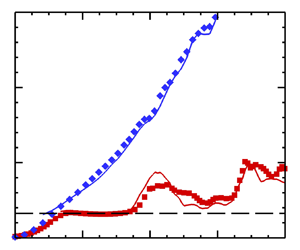
Bubble re-acceleration behaviours in compressible Rayleigh–Taylor instability with isothermal stratification
-
- Journal:
- Journal of Fluid Mechanics / Volume 954 / 10 January 2023
- Published online by Cambridge University Press:
- 03 January 2023, A16
-
- Article
- Export citation
-
The highly nonlinear evolution of the single-mode stratified compressible Rayleigh–Taylor instability (RTI) is investigated via direct numerical simulation over a range of Atwood numbers ( $A_T=0.1$– $0.9$) and Mach numbers ( $Ma=0.1$– $0.7$) for characterising the isothermal background stratification. After the potential stage, it is found that the bubble is accelerated to a velocity which is well above the saturation value predicted in the potential flow model. Unlike the bubble re-acceleration behaviour in quasi-incompressible RTI with uniform background density, the characteristics in the stratified compressible RTI are driven by not only vorticity accumulation inside the bubble but also flow compressibility resulting from the stratification. Specifically, in the case of strong stratification and high $A_T$, the flow compressibility dominates the bubble re-acceleration characters. To model the effect of flow compressibility, we propose a novel model to reliably describe the bubble re-acceleration behaviours in the stratified compressible RTI, via introducing the dilatation into the classical model that takes into account only vorticity accumulation.


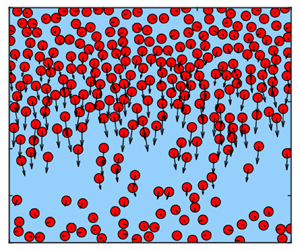
Well-posedness and ill-posedness of single-phase models for suspensions
-
- Journal:
- Journal of Fluid Mechanics / Volume 954 / 10 January 2023
- Published online by Cambridge University Press:
- 03 January 2023, A17
-
- Article
-
- You have access
- Open access
- HTML
- Export citation
-
Classical theories for suspensions have been formulated by starting from the Navier–Stokes equations describing pure liquid flow and then introducing additional dependencies to account for the presence of suspended particles. These models are often accurate for low particle concentrations but have lacked a convincing description of the frictional interactions of particles, which are important at larger solid volume fractions. The $\mu (J), \varPhi (J)$ rheology, which draws a direct analogy between suspension flow and dry granular flow, is a recent theory that addresses this issue, but is shown here to be dynamically ill-posed for large solid volume fractions. An alternative well-posed theory is introduced that includes additional dependence on the particle-phase dilation and compression. The new theory, denoted vCIDR, is tested numerically to show grid convergence for problems in which the $\mu (J), \varPhi (J)$ rheology instead suffers from catastrophic blow-up. A further well-posed extension provides a framework for handling the transition between viscous and inertial flows.


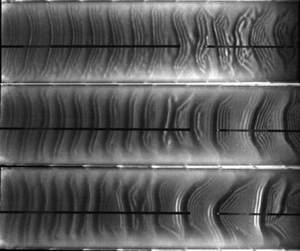
Nonlinear wave attenuation in strongly confined falling liquid films sheared by a laminar counter-current gas flow
-
- Journal:
- Journal of Fluid Mechanics / Volume 954 / 10 January 2023
- Published online by Cambridge University Press:
- 03 January 2023, A19
-
- Article
- Export citation
-
Experiments are conducted in water films falling along the bottom wall of a weakly inclined rectangular channel of height $5$ mm in the presence of a laminar counter-current air flow. Boundary conditions have been specifically designed to avoid flooding at the liquid outlet, thus allowing us to focus on the wave dynamics in the core of the channel. Surface waves are excited via coherent inlet forcing before they come into contact with the air flow. The effect of the air flow on the height, shape and speed of two-dimensional travelling nonlinear waves is investigated and contrasted with experiments of Kofman, Mergui & Ruyer-Quil (Intl J. Multiphase Flow, vol. 95, 2017, pp. 22–34), which were performed in a weakly confined channel. We observe a striking difference between these two cases. In our strongly confined configuration, a monotonic stabilizing effect or a non-monotonic trend (i.e. the wave height first increases and then diminishes upon increasing the gas flow rate) is observed, in contrast to the weakly confined configuration where the gas flow is always destabilizing. This stabilizing effect implies the possibility of attenuating waves via the gas flow and it confirms recent numerical results obtained by Lavalle et al. (J. Fluid Mech., vol. 919, 2021, R2) in a superconfined channel.


Circular bubbles in a Hele-Shaw channel: a Hele-Shaw Newton's cradle
-
- Journal:
- Journal of Fluid Mechanics / Volume 954 / 10 January 2023
- Published online by Cambridge University Press:
- 03 January 2023, A21
-
- Article
-
- You have access
- Open access
- HTML
- Export citation
-
We consider the propagation of inviscid bubbles in a Hele-Shaw cell under a uniform background flow. We focus on the distinguished limit in which the hydrodynamic pressure gradient due to the external flow balances viscous drag effects due to thin liquid films between the bubbles and the cell walls (Bretherton, J. Fluid Mech., vol. 10, issue 2, 1961, pp. 166–188), with the ratio between these two effects measured by a single dimensionless parameter that we label $\delta$. In this regime, we find that each bubble remains approximately circular, and its propagation velocity is determined by a net force balance. The analytical solution for the problem of an isolated bubble in an infinite Hele-Shaw cell is found to agree well with experimental data in the literature. In particular, we find that the bubble may move faster or slower than the background fluid speed, depending on whether $\delta >1$ or $\delta <1$, or precisely with the background flow if $\delta =1$. When the model is generalised to include the effects of multiple bubbles and boundaries in the Hele-Shaw cell, we still find that the sign of $\delta -1$ causes striking changes in the qualitative behaviour. For a train of three or more bubbles moving along a Hele-Shaw channel, we observe longitudinal waves that propagate forwards or backwards along the bubble train, depending on whether $\delta >1$ or $\delta <1$, resembling a Hele-Shaw Newton's cradle.


Reconstruction of the 3-D fields with a depth-averaged model for open-channel flows in the smooth turbulent case
-
- Journal:
- Journal of Fluid Mechanics / Volume 954 / 10 January 2023
- Published online by Cambridge University Press:
- 03 January 2023, A24
-
- Article
- Export citation
Latitudinal regionalization of rotating spherical shell convection
-
- Journal:
- Journal of Fluid Mechanics / Volume 954 / 10 January 2023
- Published online by Cambridge University Press:
- 03 January 2023, R1
-
- Article
-
- You have access
- Open access
- HTML
- Export citation
-
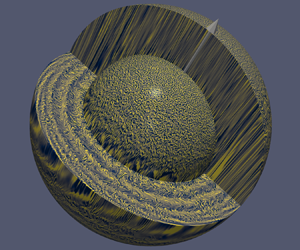
Convection occurs ubiquitously on and in rotating geophysical and astrophysical bodies. Prior spherical shell studies have shown that the convection dynamics in polar regions can differ significantly from the lower latitude, equatorial dynamics. Yet most spherical shell convective scaling laws use globally-averaged quantities that erase latitudinal differences in the physics. Here we quantify those latitudinal differences by analysing spherical shell simulations in terms of their regionalized convective heat-transfer properties. This is done by measuring local Nusselt numbers in two specific, latitudinally separate, portions of the shell, the polar and the equatorial regions, $Nu_p$ and $Nu_e$, respectively. In rotating spherical shells, convection first sets in outside the tangent cylinder such that equatorial heat transfer dominates at small and moderate supercriticalities. We show that the buoyancy forcing, parameterized by the Rayleigh number $Ra$, must exceed the critical equatorial forcing by a factor of ${\approx }20$ to trigger polar convection within the tangent cylinder. Once triggered, $Nu_p$ increases with $Ra$ much faster than does $Nu_e$. The equatorial and polar heat fluxes then tend to become comparable at sufficiently high $Ra$. Comparisons between the polar convection data and Cartesian numerical simulations reveal quantitative agreement between the two geometries in terms of heat transfer and averaged bulk temperature gradient. This agreement indicates that rotating spherical shell convection dynamics is accessible both through spherical simulations and via reduced investigatory pathways, be they theoretical, numerical or experimental.


A fundamental limit on energy savings in controlled channel flow, and how to beat it
-
- Journal:
- Journal of Fluid Mechanics / Volume 954 / 10 January 2023
- Published online by Cambridge University Press:
- 03 January 2023, R3
-
- Article
- Export citation
Multiplicative extended Kalman filter ignoring initial conditions for attitude estimation using vector observations
-
- Journal:
- The Journal of Navigation / Volume 76 / Issue 1 / January 2023
- Published online by Cambridge University Press:
- 12 January 2023, pp. 62-76
- Print publication:
- January 2023
-
- Article
- Export citation
A validation study of ISM Code's continual effectiveness through a multilateral comparative analysis of maritime accidents in Korean waters
-
- Journal:
- The Journal of Navigation / Volume 76 / Issue 1 / January 2023
- Published online by Cambridge University Press:
- 15 February 2023, pp. 77-90
- Print publication:
- January 2023
-
- Article
-
- You have access
- Open access
- HTML
- Export citation

Origins of life: first came evolutionary dynamics
-
- Journal:
- QRB Discovery / Volume 4 / 2023
- Published online by Cambridge University Press:
- 22 March 2023, e4
- Print publication:
- 2023
-
- Article
-
- You have access
- Open access
- HTML
- Export citation
Cybersecurity risk assessment of VDR
-
- Journal:
- The Journal of Navigation / Volume 76 / Issue 1 / January 2023
- Published online by Cambridge University Press:
- 31 January 2023, pp. 20-37
- Print publication:
- January 2023
-
- Article
- Export citation
How sequence alterations enhance the stability and delay expansion of DNA triplet repeat domains
-
- Journal:
- QRB Discovery / Volume 4 / 2023
- Published online by Cambridge University Press:
- 06 November 2023, e8
- Print publication:
- 2023
-
- Article
-
- You have access
- Open access
- HTML
- Export citation

Chasing collective variables using temporal data-driven strategies
-
- Journal:
- QRB Discovery / Volume 4 / 2023
- Published online by Cambridge University Press:
- 06 January 2023, e2
- Print publication:
- 2023
-
- Article
-
- You have access
- Open access
- HTML
- Export citation
NAV volume 76 issue 1 Cover and Front matter
-
- Journal:
- The Journal of Navigation / Volume 76 / Issue 1 / January 2023
- Published online by Cambridge University Press:
- 19 May 2023, pp. f1-f2
- Print publication:
- January 2023
-
- Article
-
- You have access
- Export citation
NAV volume 76 issue 1 Cover and Back matter
-
- Journal:
- The Journal of Navigation / Volume 76 / Issue 1 / January 2023
- Published online by Cambridge University Press:
- 19 May 2023, pp. b1-b2
- Print publication:
- January 2023
-
- Article
-
- You have access
- Export citation

Mouth breathing, dry air, and low water permeation promote inflammation, and activate neural pathways, by osmotic stresses acting on airway lining mucus
-
- Journal:
- QRB Discovery / Volume 4 / 2023
- Published online by Cambridge University Press:
- 14 February 2023, e3
- Print publication:
- 2023
-
- Article
-
- You have access
- Open access
- HTML
- Export citation
