Refine search
Actions for selected content:
238160 results in Physics and Astronomy
Energy landscapes and heat capacity signatures for peptides correlate with phase separation propensity
-
- Journal:
- QRB Discovery / Volume 4 / 2023
- Published online by Cambridge University Press:
- 05 September 2023, e7
- Print publication:
- 2023
-
- Article
-
- You have access
- Open access
- HTML
- Export citation
-
Phase separation plays an important role in the formation of membraneless compartments within the cell and intrinsically disordered proteins with low-complexity sequences can drive this compartmentalisation. Various intermolecular forces, such as aromatic–aromatic and cation–aromatic interactions, promote phase separation. However, little is known about how the ability of proteins to phase separate under physiological conditions is encoded in their energy landscapes and this is the focus of the present investigation. Our results provide a first glimpse into how the energy landscapes of minimal peptides that contain $ \pi $– $ \pi $ and cation– $ \pi $ interactions differ from the peptides that lack amino acids with such interactions. The peaks in the heat capacity ( $ {C}_V $) as a function of temperature report on alternative low-lying conformations that differ significantly in terms of their enthalpic and entropic contributions. The $ {C}_V $ analysis and subsequent quantification of frustration of the energy landscape suggest that the interactions that promote phase separation lead to features (peaks or inflection points) at low temperatures in $ {C}_V $. More features may occur for peptides containing residues with better phase separation propensity and the energy landscape is more frustrated for such peptides. Overall, this work links the features in the underlying single-molecule potential energy landscapes to their collective phase separation behaviour and identifies quantities ( $ {C}_V $ and frustration metric) that can be utilised in soft material design.


Low-cost integrated INS/GNSS using adaptive H∞ Cubature Kalman Filter
-
- Journal:
- The Journal of Navigation / Volume 76 / Issue 1 / January 2023
- Published online by Cambridge University Press:
- 07 February 2023, pp. 1-19
- Print publication:
- January 2023
-
- Article
- Export citation
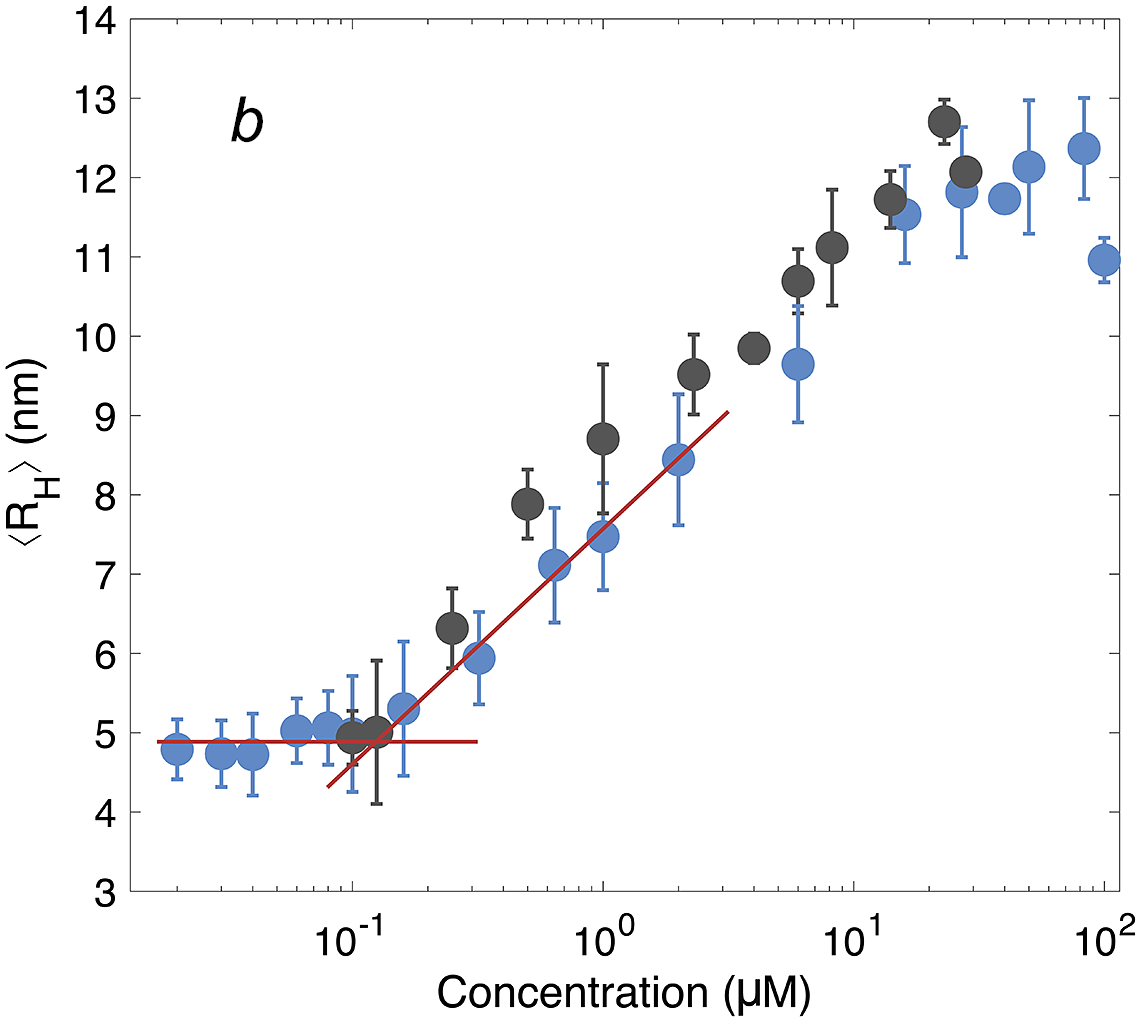
On the micelle formation of DNAJB6b
-
- Journal:
- QRB Discovery / Volume 4 / 2023
- Published online by Cambridge University Press:
- 15 August 2023, e6
- Print publication:
- 2023
-
- Article
-
- You have access
- Open access
- HTML
- Export citation
Sub-meter-level navigation with an enhanced multi-GNSS single-point positioning algorithm using iGMAS ultra-rapid products
-
- Journal:
- The Journal of Navigation / Volume 76 / Issue 1 / January 2023
- Published online by Cambridge University Press:
- 03 February 2023, pp. 133-151
- Print publication:
- January 2023
-
- Article
- Export citation
Improving measurement performance via fusion of classical and quantum accelerometers
-
- Journal:
- The Journal of Navigation / Volume 76 / Issue 1 / January 2023
- Published online by Cambridge University Press:
- 26 January 2023, pp. 91-102
- Print publication:
- January 2023
-
- Article
-
- You have access
- Open access
- HTML
- Export citation
Analysis and Discussion on Ellipsoidal and virtual sphere models used for transverse arrangement INS
-
- Journal:
- The Journal of Navigation / Volume 76 / Issue 1 / January 2023
- Published online by Cambridge University Press:
- 19 May 2023, pp. 103-112
- Print publication:
- January 2023
-
- Article
-
- You have access
- HTML
- Export citation
Sulfur-mediated chalcogen versus hydrogen bonds in proteins: a see-saw effect in the conformational space
-
- Journal:
- QRB Discovery / Volume 4 / 2023
- Published online by Cambridge University Press:
- 27 April 2023, e5
- Print publication:
- 2023
-
- Article
-
- You have access
- Open access
- HTML
- Export citation
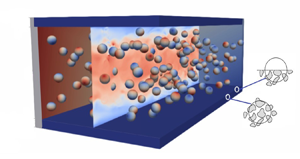
Turbulent channel flow of suspensions of neutrally buoyant particles over porous media
-
- Journal:
- Journal of Fluid Mechanics / Volume 954 / 10 January 2023
- Published online by Cambridge University Press:
- 29 December 2022, A8
-
- Article
- Export citation
-
This study discusses turbulent suspension flows of non-Brownian, non-colloidal, neutrally buoyant and rigid spherical particles in a Newtonian fluid over porous media with particles too large to penetrate and move through the porous layer. We consider suspension flows with the solid volume fraction ${{\varPhi _b}}$ ranging from 0 to 0.2, and different wall permeabilities, while porosity is constant at 0.6. Direct numerical simulations with an immersed boundary method are employed to resolve the particles and flow phase, with the volume-averaged Navier–Stokes equations modelling the flow within the porous layer. The results show that in the presence of particles in the free-flow region, the mean velocity and the concentration profiles are altered with increasing porous layer permeability because of the variations in the slip velocity and wall-normal fluctuations at the suspension-porous interface. Furthermore, we show that variations in the stress condition at the interface significantly affect the particle near-wall dynamics and migration toward the channel core, thereby inducing large modulations of the overall flow drag. At the highest volume fraction investigated here, ${{\varPhi _b}}= 0.2$, the velocity fluctuations and the Reynolds shear stress are found to decrease, and the overall drag increases due to the increase in the particle-induced stresses.


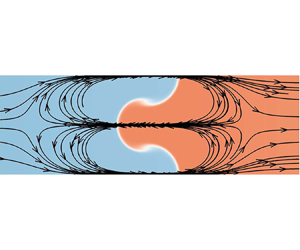
A unified theoretical model for spatiotemporal development of Rayleigh–Taylor and Richtmyer–Meshkov fingers
-
- Journal:
- Journal of Fluid Mechanics / Volume 954 / 10 January 2023
- Published online by Cambridge University Press:
- 29 December 2022, A13
-
- Article
- Export citation
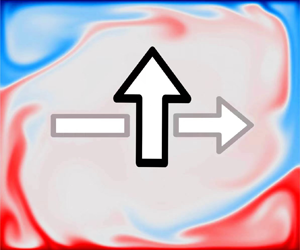
Rayleigh–Bénard thermal convection perturbed by a horizontal heat flux
-
- Journal:
- Journal of Fluid Mechanics / Volume 954 / 10 January 2023
- Published online by Cambridge University Press:
- 29 December 2022, R2
-
- Article
-
- You have access
- Open access
- HTML
- Export citation
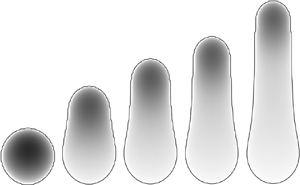
Ascent rates of 3-D fractures driven by a finite batch of buoyant fluid
-
- Journal:
- Journal of Fluid Mechanics / Volume 954 / 10 January 2023
- Published online by Cambridge University Press:
- 29 December 2022, A12
-
- Article
-
- You have access
- Open access
- HTML
- Export citation
-
Propagation of fluid-filled fractures by fluid buoyancy is important in a variety of settings, from magmatic dykes and veins to water-filled crevasses in glaciers. Industrial hydro-fracturing utilises fluid-driven fractures to increase the permeability of rock formations, but few studies have quantified the effect of buoyancy on fracture pathways in this context. Analytical approximations for the buoyant ascent rate facilitate observation-based inference of buoyant effects in natural and engineered systems. Such analysis exists for two-dimensional fractures, but real fractures are three-dimensional (3-D). Here we present novel analysis to predict the buoyant ascent speed of 3-D fractures containing a fixed-volume batch of fluid. We provide two estimates of the ascent rate: an upper limit applicable at early time, and an asymptotic estimate (proportional to $t^{-2/3}$) describing how the speed decays at late time. We infer and verify these predictions by comparison with numerical experiments across a range of scales and analogue experiments on liquid oil in solid gelatine. We find the ascent speed is a function of the fluid volume, density, viscosity and the elastic parameters of the host medium. Our approximate solutions predict the ascent rate of fluid-driven fractures across a broad parameter space, including cases of water injection in shale and magmatic dykes. Our results demonstrate that in the absence of barriers or fluid loss, both dykes and industrial hydro-fractures can ascend by buoyancy over a kilometre within a day. We infer that barriers and fluid loss must cause the arrest of ascending fractures in industrial settings.

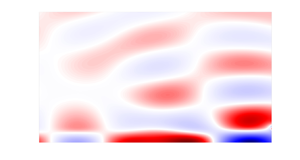
Reflection and transmission of a Kelvin–Helmholtz wave incident on a shock in a jet
-
- Journal:
- Journal of Fluid Mechanics / Volume 954 / 10 January 2023
- Published online by Cambridge University Press:
- 29 December 2022, A9
-
- Article
-
- You have access
- Open access
- HTML
- Export citation
A zero density estimate and fractional imaginary parts of zeros for $\textrm{GL}_2$ L-functions
- Part of
-
- Journal:
- Mathematical Proceedings of the Cambridge Philosophical Society / Volume 174 / Issue 3 / May 2023
- Published online by Cambridge University Press:
- 28 December 2022, pp. 605-630
- Print publication:
- May 2023
-
- Article
- Export citation
-
We prove an analogue of Selberg’s zero density estimate for $\zeta(s)$ that holds for any $\textrm{GL}_2$ L-function. We use this estimate to study the distribution of the vector of fractional parts of $\gamma\boldsymbol{\alpha}$, where $\boldsymbol{\alpha}\in\mathbb{R}^n$ is fixed and $\gamma$ varies over the imaginary parts of the nontrivial zeros of a $\textrm{GL}_2$ L-function.


Impact of temporal modulations on laser-induced damage of fused silica at 351 nm
-
- Journal:
- High Power Laser Science and Engineering / Volume 11 / 2023
- Published online by Cambridge University Press:
- 27 December 2022, e15
-
- Article
-
- You have access
- Open access
- HTML
- Export citation
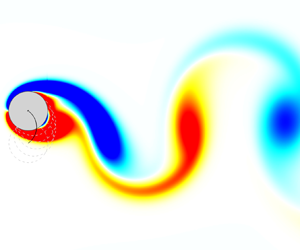
Flow-induced vibrations of a cylinder along a circular arc
-
- Journal:
- Journal of Fluid Mechanics / Volume 954 / 10 January 2023
- Published online by Cambridge University Press:
- 23 December 2022, A7
-
- Article
-
- You have access
- Open access
- HTML
- Export citation
-
An elastically mounted circular cylinder, immersed in a cross-current and free to move along a rectilinear path, is subjected to vortex-induced vibrations (VIV). These vibrations develop through a mechanism referred to as lock-in, where body motion and vortex shedding synchronize at a frequency that may deviate both from the oscillator natural frequency and from the vortex shedding frequency past a fixed cylinder. The present numerical study aims at extending the analysis to curved trajectories, by considering that the cylinder is free to translate along a circular path. The Reynolds number based on the body diameter ( $D$) and current velocity ( $U$) is set to $100$. A wide range of path radii, from $0.05D$ to $10D$, and values of the reduced velocity (inverse of the oscillator natural frequency non-dimensionalized by $D$ and $U$) up to $30$ are examined, for the concave and convex configurations, i.e. the circular path centre located upstream or downstream of the cylinder. Path curvature results in a major alteration of the flow–body system behaviour compared with rectilinear VIV, with substantially different evolutions in the concave and convex configurations. In addition to the typical lock-in mechanism, two subharmonic forms of synchronization, at half and one third of vortex formation frequency, are uncovered in the convex configuration. They coexist with a desynchronized regime where the body and the flow oscillate at incommensurable frequencies. The four interaction regimes exhibit contrasted trends in terms of structural response, spatiotemporal organization of the wake and associated forces. They particularly differ by their symmetry properties, which are closely linked to the possible reconfiguration of the oscillator due to mean fluid forcing.


Short mid-infrared watt-level all-fiber nonlinear pulse compressor above 100-MHz pulse repetition rate
-
- Journal:
- High Power Laser Science and Engineering / Volume 11 / 2023
- Published online by Cambridge University Press:
- 23 December 2022, e14
-
- Article
-
- You have access
- Open access
- HTML
- Export citation
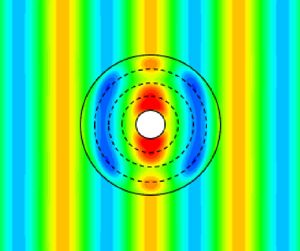
Water wave cloaking using a floating composite plate
-
- Journal:
- Journal of Fluid Mechanics / Volume 954 / 10 January 2023
- Published online by Cambridge University Press:
- 23 December 2022, A4
-
- Article
- Export citation
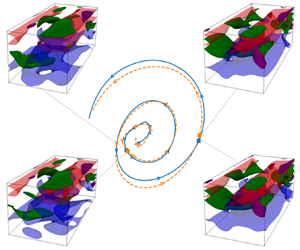
Symmetry-reduced dynamic mode decomposition of near-wall turbulence
-
- Journal:
- Journal of Fluid Mechanics / Volume 954 / 10 January 2023
- Published online by Cambridge University Press:
- 23 December 2022, A10
-
- Article
-
- You have access
- Open access
- HTML
- Export citation
A census of compact sources at 162 MHz: First data release from the MWA Phase II IPS Survey
-
- Journal:
- Publications of the Astronomical Society of Australia / Volume 39 / 2022
- Published online by Cambridge University Press:
- 23 December 2022, e063
-
- Article
-
- You have access
- Open access
- HTML
- Export citation
-
We present a catalogue of over 7000 sources from the GLEAM survey which have significant structure on sub-arcsecond scales at 162 MHz. The compact nature of these sources was detected and quantified via their Interplanetary Scintillation (IPS) signature, measured in interferometric images from the Murchison Widefield Array. The advantage of this approach is that all sufficiently compact sources across the survey area are included down to a well-defined flux density limit. The survey is based on ${\sim}250\times 10\hbox{-}\mathrm{min}$ observations, and the area covered is somewhat irregular, but the area within $1\,\mathrm{h}<\mathrm{RA}<11\,\mathrm{h}$; $-10^\circ<\mathrm{Decl.}<+20^\circ$ is covered entirely, and over 85% of this area has a detection limit for compact structure below 0.2 Jy. 7839 sources clearly showing IPS were detected ( ${>}5\sigma$ confidence), with a further 5550 tentative ( ${>}2\sigma$ confidence) detections. Normalised Scintillation Indices (NSI; a measure of the fraction of flux density coming from a compact component) are reported for these sources. Robust and informative upper limits on the NSI are reported for a further 31081 sources. This represents the largest survey of compact sources at radio frequencies ever undertaken.


Mapping the space of quasisymmetric stellarators using optimized near-axis expansion
-
- Journal:
- Journal of Plasma Physics / Volume 88 / Issue 6 / December 2022
- Published online by Cambridge University Press:
- 23 December 2022, 905880616
-
- Article
-
- You have access
- Open access
- HTML
- Export citation
-
A method is demonstrated to rapidly calculate the shapes and properties of quasi-axisymmetric and quasi-helically symmetric stellarators. In this approach, optimization is applied to the equations of magnetohydrodynamic equilibrium and quasisymmetry, expanded in the small distance from the magnetic axis, as formulated by Garren & Boozer [Phys. Fluids B, vol. 3, 1991, p. 2805]. Due to the reduction of the equations by the expansion, the computational cost is significantly reduced, to times of the order of 1 cpu second, enabling wide and high-resolution scans over parameter space. In contrast to traditional stellarator optimization, here, the cost function serves to maximize the volume in which the expansion is accurate. A key term in the cost function is $\| \boldsymbol {\nabla }\boldsymbol B \|$
 , the norm of the magnetic field gradient, to maximize scale lengths in the field. Using this method, a database of $5\times 10^5$
 optimized configurations is calculated and presented. Quasisymmetric configurations are observed to exist in continuous bands, varying in the ratio of the magnetic axis length to average major radius. Several qualitatively new types of configuration are found, including quasi-helically symmetric fields in which the number of field periods is two or more than six.


