Most cited
This page lists all time most cited articles for this title. Please use the publication date filters on the left if you would like to restrict this list to recently published content, for example to articles published in the last three years. The number of times each article was cited is displayed to the right of its title and can be clicked to access a list of all titles this article has been cited by.
Contents
- Cited by 44
On Negative Moments of the Riemann Zeta-Function
-
- Published online by Cambridge University Press:
- 26 February 2010, pp. 71-88
-
- Article
- Export citation
-
The purpose of this paper is to take some first steps the investigation of the negative moments
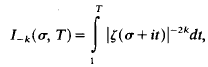
where k>0 and12, and the related discrete moments

whereruns over the complex zeros of the zeta-function. We assume the Riemann hypothesis (RH) throughout; it then follows that Ik(, T) converges for every k > 0 when>but for no k =when =. We further note that Jk(T) is only defined for all T if all the zerosare simple and, in that case, Ik(, T) converges for all k<.
- Cited by 44
Volume Inequalities and Additive Maps of Convex Bodies
- Part of:
-
- Published online by Cambridge University Press:
- 21 December 2009, pp. 211-234
-
- Article
- Export citation
- Cited by 43
There are 913 regular ternary forms
-
- Published online by Cambridge University Press:
- 26 February 2010, pp. 332-341
-
- Article
- Export citation
- Cited by 43
On self-induced separation II
-
- Published online by Cambridge University Press:
- 26 February 2010, pp. 98-108
-
- Article
- Export citation
- Cited by 43
The stability of a rigidly rotating column of liquid
-
- Published online by Cambridge University Press:
- 26 February 2010, pp. 1-9
-
- Article
- Export citation
- Cited by 43
On the reverse Lp–busemann–petty centroid inequality
- Part of:
-
- Published online by Cambridge University Press:
- 26 February 2010, pp. 1-11
-
- Article
- Export citation
- Cited by 42
Linear forms in the logarithms of algebraic numbers (II)
-
- Published online by Cambridge University Press:
- 26 February 2010, pp. 102-107
-
- Article
- Export citation
-
It was proved in a recent paper† that if au α1, …, αn denote non-zero algebraic numbers and if‡ logαn, …, log αn and and 2πi are linearly independent over the rationals then log α1, …, log αn are linearly independent over the field of all algebraic numbers. Further it was shown that if α1 …, αn are positive real algebraic numbers other than 1 and if β1, …, βn denote real algebraic numbers with 1, β1 …, βn linearly independent over the rationals then
 is transcendental.
 is transcendental.
- Cited by 42
Combinatorially regular polytopes
-
- Published online by Cambridge University Press:
- 26 February 2010, pp. 142-150
-
- Article
- Export citation
-
Let Pn (n ≥ 0) be an n-polytope, that is, a convex polytope in n-dimensional euclidean space
 (Grünbaum [5], 3.1), and for 0 ≤ j ≤ n − 1 let
  be its j-faces. If Pn itself and Ø (the empty set) are also allowed to be faces of Pn, of dimensions n and − 1 respectively, then the set of faces of Pn forms a lattice
  partially ordered by inclusion ([5], 3.2). Two polytopes P1n and P2n are said to be combinatorially isomorphic, or of the same combinatorial type if their respective lattices of faces are isomorphic; that is, if there is a one–to–one correspondence between the set of faces of P1n and the set of faces of P2n which preserves the relation of inclusion ([5], 3.2). Similarly, any permutation of the set of faces of Pn which preserves inclusion will be called a (combinatorial) automorphism; it is clear that the set of automorphisms of Pn forms a group Γ(Pn), called the automorphism group of Pn.
 (Grünbaum [
 be its j-faces. If P
 partially ordered by inclusion ([
- Cited by 42
On the fractional parts of the powers of a rational number (II)
-
- Published online by Cambridge University Press:
- 26 February 2010, pp. 122-124
-
- Article
- Export citation
-
About twenty years ago, in a note of the same title [2], I obtained the following result.
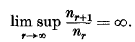
THEOREM 1. Let u and v be relatively prime integers satisfying u> v ≥ 2 and let ε be an arbitrarily small positive number. Suppose the inequality

is satisfied by an infinite sequence of positive integers n1 n2, … Then
- Cited by 42
Hausdorff dimension and the exceptional set of projections
- Part of:
-
- Published online by Cambridge University Press:
- 26 February 2010, pp. 109-115
-
- Article
- Export citation
- Cited by 41
The stability of a column of rotating liquid
-
- Published online by Cambridge University Press:
- 26 February 2010, pp. 25-32
-
- Article
- Export citation
- Cited by 41
Semiselective coideals
- Part of:
-
- Published online by Cambridge University Press:
- 26 February 2010, pp. 79-103
-
- Article
- Export citation
- Cited by 40
Axisymmetric inertial oscillations of a fluid in a rotating spherical shell
-
- Published online by Cambridge University Press:
- 26 February 2010, pp. 163-168
-
- Article
- Export citation
- Cited by 40
Shadow Systems and Volumes of Polar Convex Bodies
- Part of:
-
- Published online by Cambridge University Press:
- 21 December 2009, pp. 129-148
-
- Article
- Export citation
- Cited by 39
Explicit bounds on exponential sums and the scarcity of squarefree binomial coefficients
- Part of:
-
- Published online by Cambridge University Press:
- 26 February 2010, pp. 73-107
-
- Article
- Export citation
-
The distribution of squarefree binomial coefficients. For many years, Paul Erdős has asked intriguing questions concerning the prime divisors of binomial coefficients, and the powers to which they appear. It is evident that, if k is not too small, then
 must be highly composite in that it contains many prime factors and often to high powers. It is therefore of interest to enquire as to how infrequently is squarefree. One well-known conjecture, due to Erdős, is that
  is not squarefree once n > 4. Sarközy [Sz] proved this for sufficiently large n but here we return to and solve the original question.
 must be highly composite in that it contains many prime factors and often to high powers. It is therefore of interest to enquire as to how infrequently
  is not squarefree once n > 4. Sarközy [Sz] proved this for sufficiently large n but here we return to and solve the original question.
- Cited by 39
On hypersonic self-induced separation, hydraulic jumps and boundary layers with algebraic growth
- Part of:
-
- Published online by Cambridge University Press:
- 26 February 2010, pp. 77-93
-
- Article
- Export citation
- Cited by 39
Selberg's sieve with weights
-
- Published online by Cambridge University Press:
- 26 February 2010, pp. 1-22
-
- Article
- Export citation
-
Let
 be a (finite) non-empty sequence of integers, and let K be a positive integer. The aim of the Brun-Selberg sieve is to obtain bounds for the “sifting function”
where z ≥ 2 is a real number and

 be a (finite) non-empty sequence of integers, and let K be a positive integer. The aim of the Brun-Selberg sieve is to obtain bounds for the “sifting function”

- Cited by 39
On the power free values of polynomials
-
- Published online by Cambridge University Press:
- 26 February 2010, pp. 21-26
-
- Article
- Export citation
- Cited by 39
The determination of convex bodies from their mean radius of curvature functions
-
- Published online by Cambridge University Press:
- 26 February 2010, pp. 1-13
-
- Article
- Export citation
- Cited by 38
Intersection bodies and ellipsoids
- Part of:
-
- Published online by Cambridge University Press:
- 26 February 2010, pp. 295-304
-
- Article
- Export citation
