Contents
Research Article
The Dirichlet problem at infinity on Hadamard manifolds
-
- Published online by Cambridge University Press:
- 22 January 2016, pp. 1-18
-
- Article
-
- You have access
- Export citation
-
Let M be an n-dimensional Hadamard manifold, that is, a complete simply connected C∞ Riemannian manifold with nonpositive sectional curvatures. Making use of geodesic rays, Eberlein and O’Neill [11] constructed a compactification
 = M
= M S(∞) of M which gives a homeomorphism of (M, S(∞)) with the Euclidean pair (Bn, Sn-1 ). In this paper we shall study the asymptotic Dirichlet problem for the Laplace-Beltrami operator, which is stated as follows:
 =
= 
Cauchy transforms on polynomial curves and related operators
-
- Published online by Cambridge University Press:
- 22 January 2016, pp. 19-32
-
- Article
-
- You have access
- Export citation
-
Let
 be a curve in R2 defined by y = A(x). The Cauchy transform
  on is defined by the kernel
 be a curve in R
 on
on 
Microscopic asymptotics for solutions of some semilinear Elliptic equations
-
- Published online by Cambridge University Press:
- 22 January 2016, pp. 33-50
-
- Article
-
- You have access
- Export citation
-
In our previous work [8], we picked up the elliptic equation
(1)

with the nonlinearity f(u) ⊇ 0 in C1. We studied the asymptotics of the family {(λ, u(x))} of classical solutions satisfying
(2)

Local times of self-intersection for multidimensional Brownian motion*
-
- Published online by Cambridge University Press:
- 22 January 2016, pp. 51-64
-
- Article
-
- You have access
- Export citation
-
We will define local times of self-intersection for multidimensional Brownian motion as generalized Wiener functionals under the framework of white noise analysis as in H. Watanabe ([6]). By making use of the chaotic representation of
 -function and precise computation we get a deep insight into the problem. In the section 1 multiple Wiener integrals with respect to multidimensional Brownian motion and chaotic representations for square-integrable Wiener functionals are given. They are indispensable, but seem not to be formulated clearly and correctly before. The useful concepts and results of white noise analysis are illustrated in the section 2. Section 3 is the main part of the paper. The applications to local times are introduced in the section 4 briefly.
 -function and precise computation we get a deep insight into the problem. In the section 1 multiple Wiener integrals with respect to multidimensional Brownian motion and chaotic representations for square-integrable Wiener functionals are given. They are indispensable, but seem not to be formulated clearly and correctly before. The useful concepts and results of white noise analysis are illustrated in the section 2. Section 3 is the main part of the paper. The applications to local times are introduced in the section 4 briefly.
Boundary behaviour of extremal plurisubharmonic functions
-
- Published online by Cambridge University Press:
- 22 January 2016, pp. 65-112
-
- Article
-
- You have access
- Export citation
-
In [Mo.l], S. Momm studied the boundary behaviour of extremal plurisubharmonic functions by using the pluricomplex Green function gΩ of a bounded convex domain Ω in Cn to exhaust the domain by a family of sublevel sets. Let Ω be a bounded convex domain in Cn containing the origin
 in its interior. The pluricomplex green function of Ω with a pole
  is defined by
(1.1)

 in its interior. The pluricomplex green function of
  is defined by
The h-vector of a Gorenstein codimension three domain
-
- Published online by Cambridge University Press:
- 22 January 2016, pp. 113-140
-
- Article
-
- You have access
- Export citation
-
Let k be an infinite field and A a standard G-algebra. This means that there exists a positive integer n such that A = R/I where R is the polynomial ring R := k[Xv …, Xn] and I is an homogeneous ideal of R. Thus the additive group of A has a direct sum decomposition A = ⊕ At where AiAj ⊆ Ai+j . Hence, for every t ≥ 0, At is a finite-dimensional vector space over k. The Hilbert Function of A is defined by

Existence of Dirichlet infinite harmonic measures on the unit disc
-
- Published online by Cambridge University Press:
- 22 January 2016, pp. 141-167
-
- Article
-
- You have access
- Export citation
A question of Gross and the uniqueness of entire functions
-
- Published online by Cambridge University Press:
- 22 January 2016, pp. 169-177
-
- Article
-
- You have access
- Export citation
-
For any set S and any entire function f let

where each zero of f — a with multiplicity m is repeated m times in Ef(S) (cf. [1]). It is assumed that the reader is familiar with the notations of the Nevanlinna Theory (see, for example, [2]). It will be convenient to let E denote any set of finite linear measure on 0 < r < ∞, not necessarily the same at each occurrence. We denote by S(r, f) any quantity satisfying
 .
.
 .
.On Siegel modular forms part II
-
- Published online by Cambridge University Press:
- 22 January 2016, pp. 179-197
-
- Article
-
- You have access
- Export citation
-
In this paper we compute dimension formulas for rings of Siegel modular forms of genus g = 3. Let denote
 the main congruence subgroup of level two,
  the Hecke subgroup of level two and
  the full modular group. We give the dimension formulas for genus g = 3 for the above mentioned groups
  and determine the graded ring
  of modular forms with respect to
  .
.
 the main congruence subgroup of level two,
  the Hecke subgroup of level two and
  the full modular group. We give the dimension formulas for genus
  and determine the graded ring
  of modular forms with respect to
  .
.Class-number problems for cubic number fields
-
- Published online by Cambridge University Press:
- 22 January 2016, pp. 199-208
-
- Article
-
- You have access
- Export citation
-
Let M be any number field. We let D M, d M, hu ,
 , AM and RegM be the discriminant, the absolute value of the discriminant, the class-number, the Dedekind zeta-function, the ring of algebraic integers and the regulator of M, respectively.
we set
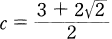 If q is any odd prime we let (⋅/q) denote the Legendre’s symbol.
 , A
, A If
If Front Matter
NMJ volume 138 Cover and Front matter
-
- Published online by Cambridge University Press:
- 22 January 2016, pp. f1-f5
-
- Article
-
- You have access
- Export citation
Back Matter
NMJ volume 138 Cover and Back matter
-
- Published online by Cambridge University Press:
- 22 January 2016, pp. b1-b2
-
- Article
-
- You have access
- Export citation