Contents
Research Article
On a Solution of the Hammerstein Equation with Singular Normal Kernels
-
- Published online by Cambridge University Press:
- 20 November 2018, pp. 415-421
-
- Article
-
- You have access
- Export citation
-
We consider here the equation
1

This equation was first studied by Hammerstein [4] under the assumption that the linear operator
2
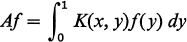
is selfadjoint and completely continuous. V. Nemytsky [5] and M. Golomb [3] dropped the assumption that A be selfadjoint and positive. M. Vainberg [6] considered (among other cases) the case in which A is a bounded operator generated by a Carleman kernel. The kernels considered in this work do not necessarily generate bounded, completely continuous or selfadjoint, operators.
On Y. C. Wong's Conjecture
-
- Published online by Cambridge University Press:
- 20 November 2018, pp. 423-424
-
- Article
-
- You have access
- Export citation
-
Let M be an n-dimensional connected C∞ manifold with a linear connection Γ. M is said to be of recurrent curvature with respect to Γ if the corresponding curvature tensor R satisfies [1], [4]

where Δ denotes covariant derivative with respect to Γ and W is a nonzero covector called the recurrence co-vector. Let T be the torsion of Γ.
On Rings of Fractions
-
- Published online by Cambridge University Press:
- 20 November 2018, pp. 425-430
-
- Article
-
- You have access
- Export citation
-
Let R be a commutative Noetherian ring with identity, and let M be a fixed ideal of R. Then, trivially, ring multiplication is continuous in the ilf-adic topology. Let S be a multiplicative system in R, and let j = js: R → S-1R, be the natural map. One can then ask whether (cf. Warner [3, p. 165]) S-1R is a topological ring in ihe j(M)-adic topology. In Proposition 1, I prove this is the case if and only if M ⊂ p(S), where

Hence S -1 R is a topological ring for all S if and only if M ⊂ p*(R), where

Left Cauchy Integral Bases in Linear Topological Spaces
-
- Published online by Cambridge University Press:
- 20 November 2018, pp. 431-439
-
- Article
-
- You have access
- Export citation
Note on the Singular Submodule
-
- Published online by Cambridge University Press:
- 20 November 2018, pp. 441-442
-
- Article
-
- You have access
- Export citation
On Free Groups of the Variety AN 2 ∧ N 2 A
-
- Published online by Cambridge University Press:
- 20 November 2018, pp. 443-446
-
- Article
-
- You have access
- Export citation
On a 3-Dimensional Isoperimetric Problem
-
- Published online by Cambridge University Press:
- 20 November 2018, pp. 447-449
-
- Article
-
- You have access
- Export citation
-
Let L(P) denote the total edge length and A(P) the total surface area of a three-dimensional convex polyhedron P. In [5] it was shown that if P belongs to the set
 of all polyhedra with triangular faces then for all

with equality if and only if
is a regular tetrahedron.It is not difficult to establish the inequality

 of all polyhedra with triangular faces then for all

Magic Valuations of Finite Graphs
-
- Published online by Cambridge University Press:
- 20 November 2018, pp. 451-461
-
- Article
-
- You have access
- Export citation
One-Dimensional Representations of the Cycle Subalgebra of a Semi-Simple Lie Algebra
-
- Published online by Cambridge University Press:
- 20 November 2018, pp. 463-467
-
- Article
-
- You have access
- Export citation
-
Let L denote a semi-simple, finite dimensional Lie algebra over an algebraically closed field K of characteristic zero. If
 denotes a Cartan subalgebra of L and
  denotes the centralizer of in the universal enveloping algebra U of L, then it has been shown that each algebra homomorphism
  (called a "mass-function" on ) uniquely determines a linear irreducible representation of L. The technique involved in this construction is analogous to the Harish-Chandra construction [2] of dominated irreducible representations of L starting from a linear functional
  . The difference between the two results lies in the fact that all linear functionals on are readily obtained, whereas since is in general a noncommutative algebra the construction of mass-functions is decidedly nontrivial.
 denotes a Cartan subalgebra of
  denotes the centralizer of
  (called a "mass-function" on
  . The difference between the two results lies in the fact that all linear functionals on
 On Certain Classes of Bounded Linear Operators
-
- Published online by Cambridge University Press:
- 20 November 2018, pp. 469-473
-
- Article
-
- You have access
- Export citation
Are One-Sided Inverses Two-Sided Inverses in a Matrix Ring Over a Group Ring?
-
- Published online by Cambridge University Press:
- 20 November 2018, pp. 475-479
-
- Article
-
- You have access
- Export citation
A Note on the Σ(S)-Injectivity of R(S)
-
- Published online by Cambridge University Press:
- 20 November 2018, pp. 481-489
-
- Article
-
- You have access
- Export citation
Arithmetical Functions and Distributivity
-
- Published online by Cambridge University Press:
- 20 November 2018, pp. 491-496
-
- Article
-
- You have access
- Export citation
Counterexample to a Conjecture of Greenleaf
-
- Published online by Cambridge University Press:
- 20 November 2018, pp. 497-499
-
- Article
-
- You have access
- Export citation
-
Greenleaf states the following conjecture in [1, p. 69]. Let G be a (connected, separable) amenable locally compact group with left Haar measure, μ, and let U be a compact symmetric neighbourhood of the unit. Then the sets, {U m}, have the following property: given ɛ > 0 and compact K ⊂ G, ∃ m 0 = m 0(ɛ, K) such that

A Remark on the Krull-Schmidt-Azumaya Theorem
-
- Published online by Cambridge University Press:
- 20 November 2018, pp. 501-505
-
- Article
-
- You have access
- Export citation
On the Ordering of Multi-Point Boundary Value Functions
-
- Published online by Cambridge University Press:
- 20 November 2018, pp. 507-513
-
- Article
-
- You have access
- Export citation
-
We are concerned with the nth-order linear differential equation
1
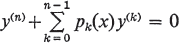
where the coefficients are continuous. Aliev [1, 2] showed, in papers unavailable to the author that for n = 4
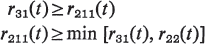
(see Definition 2). Theorems 1 and 5 give respectively nth-order generalizations of these two results.
On the Minimal Graph with a Given Number of Spanning Trees
-
- Published online by Cambridge University Press:
- 20 November 2018, pp. 515-517
-
- Article
-
- You have access
- Export citation
Integers of Biquadratic Fields
-
- Published online by Cambridge University Press:
- 20 November 2018, pp. 519-526
-
- Article
-
- You have access
- Export citation
Corrections
On the Hahn-Banach Extension Property
-
- Published online by Cambridge University Press:
- 20 November 2018, p. 526
-
- Article
-
- You have access
- Export citation
A Note on Endomorphism Semigroups
-
- Published online by Cambridge University Press:
- 20 November 2018, p. 526
-
- Article
-
- You have access
- Export citation